The Sky Library.

Every one of these is a real thing you can point at. They are the stories SkyLumi tells you in the app — reviewed for accuracy, written to be read by someone standing outside in the dark rather than sitting an exam.

52 stories. Each one is anchored to a real place in the sky, and SkyLumi can take you to it.

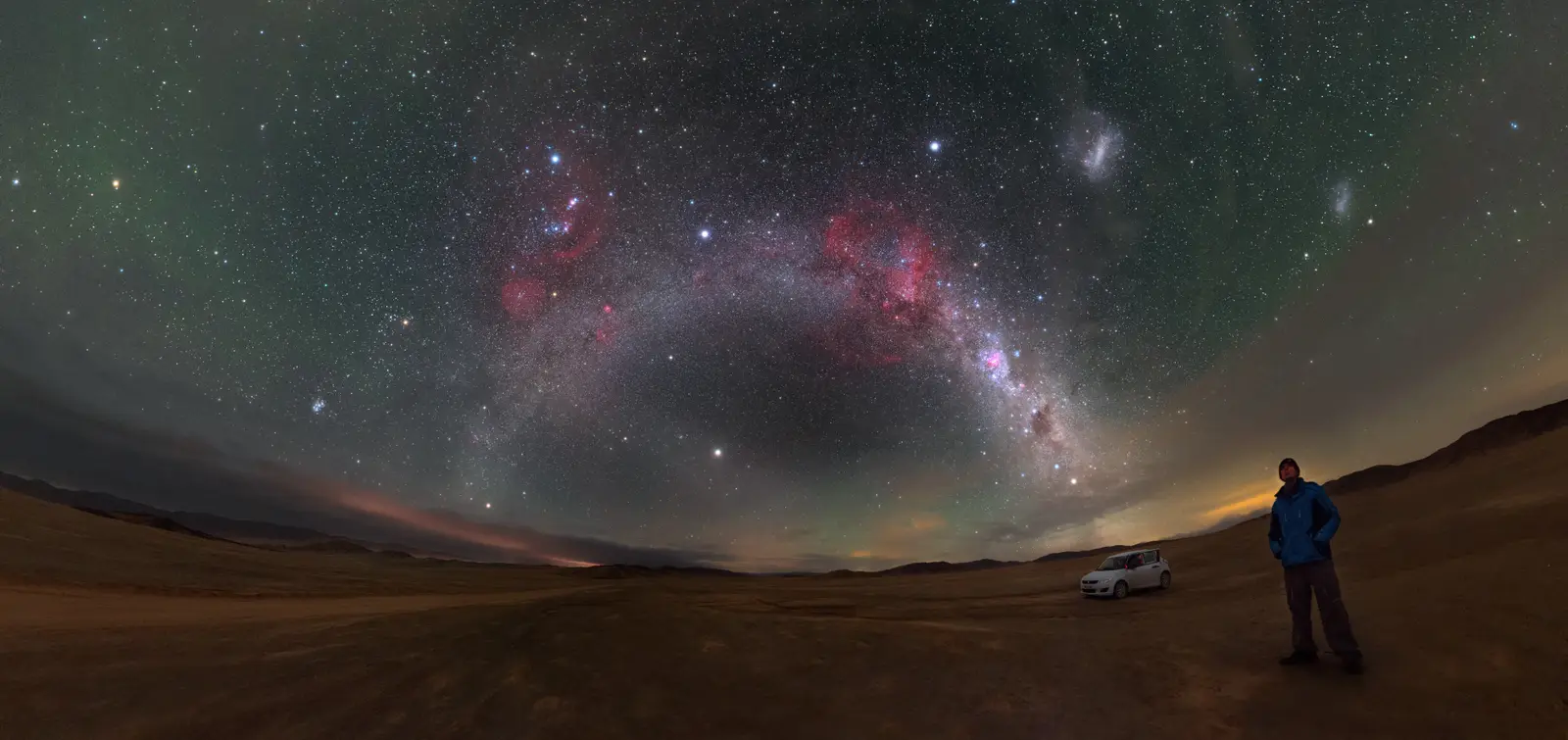
A deep wide-angle night-sky panorama over the Atacama Desert: the arch of the Milky Way with the pink half-ring of Barnard’s Loop, and the Small and Large Magellanic Clouds as two pale diffuse patches at upper right.

Everything you see is ours

Every naked-eye star belongs to the Milky Way. Other galaxies you can see without a telescope: Andromeda, and from the south the two Magellanic Clouds. Arrows mark whichever of them are above your horizon tonight.

ESO/P. Horálek · CC BY 4.0
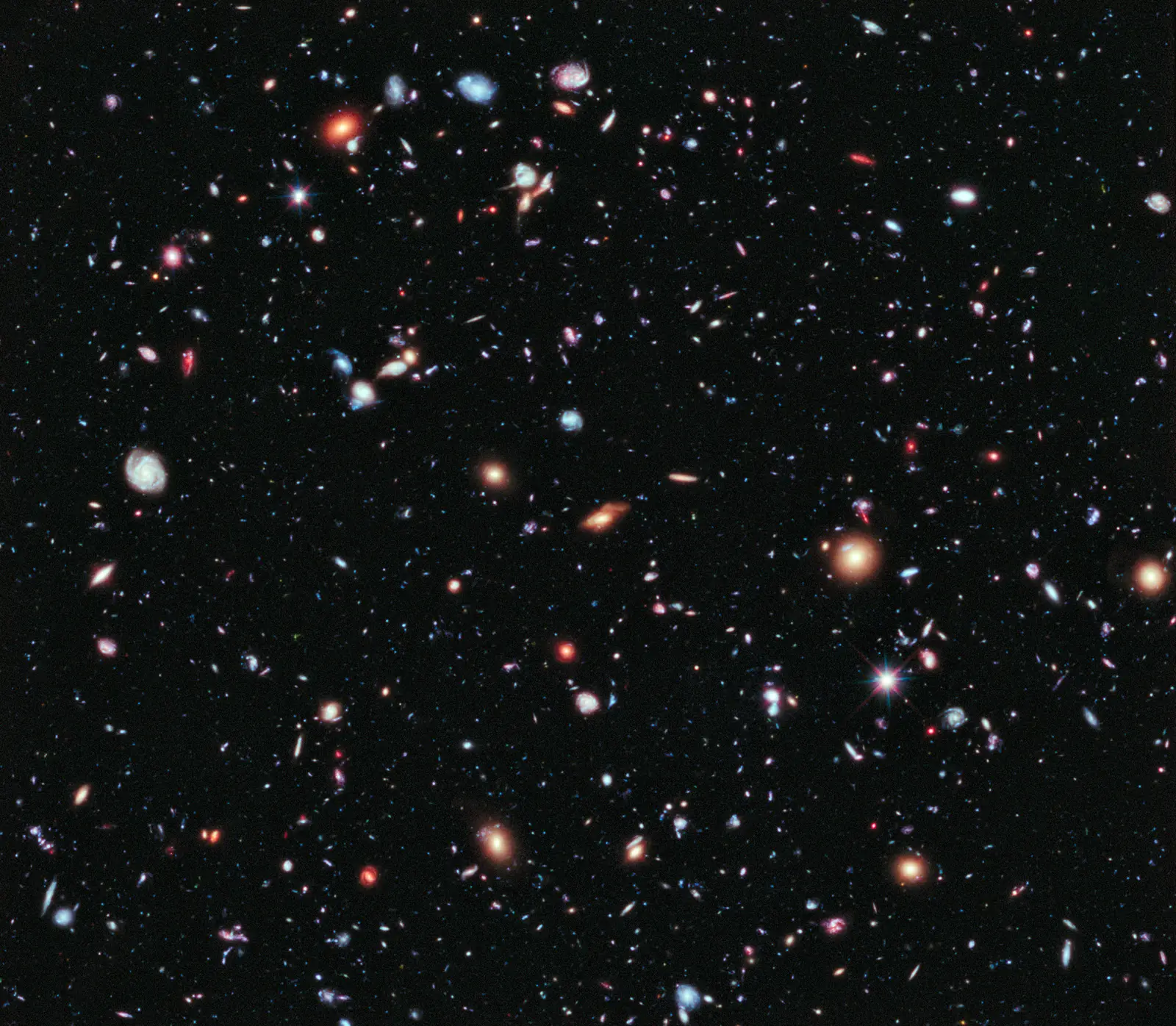
The Hubble eXtreme Deep Field: a black sky densely scattered with thousands of galaxies of every colour and shape, the faintest reddened by their enormous distance.

Light from different eras

Everything you're seeing is from the past as light needs time to reach you. Moon: 1.3 seconds. Vega: 25 years. Betelgeuse: ~600 years. Andromeda: 2.5 million. The slider steps through tonight's sky by age.

NASA/ESA Hubble · CC BY 4.0
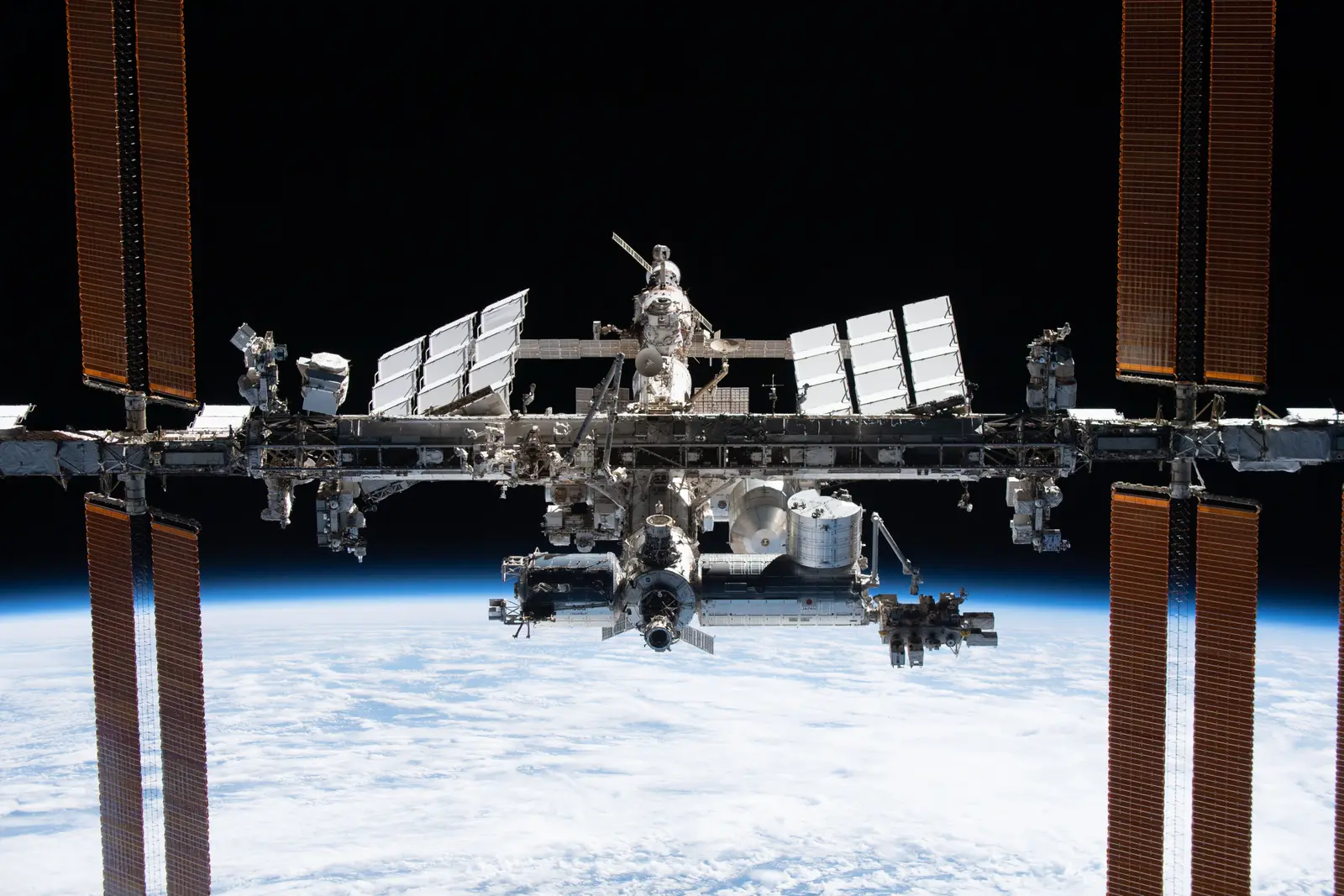
The International Space Station photographed against the blackness of space from the departing SpaceX Crew Dragon Endeavour, its solar arrays and truss fully extended.

The International Space Station

A space station the size of a football field, 400 km up, orbiting at 28,000 km/h — one lap every 90 minutes. The crew sees 16 sunrises a day.

NASA

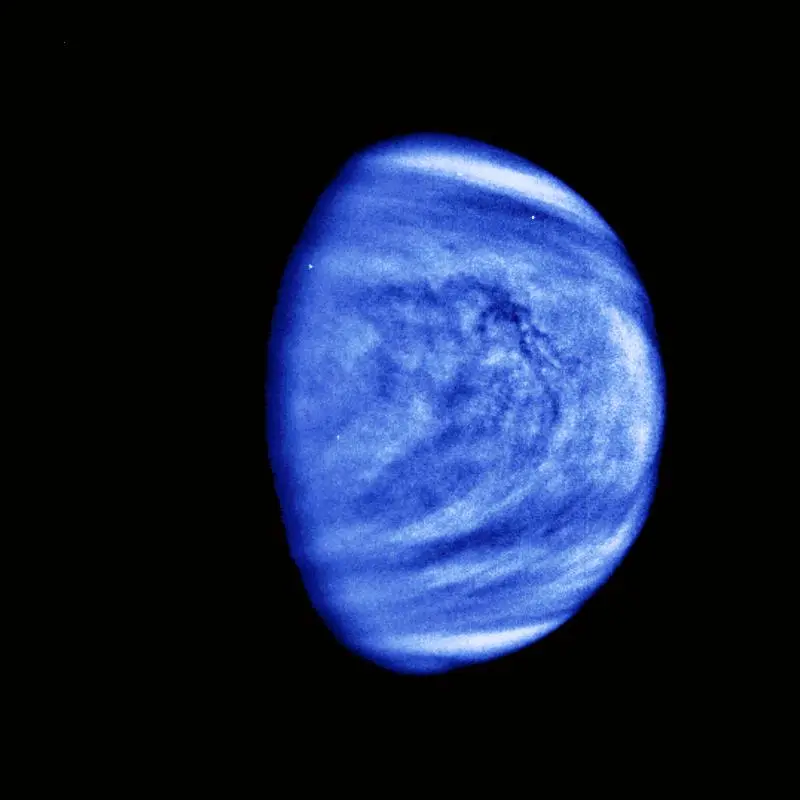
Venus as a single pale globe, its featureless sulphuric-acid cloud deck showing faint swirling bands, imaged in ultraviolet by the Galileo spacecraft.

Venus

Not a star: a planet wrapped in reflective cloud. Surface: ~460°C, hotter than Mercury. The brightest object in the night sky after the Moon.

NASA/JPL

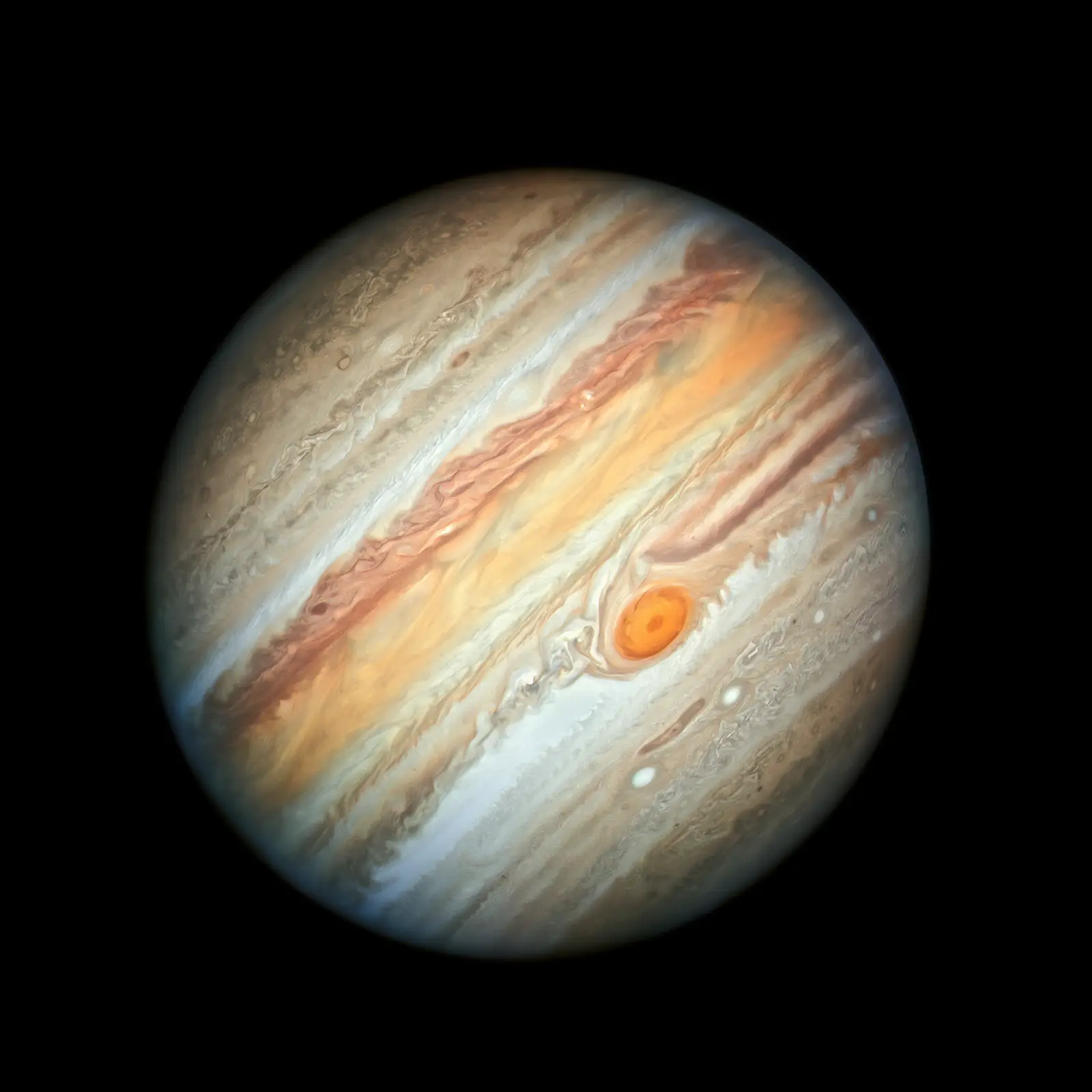
Jupiter filling the frame in banded cream, ochre and rust, with the Great Red Spot prominent below the equator.

Jupiter

The largest planet: all the others would fit inside it. The Great Red Spot is a storm wider than Earth, observed for 190+ years. 115 known moons as of 2026; 4 show in binoculars.

NASA/ESA Hubble · CC BY 4.0
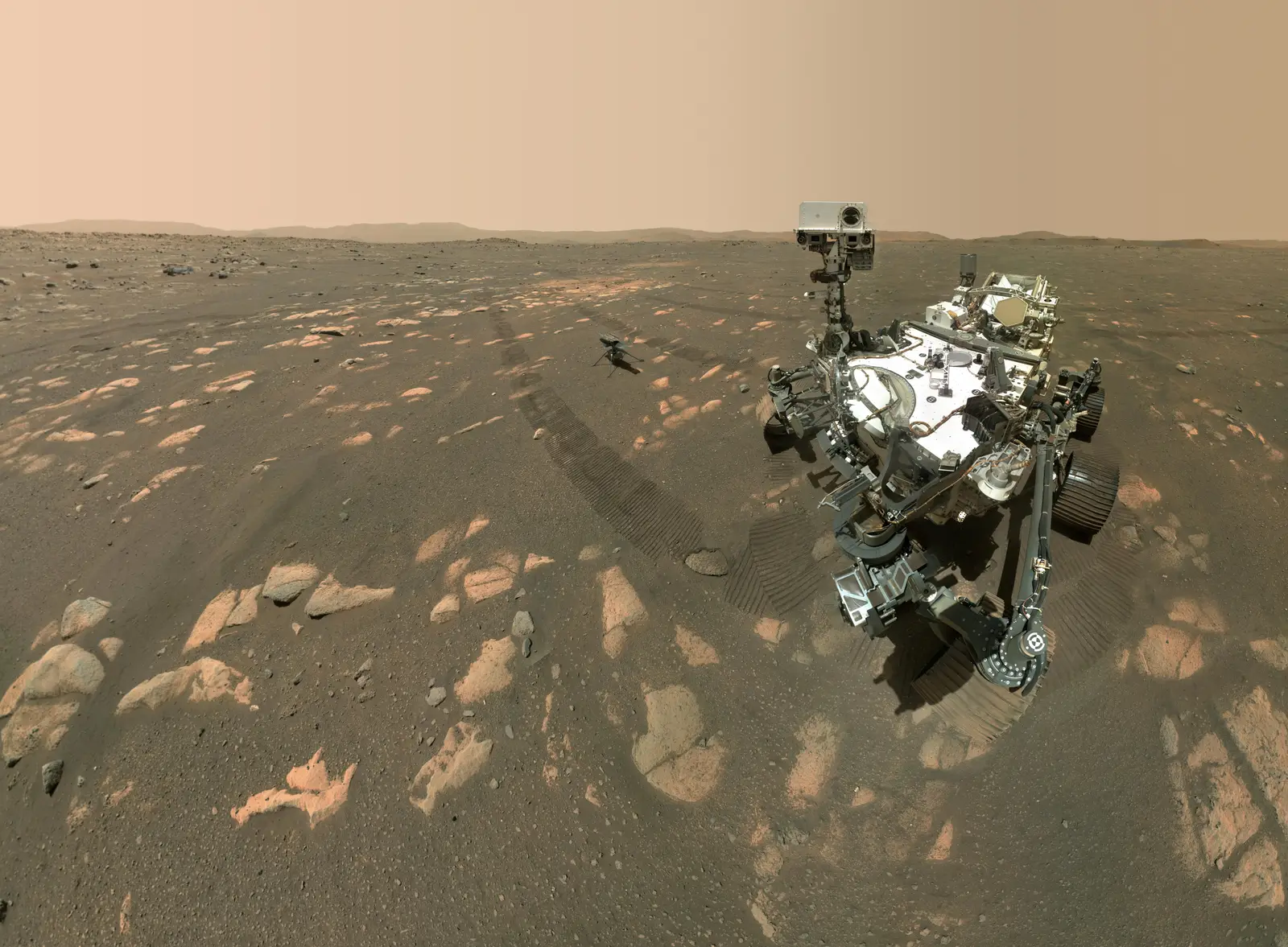
The Perseverance rover’s selfie on the rust-red Martian surface, with the small Ingenuity helicopter sitting on the ground a few metres away.

Mars

The red is rust: iron oxide dust. It is inhabited only by robots — two active rovers. It also has the solar system's tallest volcano, 2.5× Everest.

NASA/JPL-Caltech/MSSS

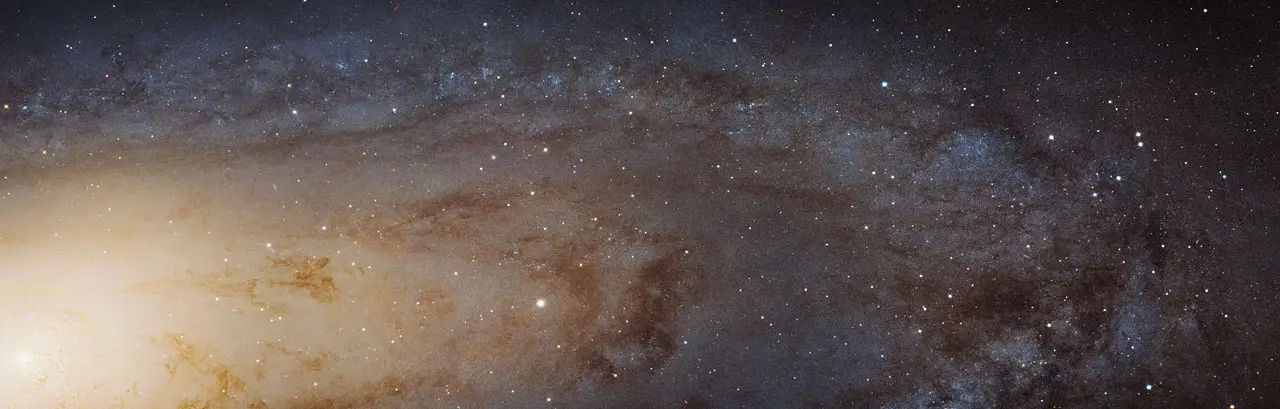
The sharpest ever view of the Andromeda Galaxy: a vast tilted spiral resolved into a haze of individual stars, threaded with dark dust lanes.

The Andromeda Galaxy

1 trillion stars, 2.5 million light-years away — the farthest naked-eye object. It spans 6 full Moons at its widest; your eye catches only its core. It approaches at 110 km/s.

NASA/ESA Hubble · CC BY 4.0
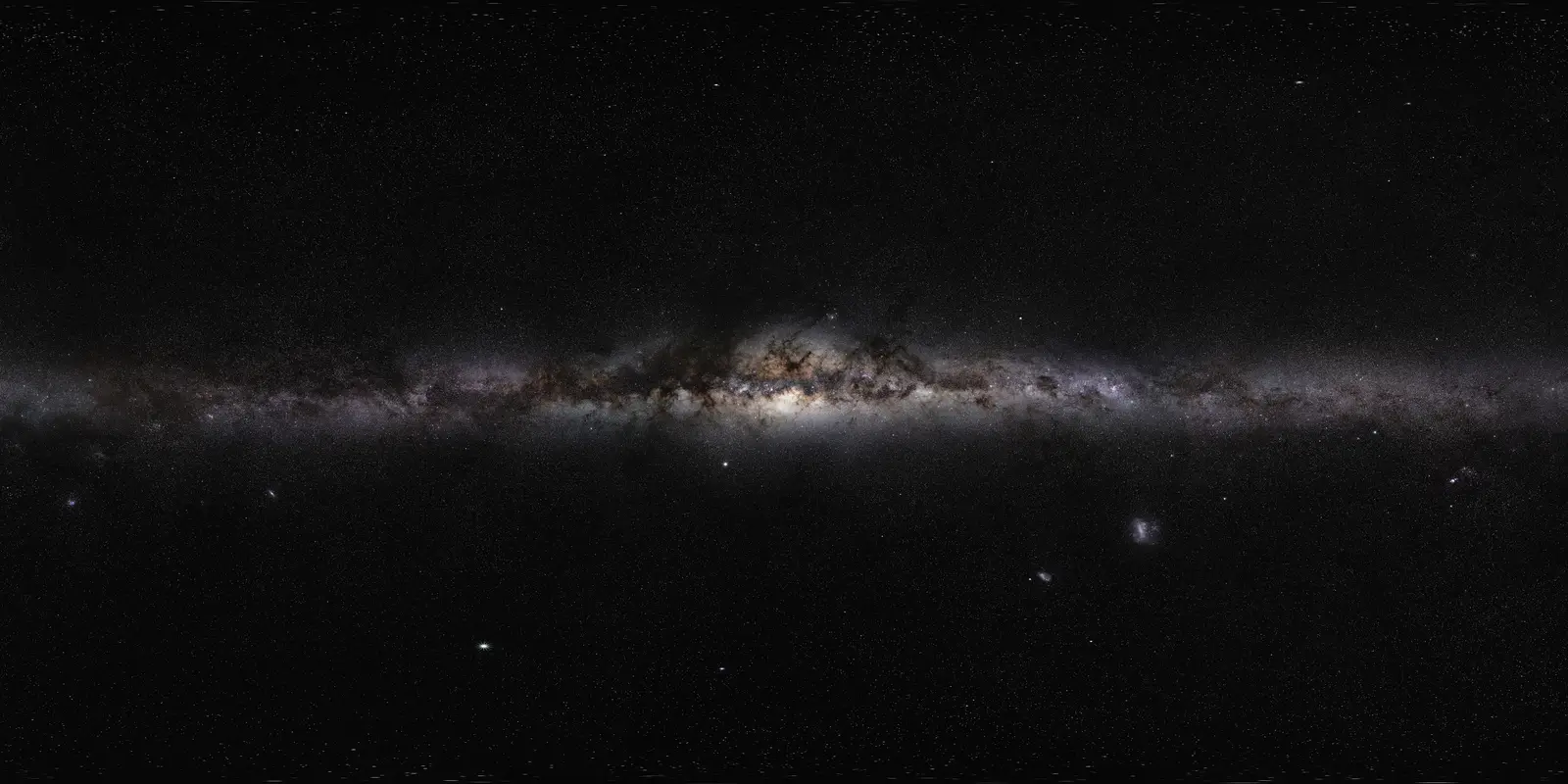
The complete 360-degree Milky Way panorama: the galactic disc stretched into a horizontal band of stars and dark dust across a black sky, thinning towards the top and bottom of the frame.

The galactic sandwich

Our galaxy is a flat disc, seen from inside. The bright band means looking along it through billions of stars. 90° away means looking out of it, toward other galaxies.

ESO/S. Brunier · CC BY 4.0
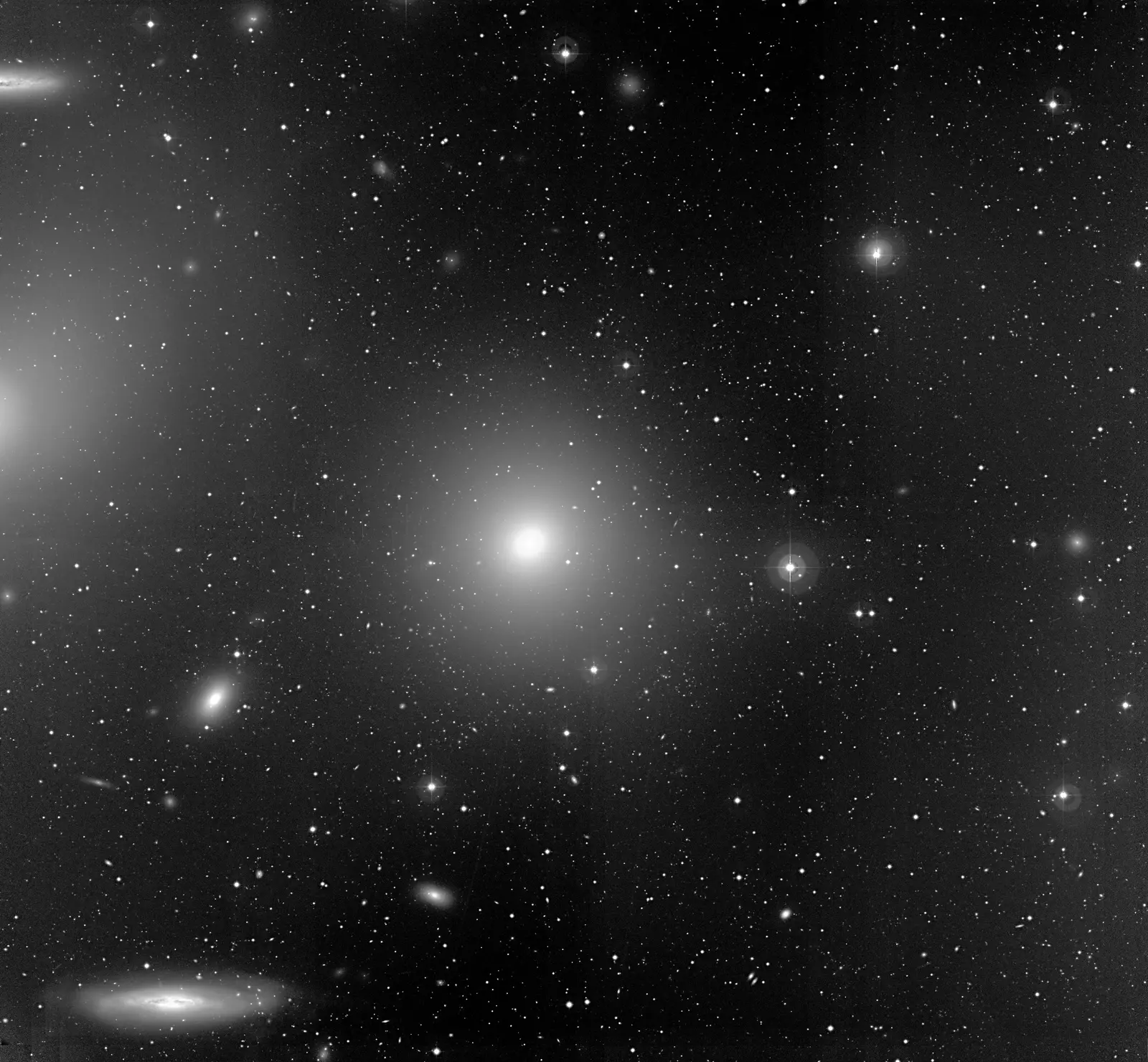
A crowded field of the Virgo Cluster imaged with the Wide Field Imager at La Silla: the giant elliptical Messier 84 at centre surrounded by many smaller galaxies, with the edge-on spiral NGC 4388 at lower left.

The galaxy weather map + the fist test

Galaxies are not spread evenly. Virgo and Coma: thousands behind one patch. The Milky Way band: blocked by our dust. Boötes: a 330-million-light-year void. A fist at arm’s length covers 10°.

ESO · CC BY 4.0
The Milky Way over Paranal with the dark dust lanes traced out as the Emu in the Sky, an Australian Aboriginal constellation drawn from the darkness rather than the stars.

The dark clouds — constellations made of darkness

The dark rifts in the band are dense dust clouds — star nurseries, not gaps. Aboriginal Australians drew the Emu in the Sky from them; the Coalsack is its head.

ESO/Y. Beletsky · CC BY 4.0
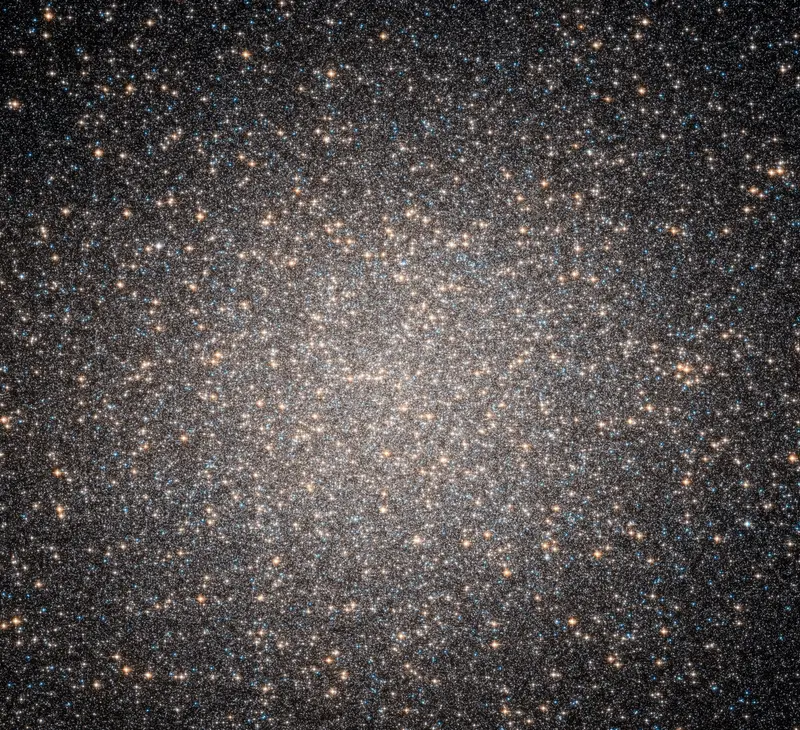
The globular cluster Omega Centauri: a dense ball of hundreds of thousands of stars, yellow-white elders mixed with a scattering of hot blue ones.

The oldest and newest sky

Amber: globular clusters, 12–13 billion years old — older than the galaxy’s spiral. Cyan: Orion and the Pleiades, under 100 million. Sharks are older than the Pleiades.

NASA/ESA Hubble · CC BY 4.0
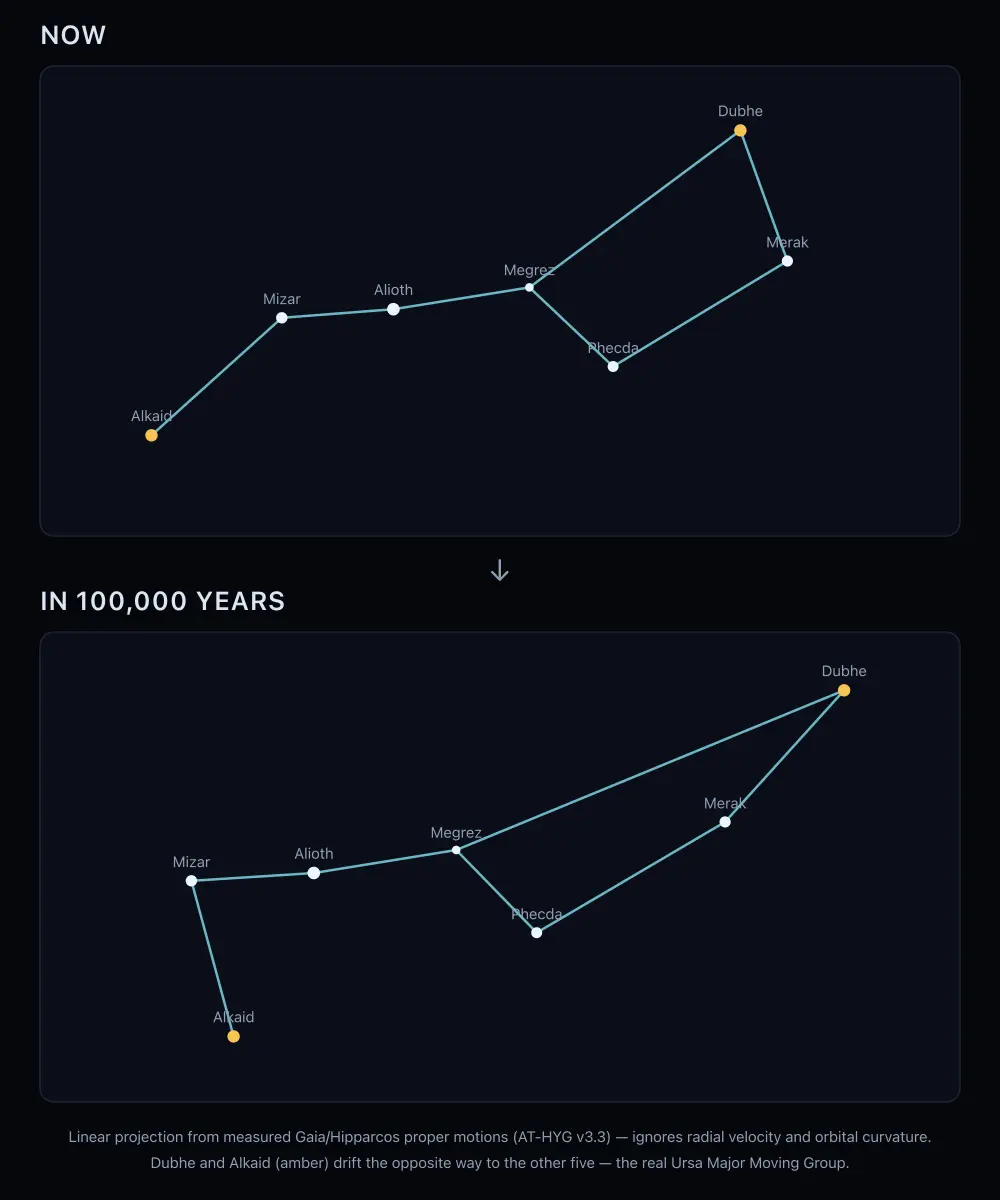
A two-panel diagram of the Big Dipper, one panel above the other: on top, the seven stars and their bowl-and-handle outline as they look now; below, the same seven stars projected 100,000 years into the future, the shape visibly sheared — Dubhe and Alkaid, in amber, drifting the opposite way to the other five.
Data visualisation

The Big Dipper is a family — and we're driving through it

5 of the Dipper’s 7 stars formed together ~300 million years ago and still travel as a group. The Sun is just passing through. The pattern changes within ~100,000 years.

SkyLumi · Gaia DR3 / Hipparcos · CC BY-SA 4.0

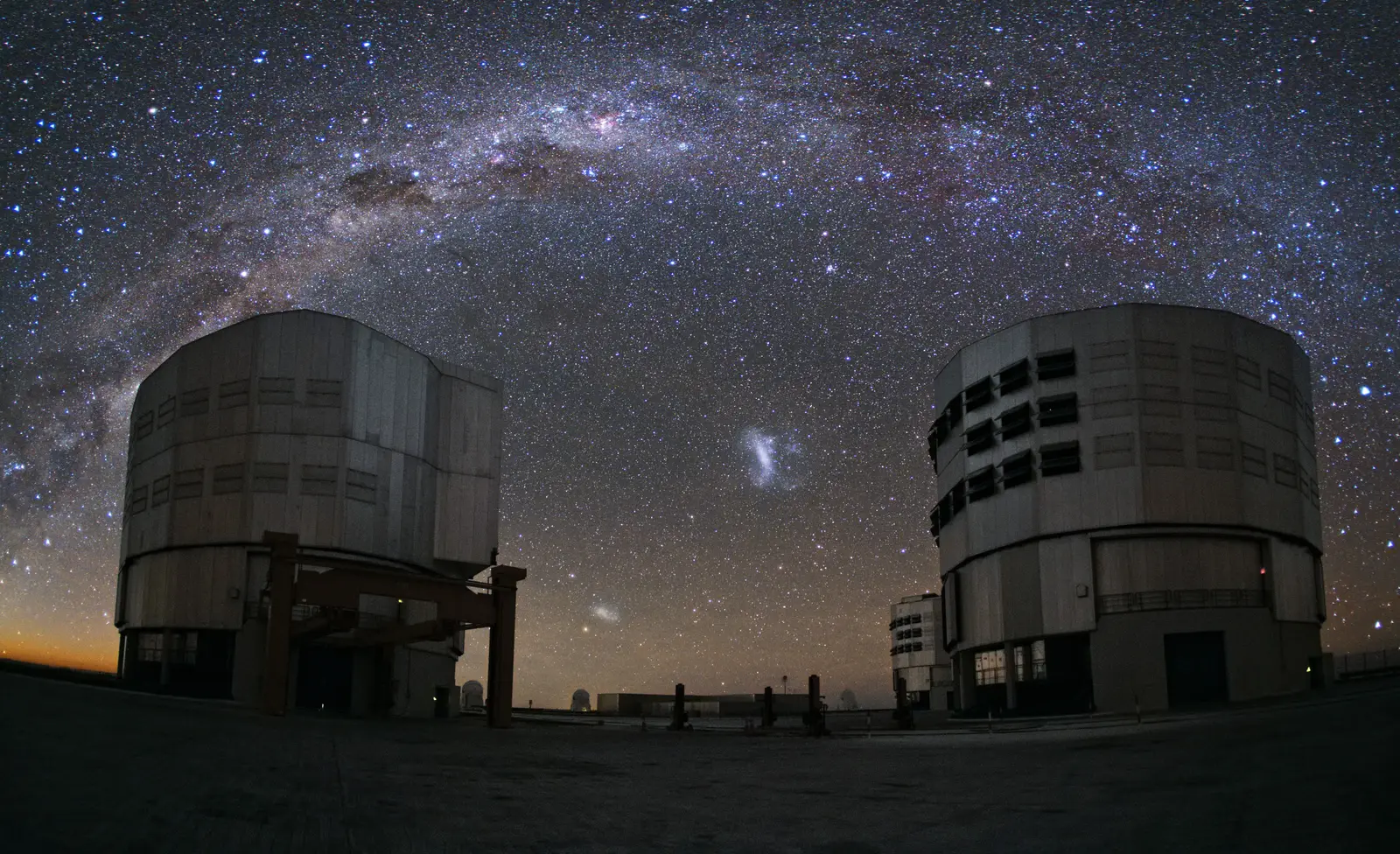
A wide panorama of the Milky Way arching over the Very Large Telescope platform at Paranal, the galactic band running from horizon to horizon.

Which way is everything going

You are part of three motions at once: the Sun drifts toward Vega at ~70,000 km/h; Andromeda approaches at 110 km/s; everything nearby streams toward the Great Attractor at ~600 km/s. Arrows mark the ones above your horizon.

ESO/F. Char · CC BY 4.0
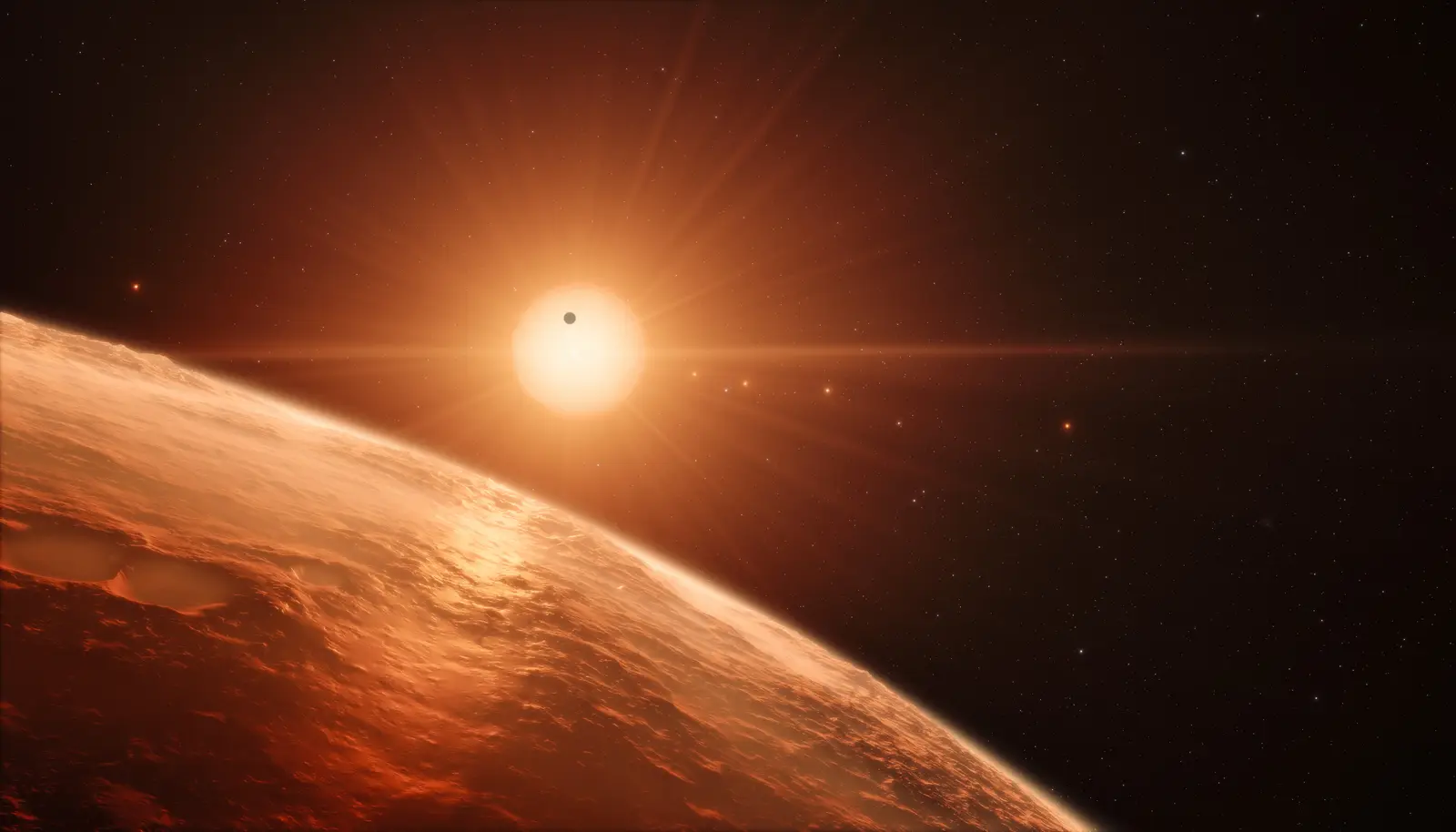
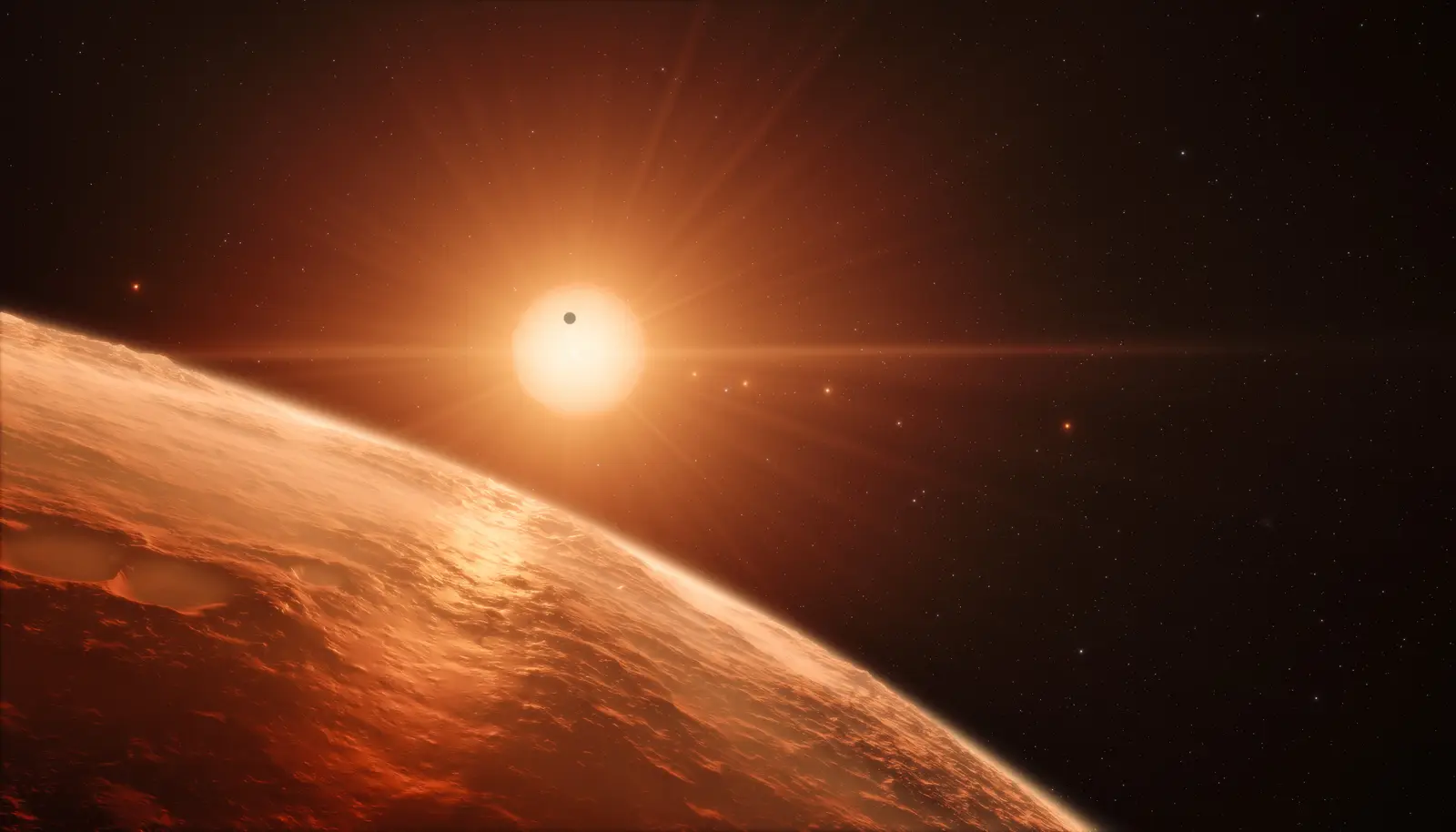
Artist's impression of the TRAPPIST-1 system seen from the rocky surface of one of its planets: a small red-orange star low over the horizon with a transiting dot crossing it, and the system's other worlds strung out beside it as bright points.
Artist's impression

The habitable neighborhoods

Marked: TRAPPIST-1 (7 Earth-sized planets), Proxima b (the nearest exoplanet), and the Kepler field — ~2,700 confirmed planets in one small square because we stared there for 4 years.

ESO/N. Bartmann · CC BY 4.0
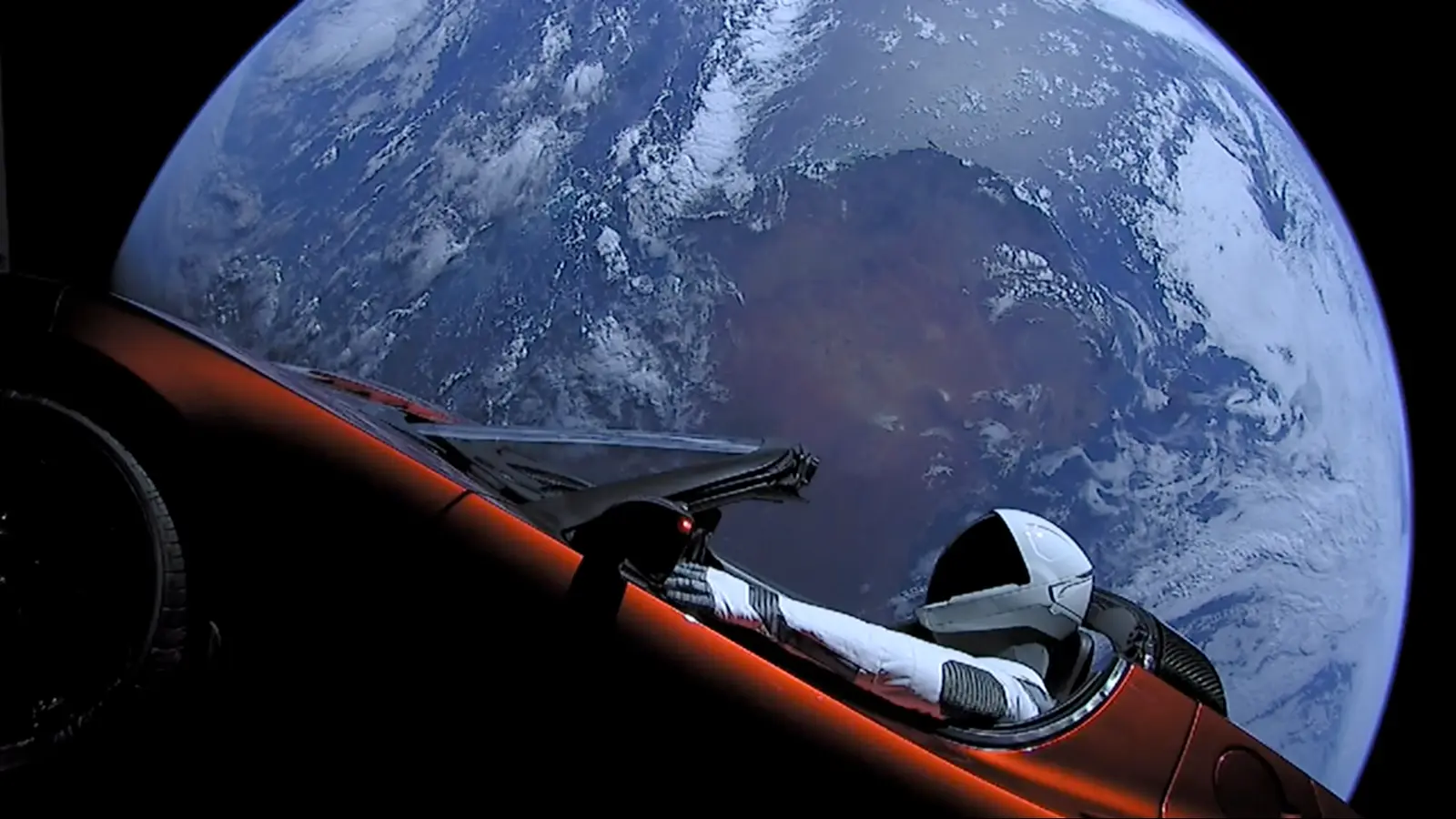
The Tesla Roadster with the Starman mannequin floating in space, with Earth in the background.

Starman and the Roadster

Launched in 2018 as a rocket test dummy payload: a red Tesla with a spacesuited mannequin. It now orbits the Sun beyond Mars’s orbit. The arrow marks its live position.

SpaceX · public-domain

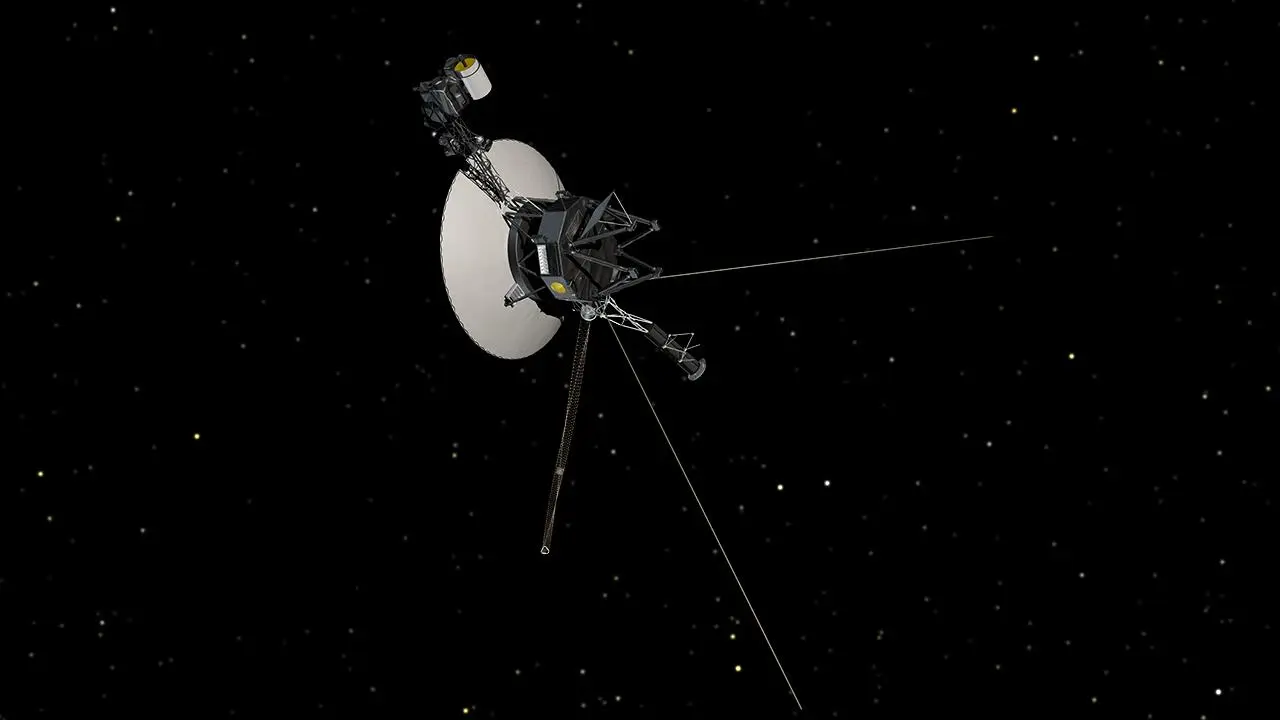
An artist’s rendering of the Voyager spacecraft — its dish antenna and long booms — against a backdrop of stars.
Artist's impression

Voyager 1 — the farthest thing we've ever made

Launched in 1977. The farthest human-made object: a radio call takes nearly a day to reach it. Still transmitting at 17 km/s. Power runs out in the 2030s; it keeps coasting.

NASA/JPL-Caltech

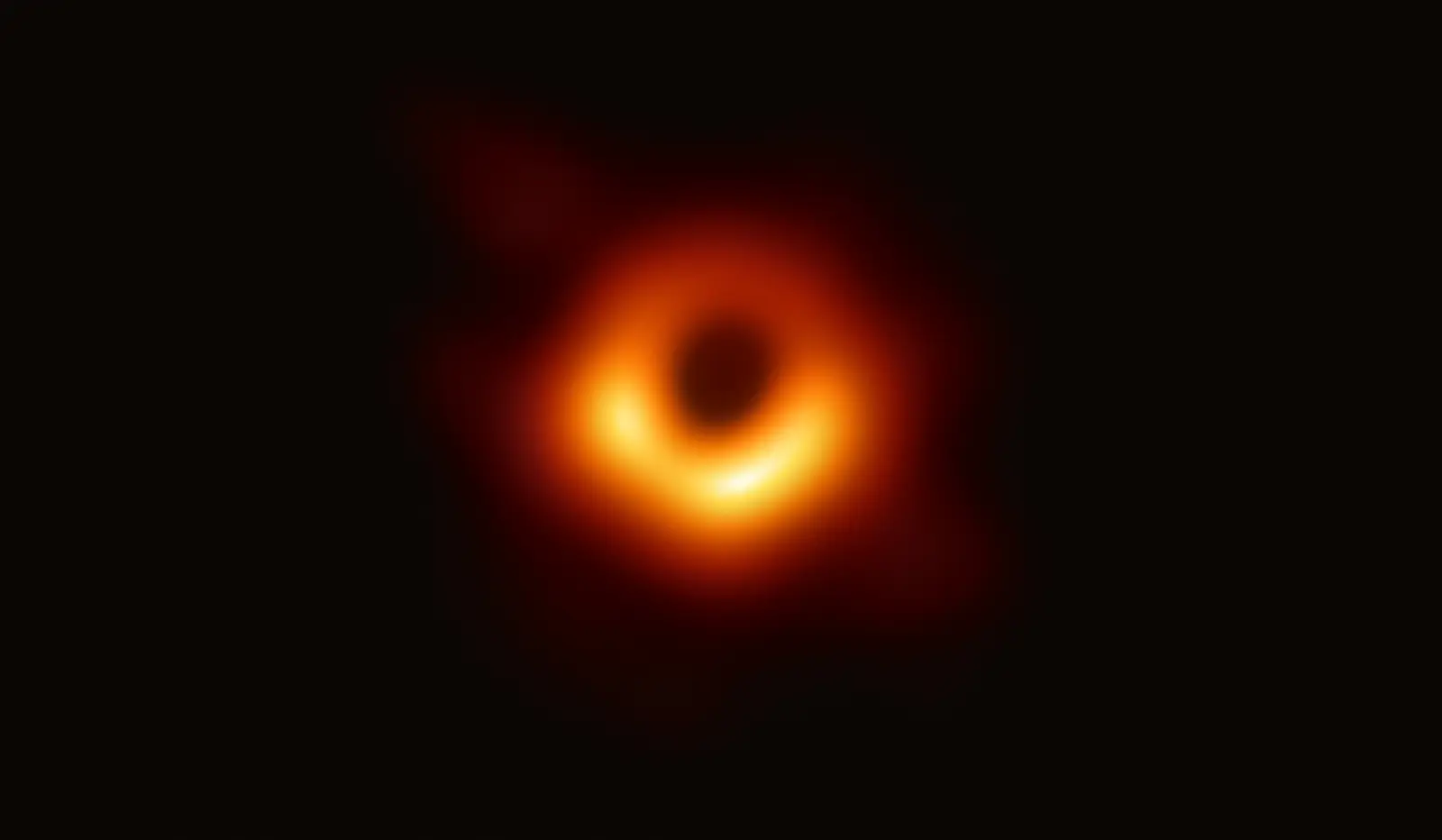
The first image of a black hole: a fuzzy orange ring of light, brighter along its lower edge, surrounding a dark central shadow.

M87* — the first photograph of a black hole

The first photographed black hole (2019). Mass: 6.5 billion Suns. Distance: 55 million light-years. The ring is light bent around it from behind.

EHT Collaboration · CC BY 4.0
An artist’s view of the TRAPPIST-1 system: a dim red dwarf with several rocky, Earth-sized worlds strung close around it.
Artist's impression

TRAPPIST-1 — seven Earths around one tiny star

7 Earth-sized planets around one red dwarf. The whole system is smaller than Mercury’s orbit. 3 are in the habitable zone. All are tidally locked: permanent day on one face, night on the other.

ESO/N. Bartmann/spaceengine.org · CC BY 4.0
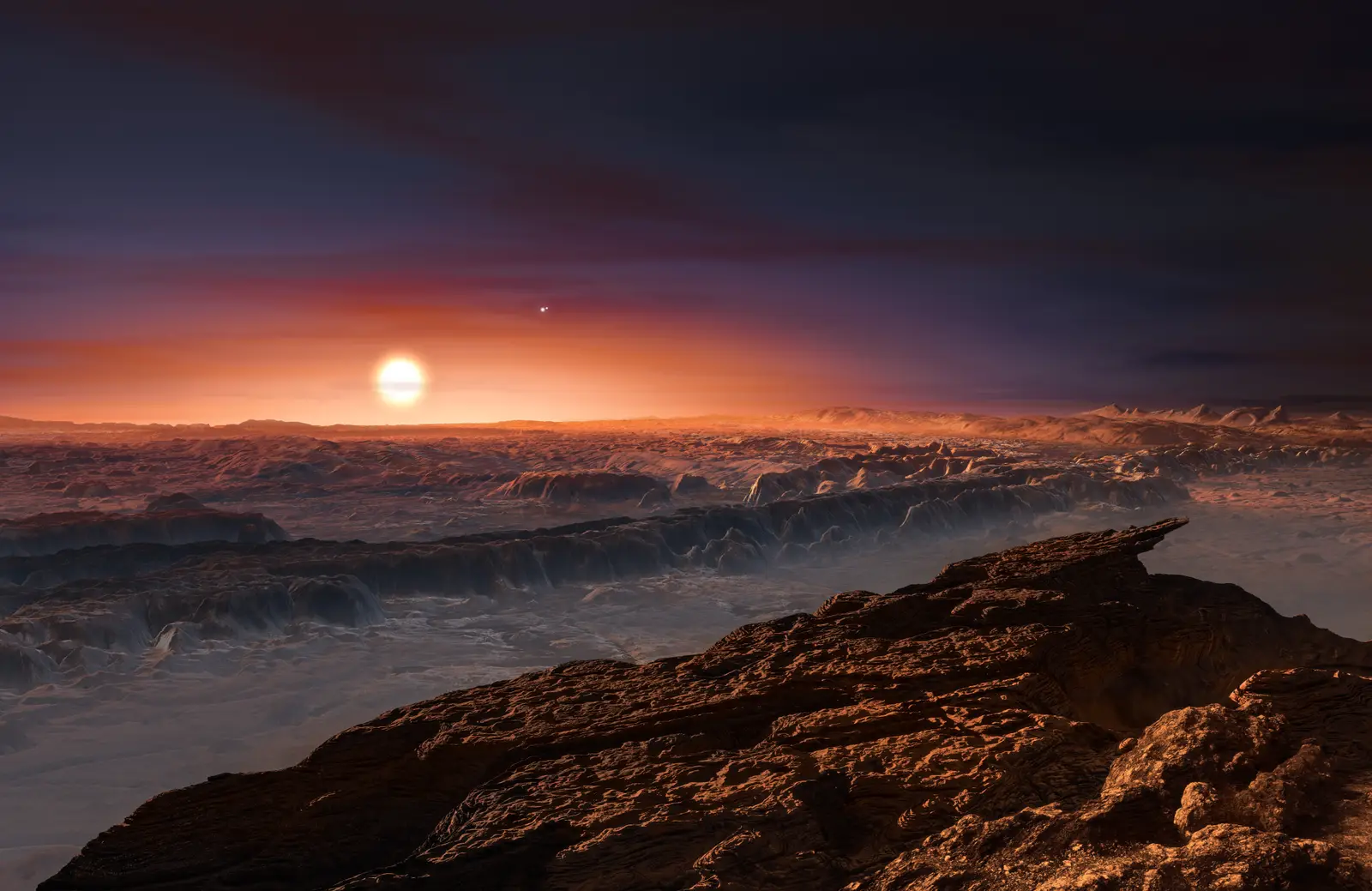
An artist’s view of the surface of Proxima b, a rocky world lit dull red by its dwarf star, with Alpha Centauri A and B as two bright points nearby.
Artist's impression

Proxima b — the nearest world beyond the Sun

The nearest exoplanet: 4.2 light-years away, roughly Earth-sized, and in the habitable zone. Its red-dwarf star flares hard. Today’s spacecraft would take tens of thousands of years to get there.

ESO/M. Kornmesser · CC BY 4.0
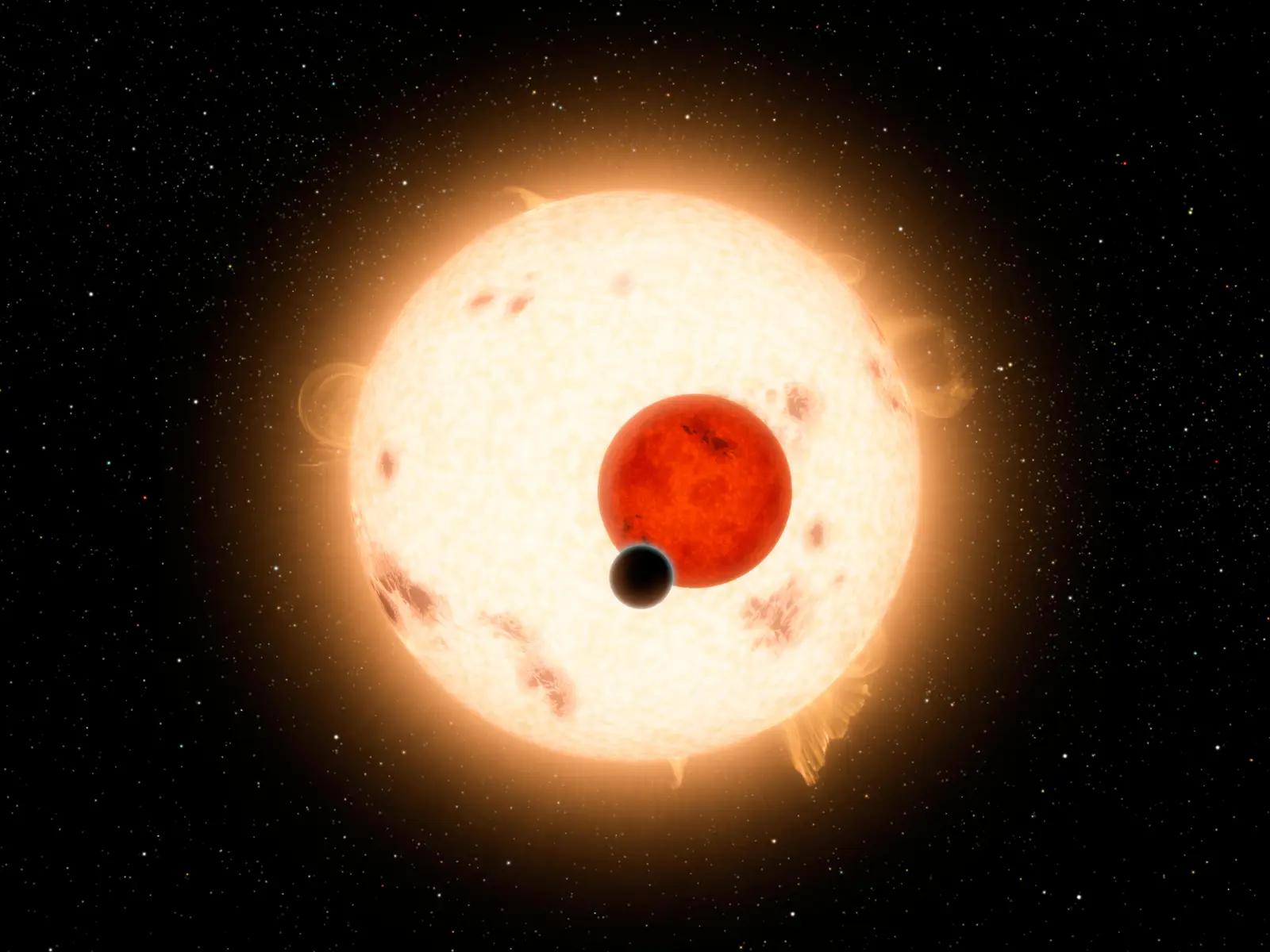
An artist’s concept of the surface of Kepler-16b with two suns — one large and orange, one smaller and red — setting together on the horizon.
Artist's impression

Kepler-16b — the planet with two suns

A confirmed planet orbiting two stars — a real double sunset. On its moons, you would cast two shadows. NASA’s travel poster says: “where your shadow always has company.”

NASA/JPL-Caltech

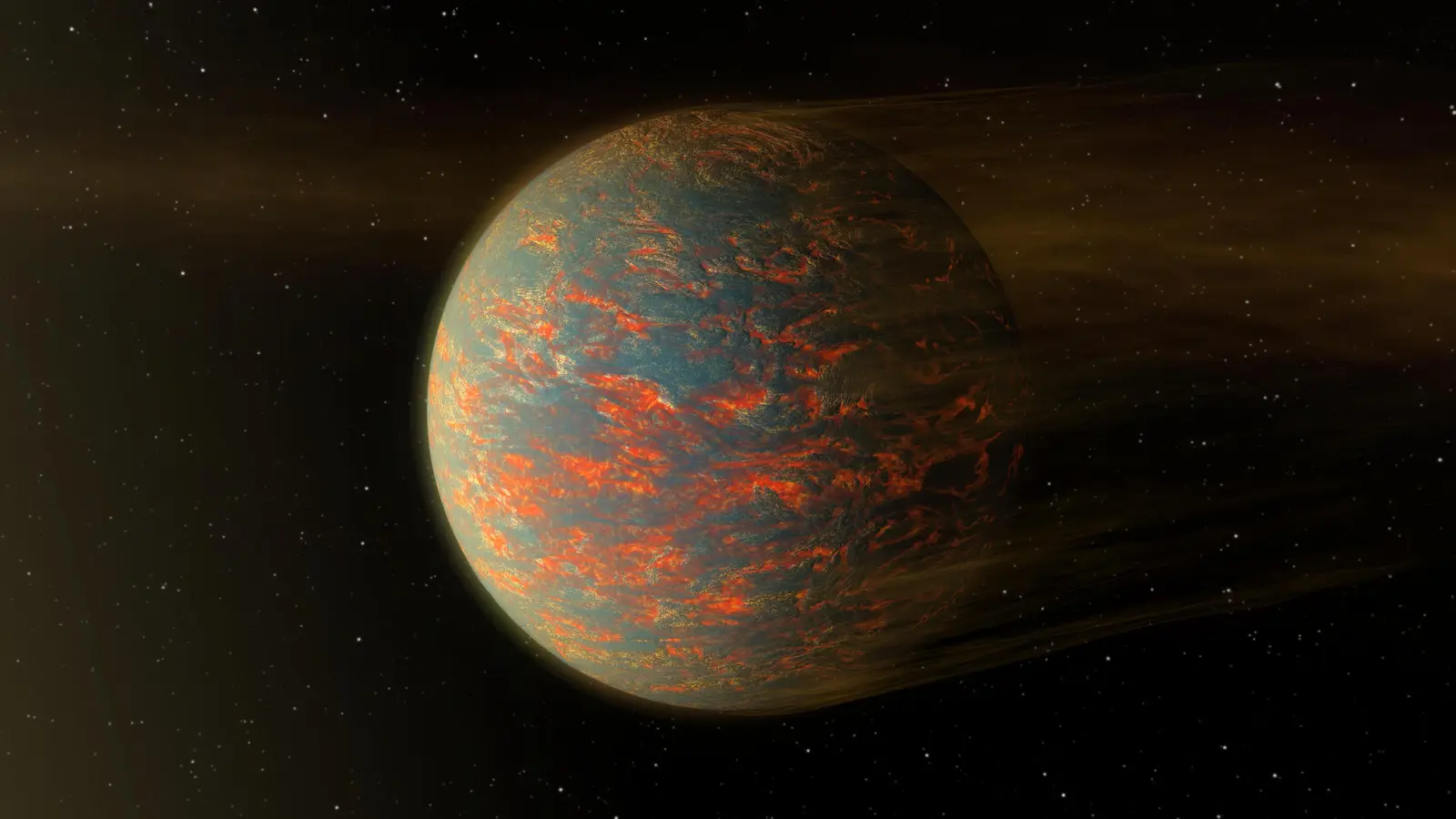
An artist’s illustration of 55 Cancri e: a scorched super-Earth with a glowing molten dayside facing its star.
Artist's impression

55 Cancri e — the lava world

A planet twice Earth's size, covered in molten rock. Its year is 18 hours. Surface: 1,500°C+. Its star is visible to the naked eye from dark sites.

NASA/JPL-Caltech

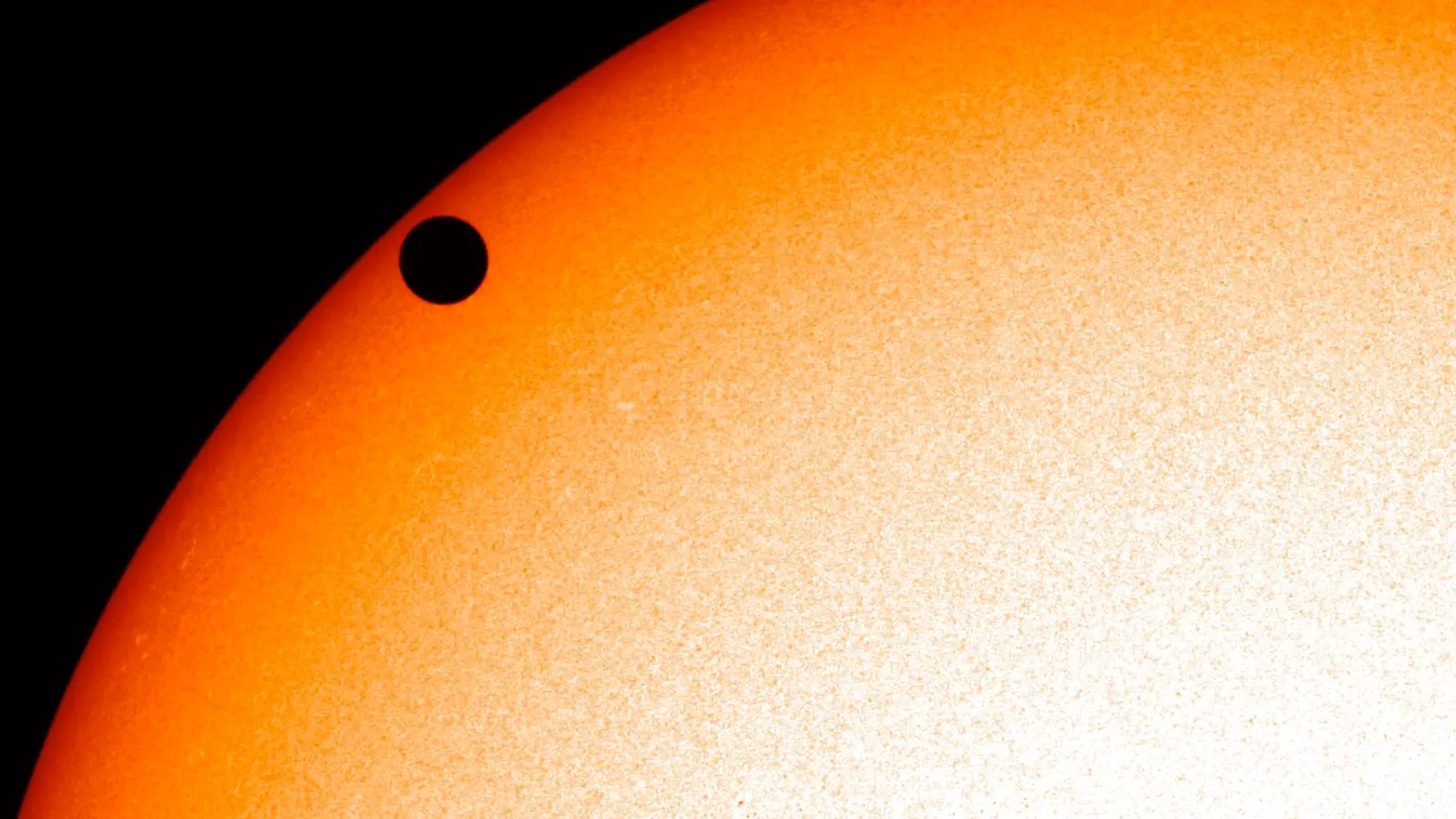
A close-up of the Sun’s disc during the 2012 transit of Venus, with the planet a small perfectly black circle silhouetted against the churning solar surface.

The Earth Transit Zone — who can see US

The thin sky band where Earth's transit across the Sun is detectable. ~1,700 star systems have had that view in 5,000 years; ~75 are close enough to have received our broadcasts.

NASA/SDO

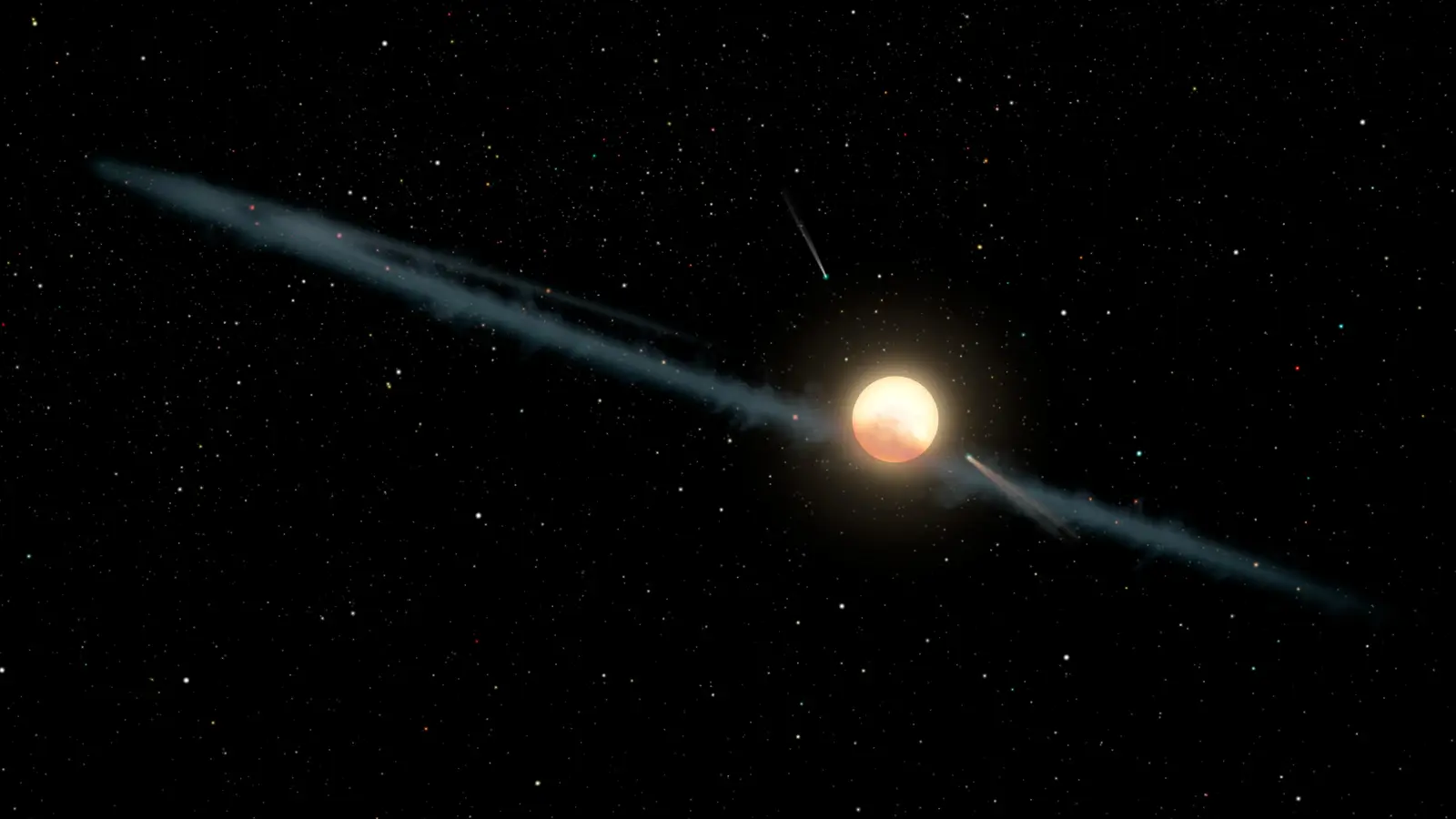
An artist’s illustration of an uneven ring of dust orbiting Tabby’s Star, partially veiling the star behind it.
Artist's impression

Tabby's Star — the one nobody could explain

From 2015, this star dimmed by up to 22% at random — a planet blocks ~1%. Astronomers seriously tested the alien-megastructure idea. The best answer is uneven dust.

NASA/JPL-Caltech

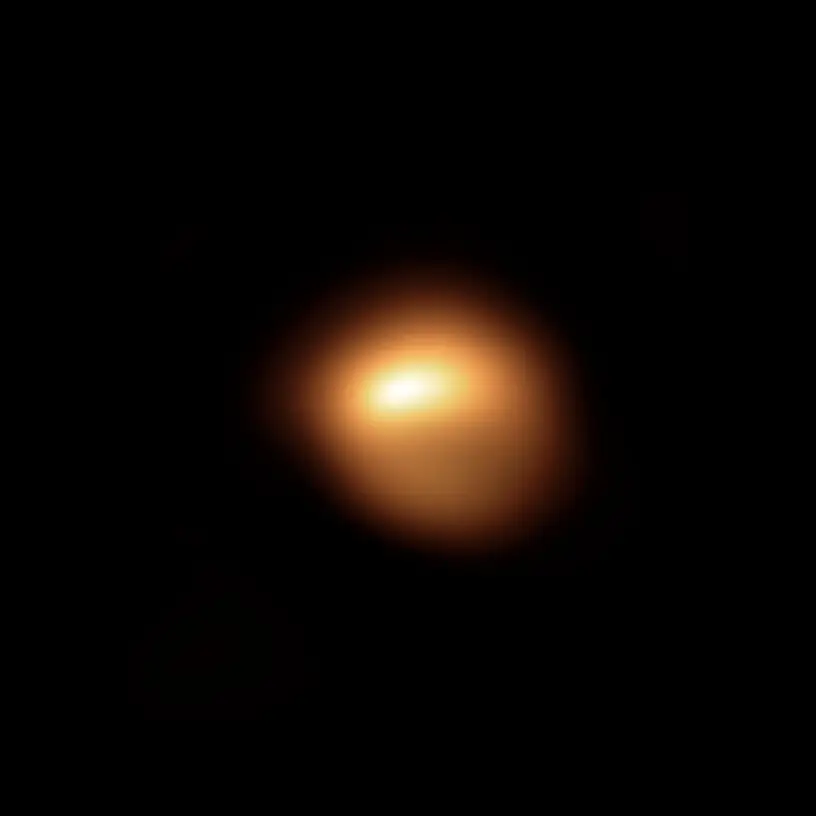
The resolved disc of Betelgeuse imaged by SPHERE on the Very Large Telescope in December 2019, visibly lopsided and dimmed across its southern half.

Betelgeuse — the ghost

A red supergiant ~600 light-years away. At the Sun, it would engulf Mars. It will go supernova within ~100,000 years. Its light is 600 years old, so it may already have exploded.

ESO/M. Montargès et al. · CC BY 4.0

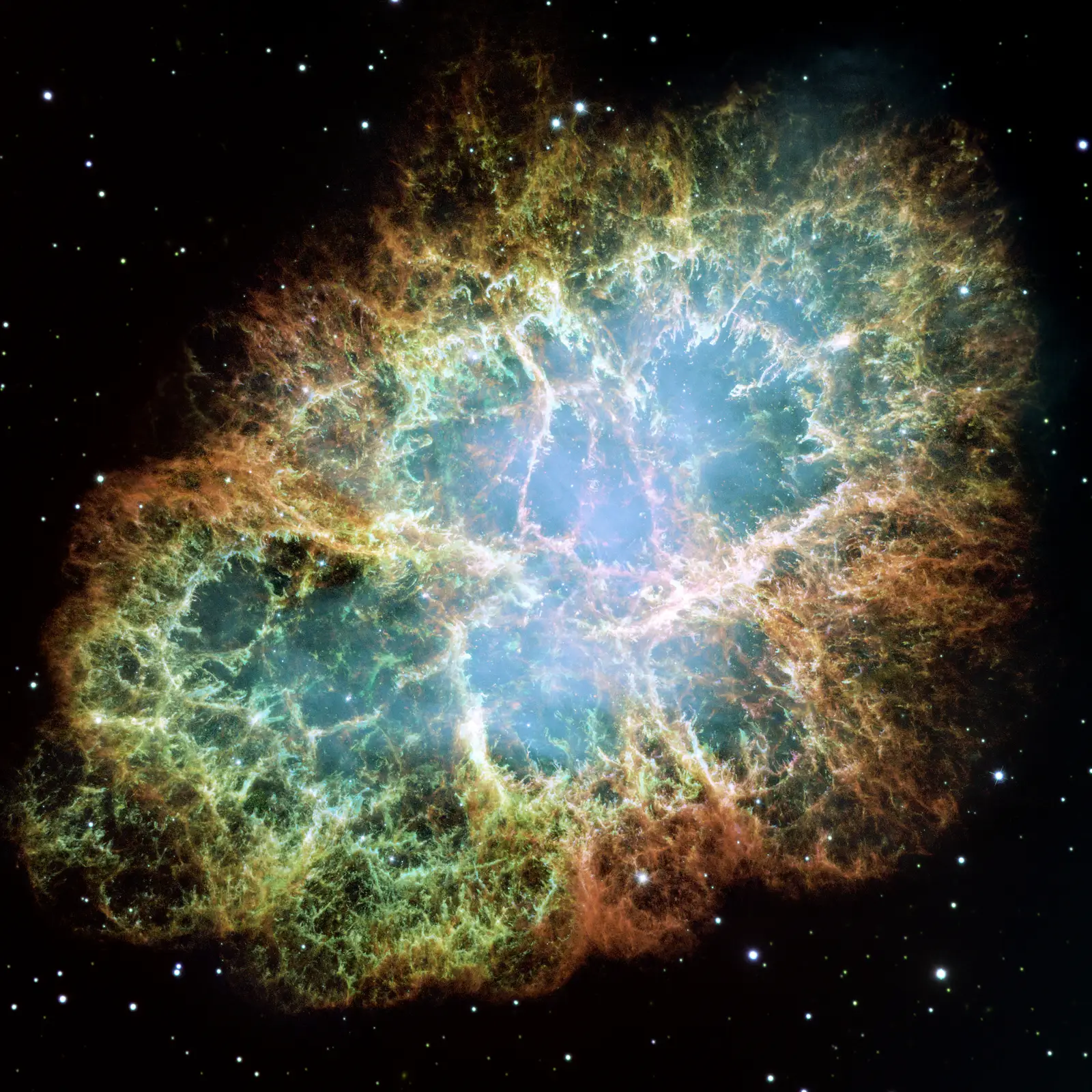
The Crab Nebula: a tangled oval cage of orange and green filaments around a blue-white glowing interior, the wreckage of the star that exploded in 1054.

The Crab Nebula — the explosion people wrote down

A supernova recorded in China on July 4, 1054 — visible by day for 23 days. Its debris still expands at 1,500 km/s and visibly grows between photos taken decades apart.

NASA/ESA Hubble · CC BY 4.0

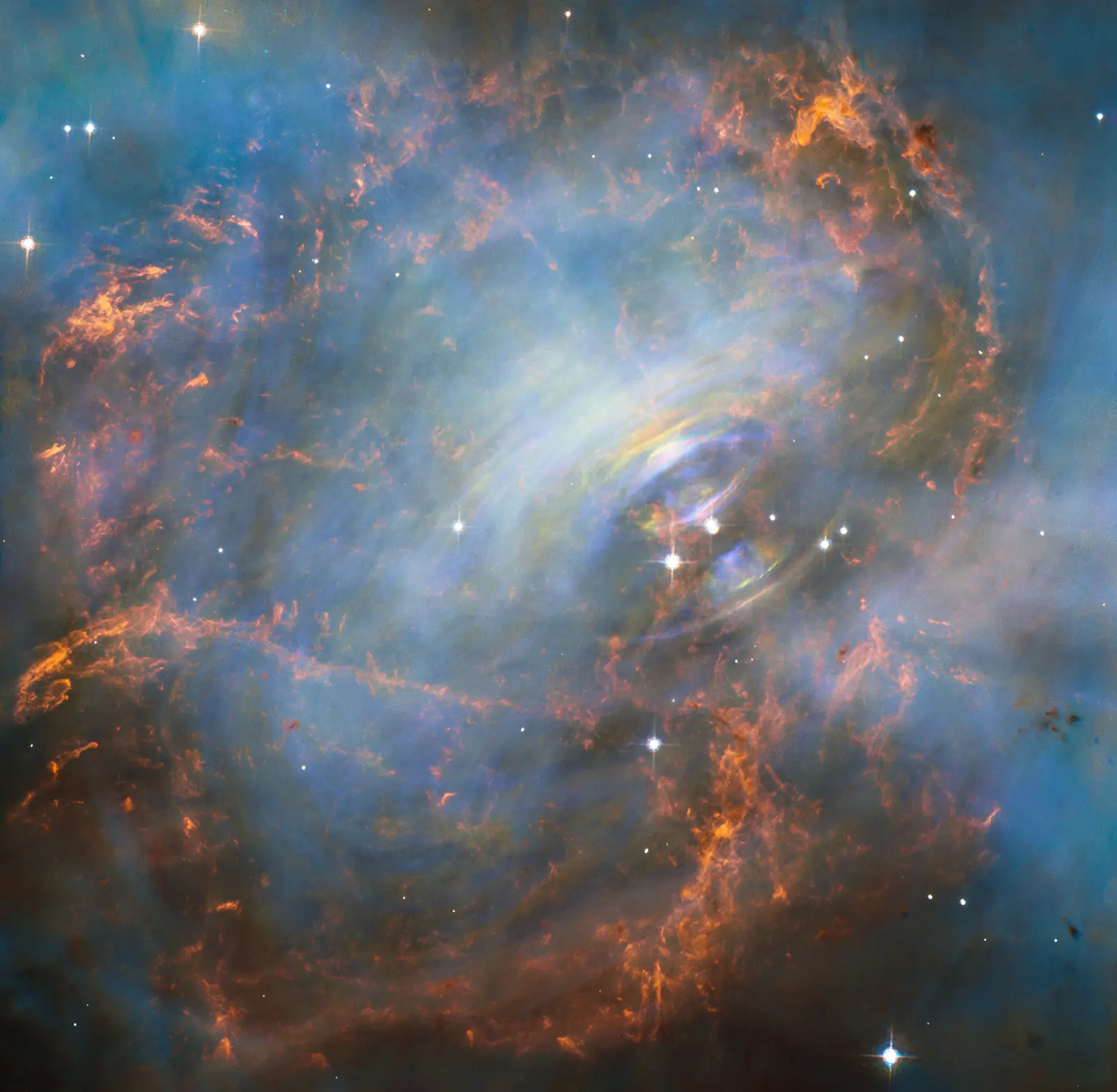
A close-up of the beating heart of the Crab Nebula, the pulsar and the ghostly blue wisps of energised gas whipping outward from it.

Pulsars — the fastest-spinning things in the universe

Collapsed star cores: more than a Sun’s mass in a city-sized sphere. The Crab spins 30×/second; the record holder, PSR J1748−2446ad, 716×/second. A teaspoon outweighs a mountain.

ESA/Hubble & NASA · CC BY 4.0

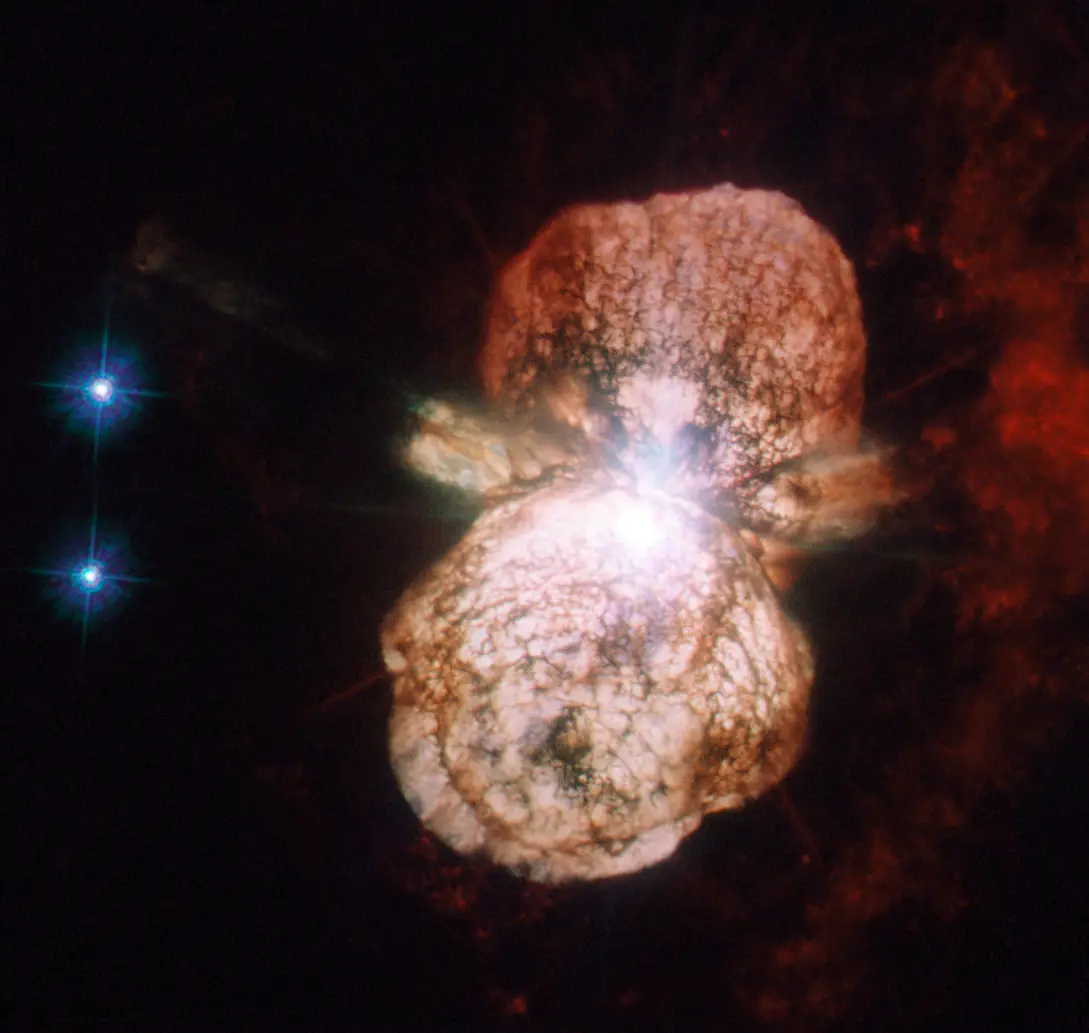
Eta Carinae’s Homunculus Nebula: two bright lobes of gas billowing away from the star in opposite directions, the debris of its 1840s eruption.

Eta Carinae — the star that nearly died and didn't

In the 1840s it flared to the second-brightest star in the sky, shed 10+ Suns of material, and survived. Mass: ~100 Suns. A future supernova is guaranteed.

ESA/Hubble & NASA · CC BY 4.0

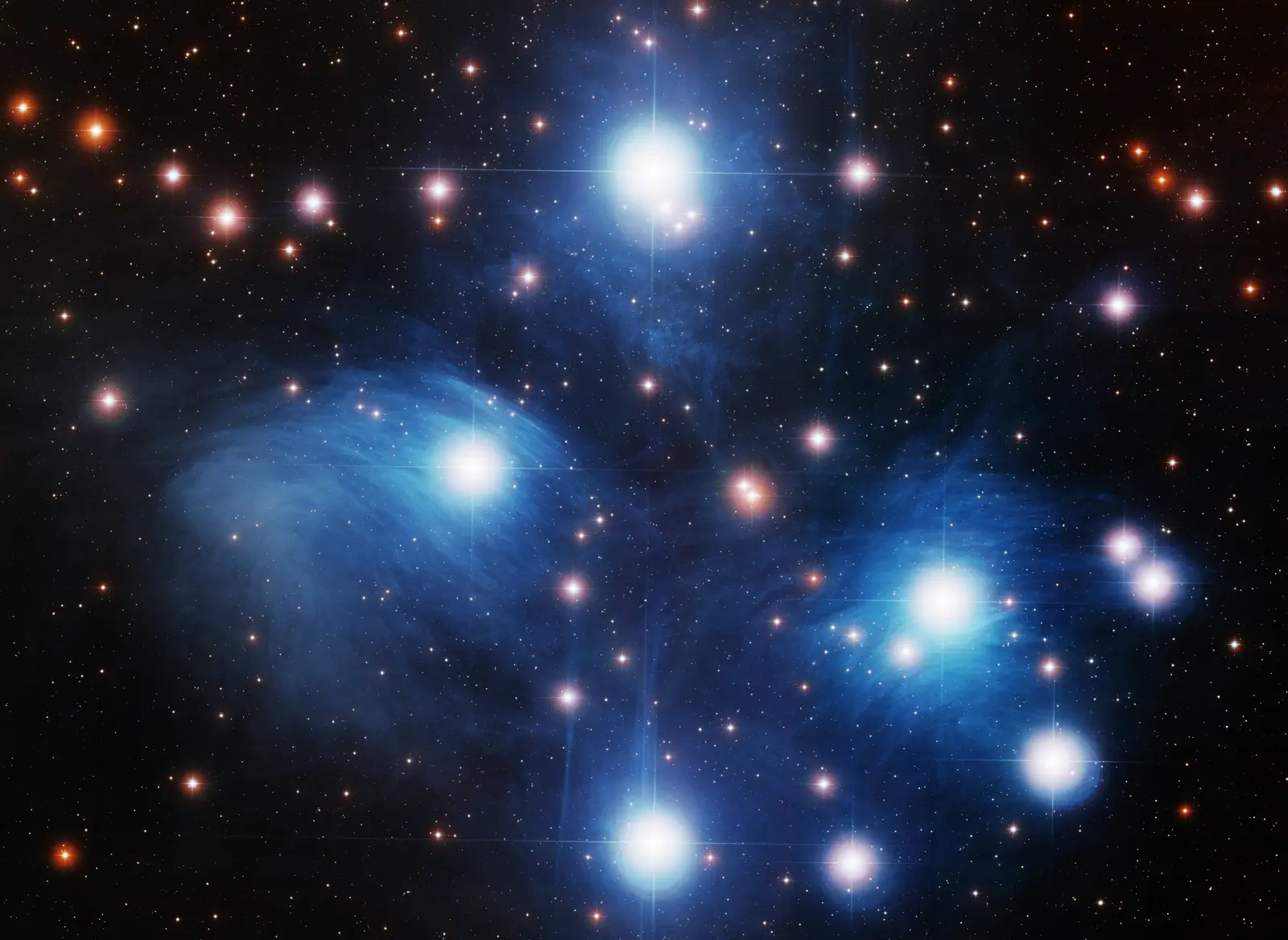
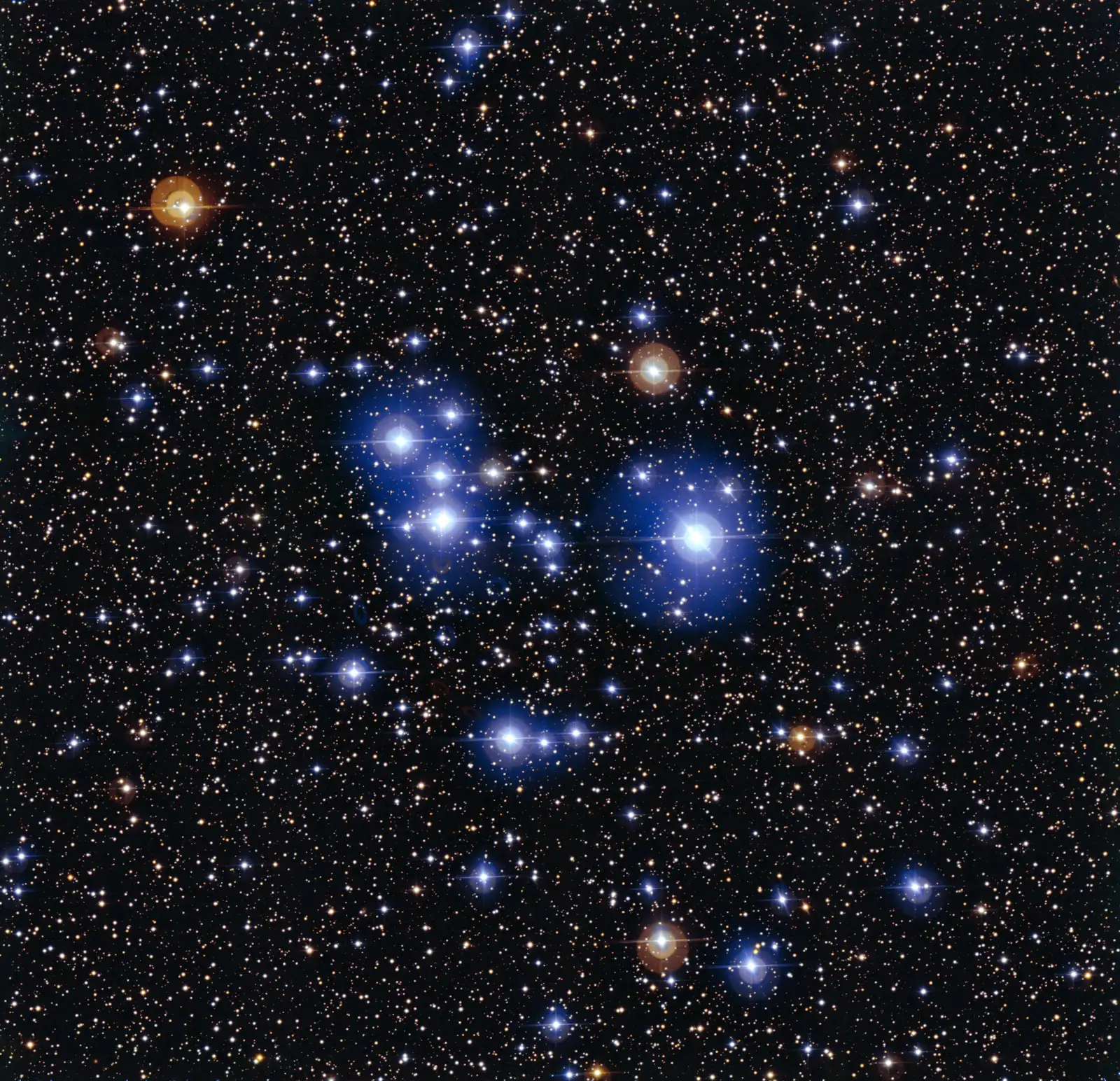
The Pleiades: a tight knot of hot blue-white stars wrapped in wispy blue reflection nebulosity.

The Pleiades — seven sisters, still babies

A cluster of 1,000+ stars, ~100 million years old — younger than sharks. Unrelated cultures worldwide tell of seven sisters, with one missing.

NOIRLab/NSF/AURA · CC BY 4.0

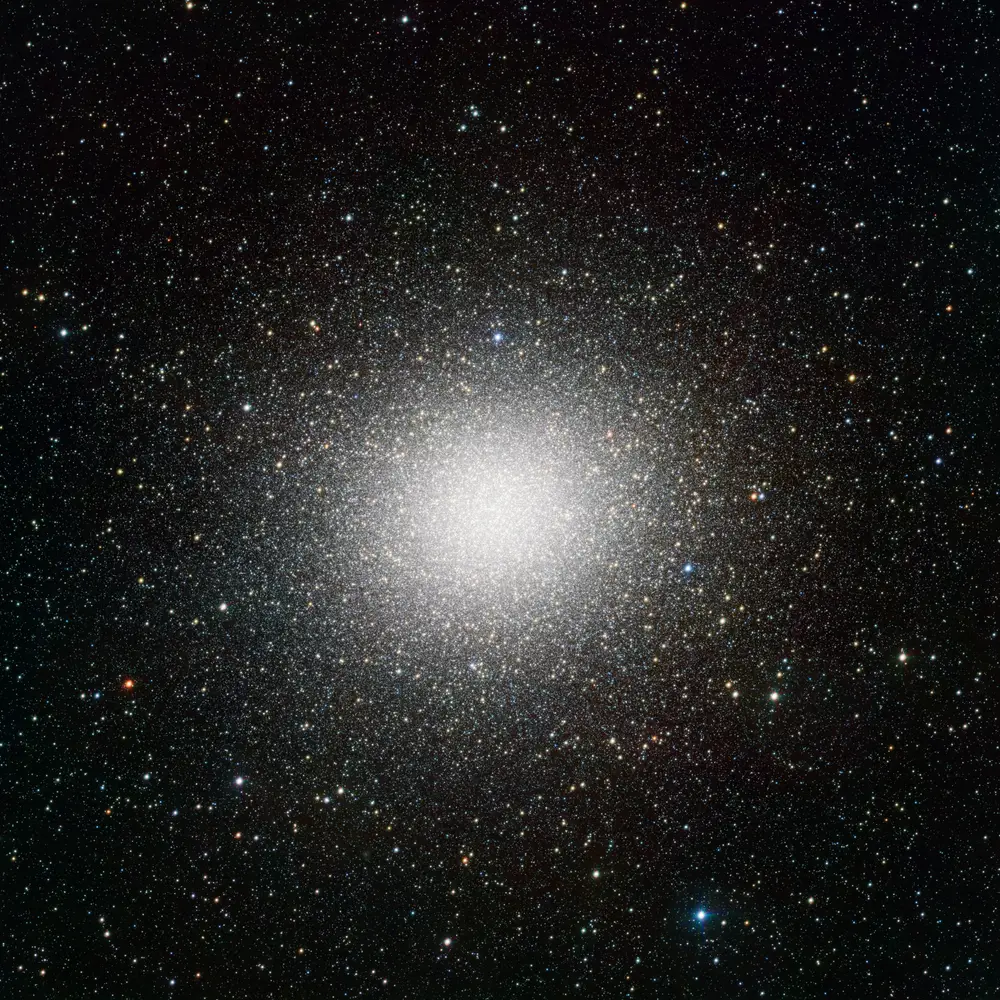
The giant globular cluster Omega Centauri imaged by the VLT Survey Telescope: millions of stars packed into a single glowing sphere that fills the frame.

Omega Centauri — ten million stars in a ball

~10 million stars in one ball, seen as one fuzzy star. Near its core, stars are a fraction of a light-year apart. It may be the stripped core of a swallowed galaxy.

ESO/INAF-VST/OmegaCAM · CC BY 4.0

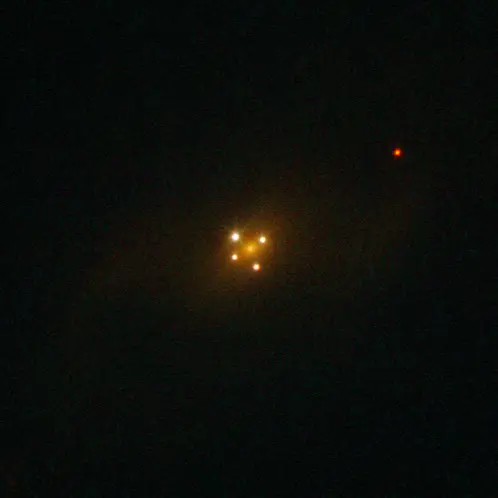
The Einstein Cross: four bright points of light arranged in a cross around the faint diffuse core of a foreground galaxy — four lensed images of a single distant quasar.

The Einstein Cross — one quasar, four times

One quasar, 8 billion light-years away, appears 4 times because a foreground galaxy bends its light along different paths. This is gravitational lensing, exactly as Einstein predicted.

ESA/Hubble & NASA · CC BY 4.0

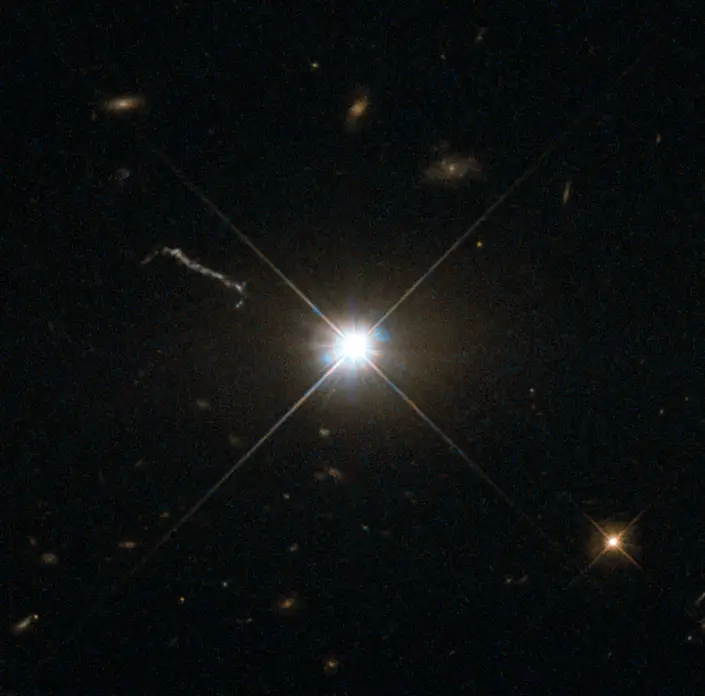
The quasar 3C 273 as a brilliant star-like point with its narrow jet extending to one side, the host galaxy suppressed by a coronagraph.

3C 273 — the deepest your own eye can go

The brightest quasar in visible light: 2.4 billion light-years away, magnitude ~12.9, and reachable with an 8-inch telescope. The farthest object a human eye can see directly.

ESA/Hubble & NASA · CC BY 4.0

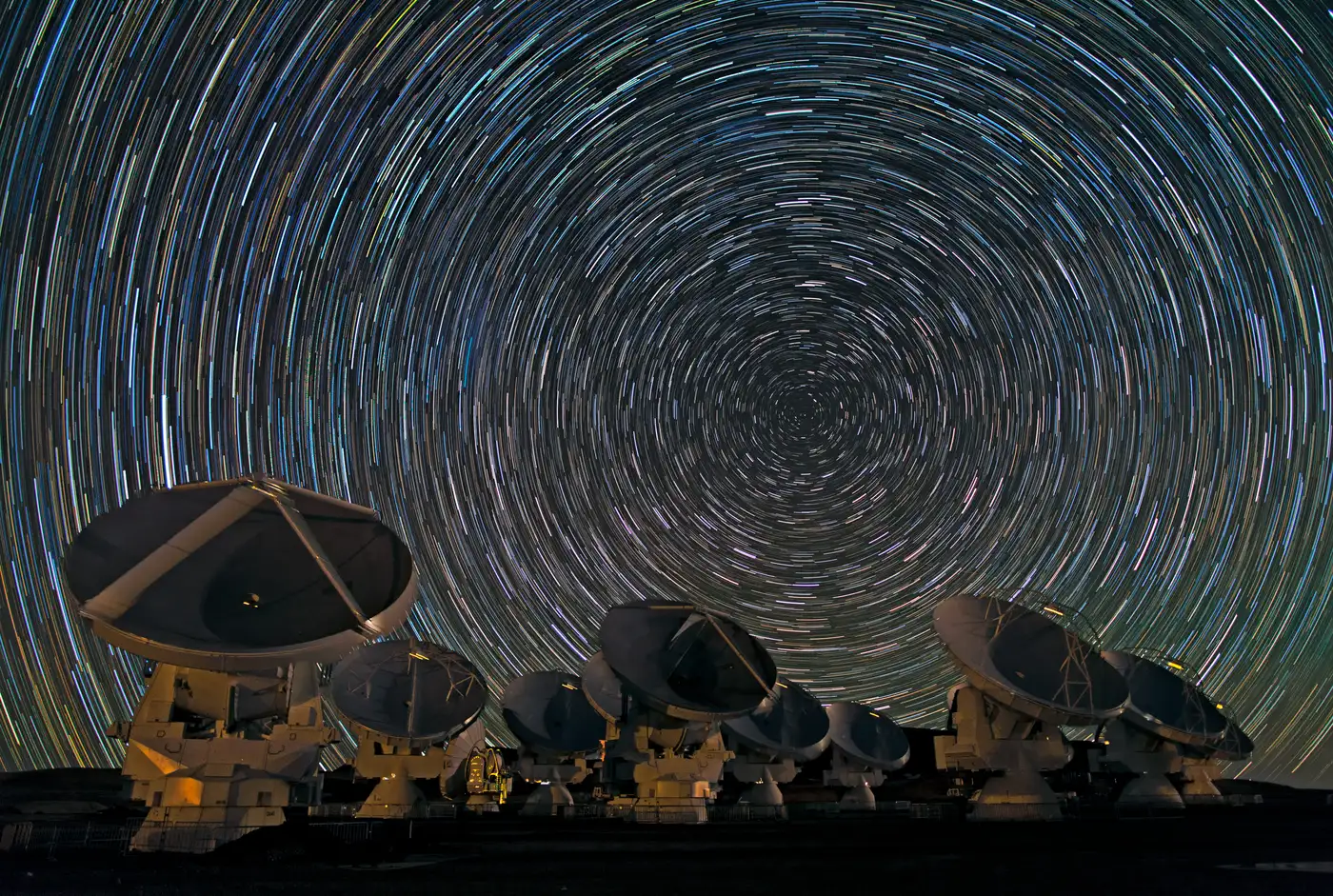
A long-exposure star-trail image over the ALMA antennas: every star drawn out into a concentric arc around the celestial pole.

The spin of the sky — and the wobble

Earth’s axis wobbles on a ~26,000-year cycle. Polaris is temporary; Vega takes over in ~12,000 years. The pyramids aligned with an earlier pole star, Thuban.

ESO/B. Tafreshi (twanight.org) · CC BY 4.0

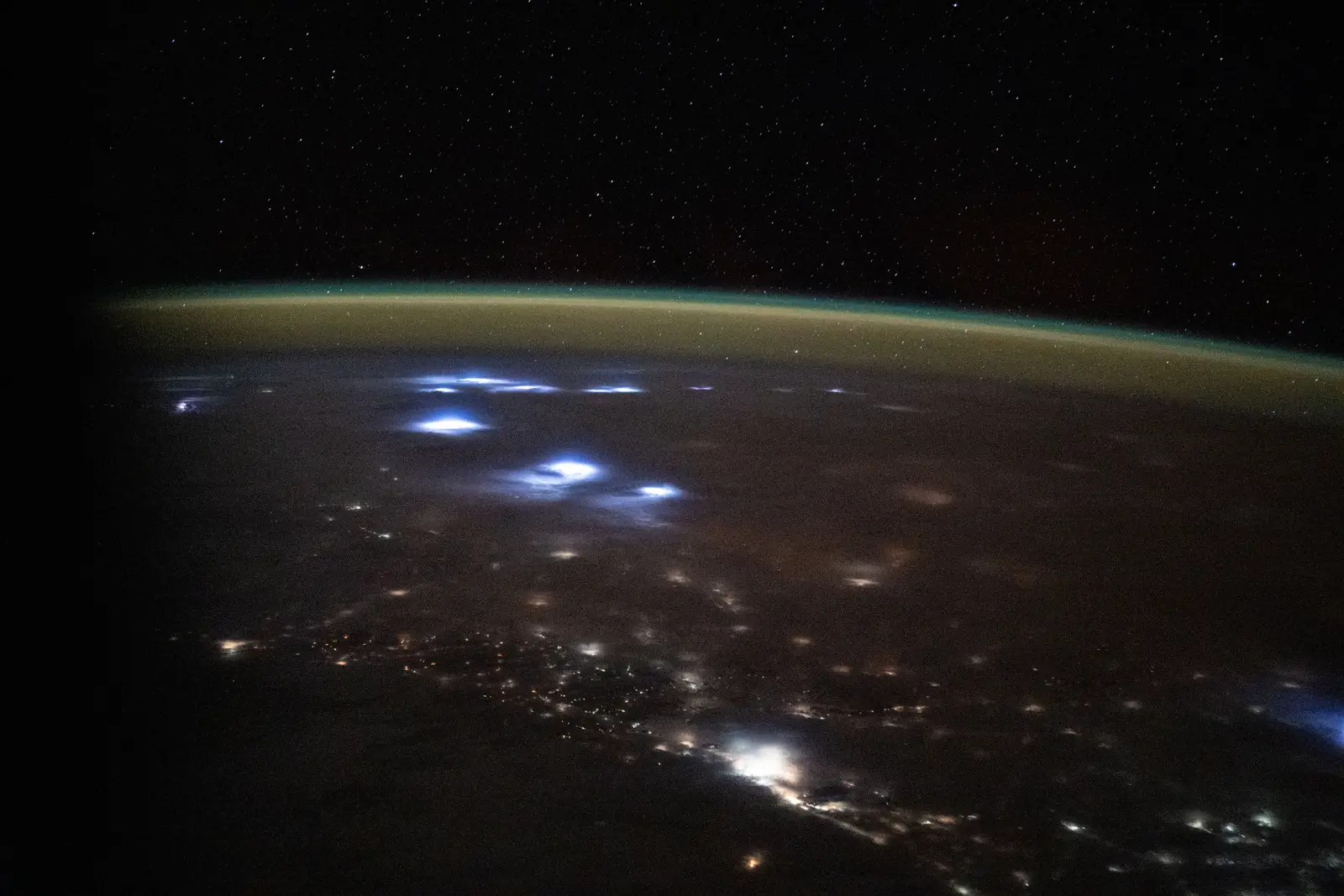
Night-side Earth photographed from the International Space Station: the scattered orange city lights of western Africa, blue flares of lightning inside cloud tops, a green-gold band of airglow along the limb, and stars in the black above it.

The radio bubble — who has heard us

Our broadcasts spread at light speed, growing one light-year a year. The 1969 Moon-landing signal is a sphere a little under 60 light-years across — still in that shell.

NASA

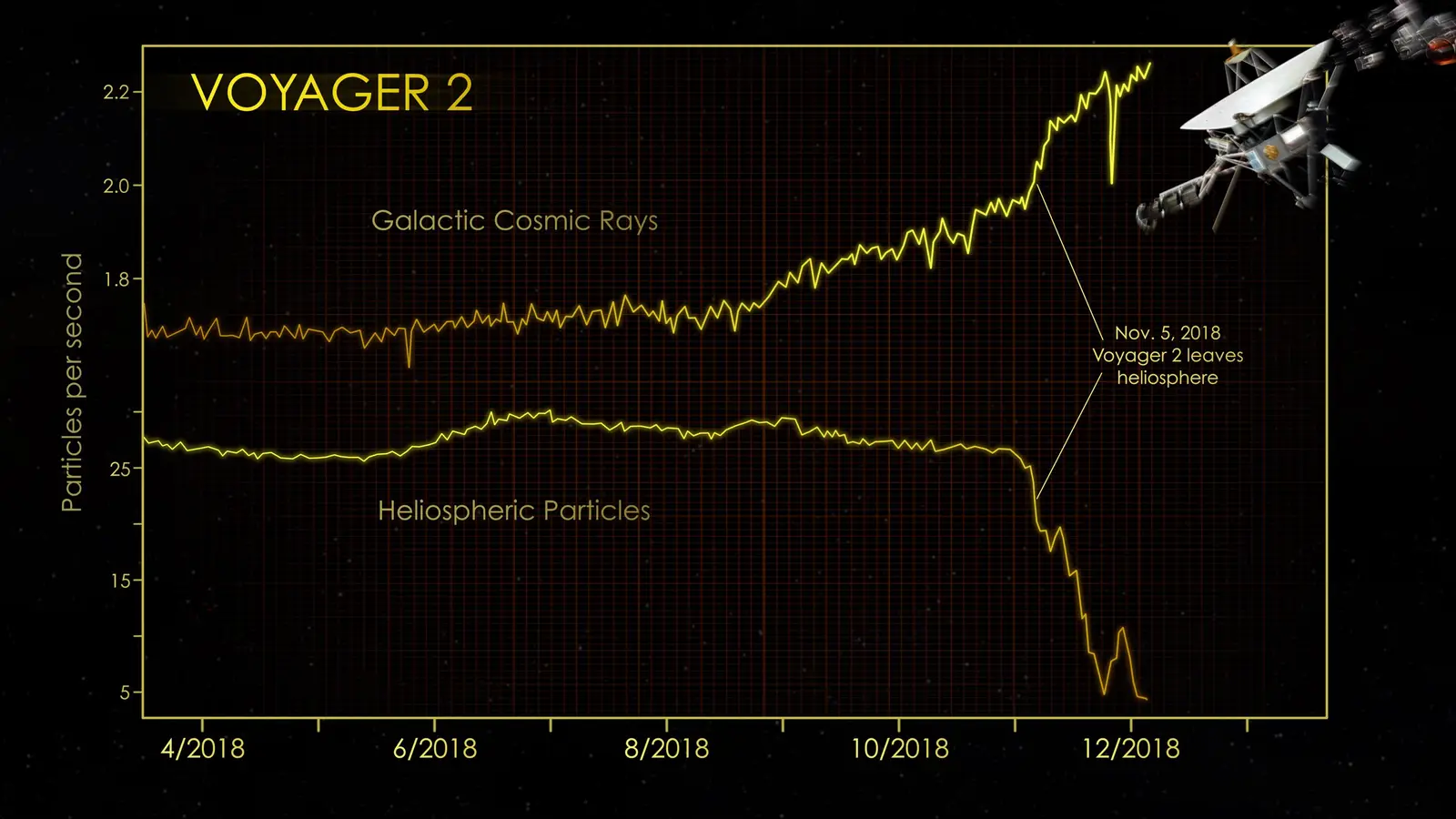
A diagram of the heliosphere — the bubble the Sun blows around itself — with the Voyager spacecraft trajectories crossing its outer boundary into interstellar space.
Data visualisation

The five escape routes

Five spacecraft are leaving the solar system forever: Voyager 1 and 2, Pioneer 10 and 11, and New Horizons. Five directions. No return.

NASA/JPL-Caltech/GSFC

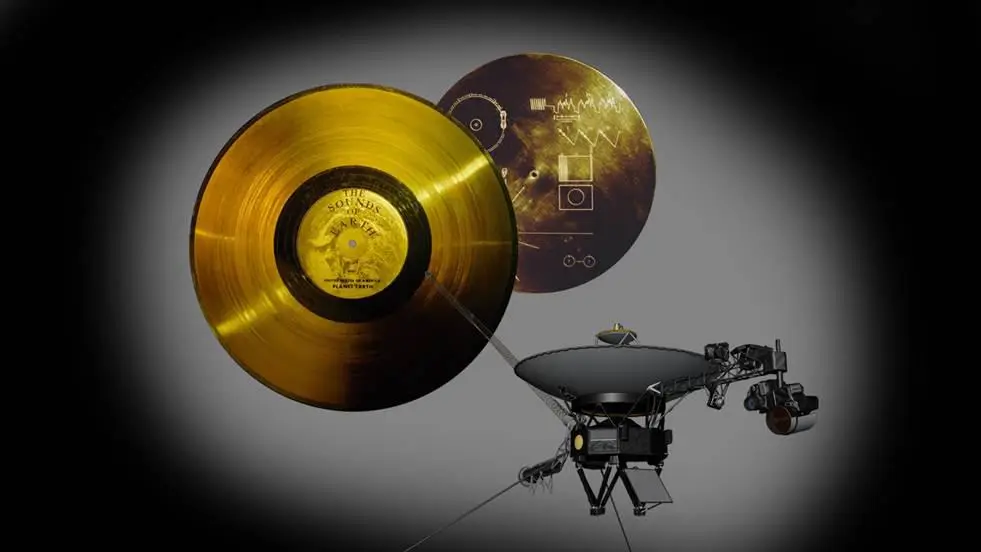
The Voyager Golden Record: a gold-plated phonograph disc in its engraved aluminium cover, marked with the diagrams that explain how to play it.

The Golden Record's destination

Voyager 1 carries a playable gold record: greetings in 55 languages, music, a heartbeat, and player instructions. Its first stellar flyby is Gliese 445, in ~40,000 years.

NASA/JPL-Caltech

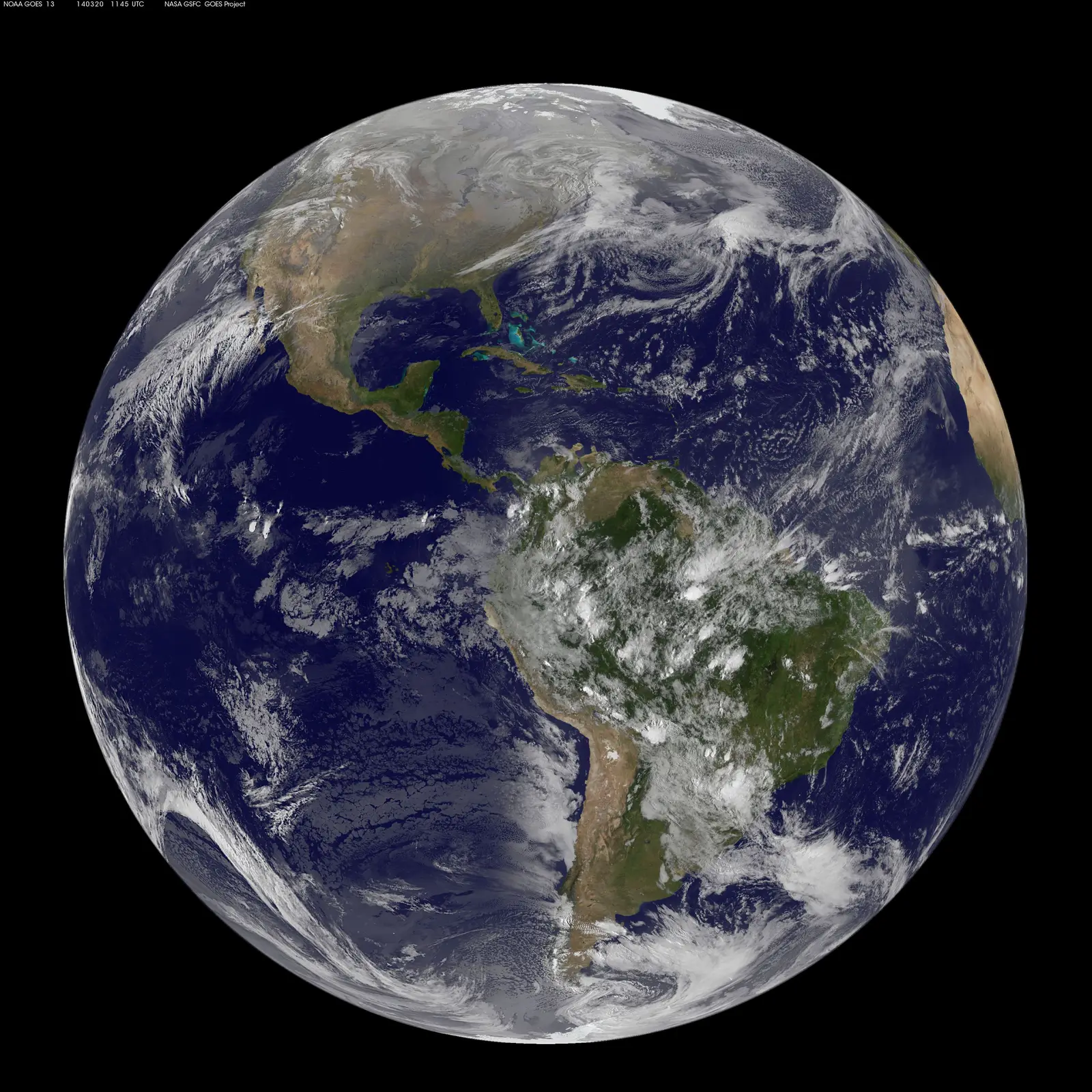
A full-disc view of Earth from geostationary orbit: the whole Americas hemisphere in one frame, cloud systems sharp against blue ocean.

The Clarke Belt — the ring that never moves

Geostationary orbit is 35,786 km up, where one orbit takes one day, so satellites stay over one spot. Hundreds sit along this arc. Clarke published the idea in 1945.

NOAA/NASA GOES Project

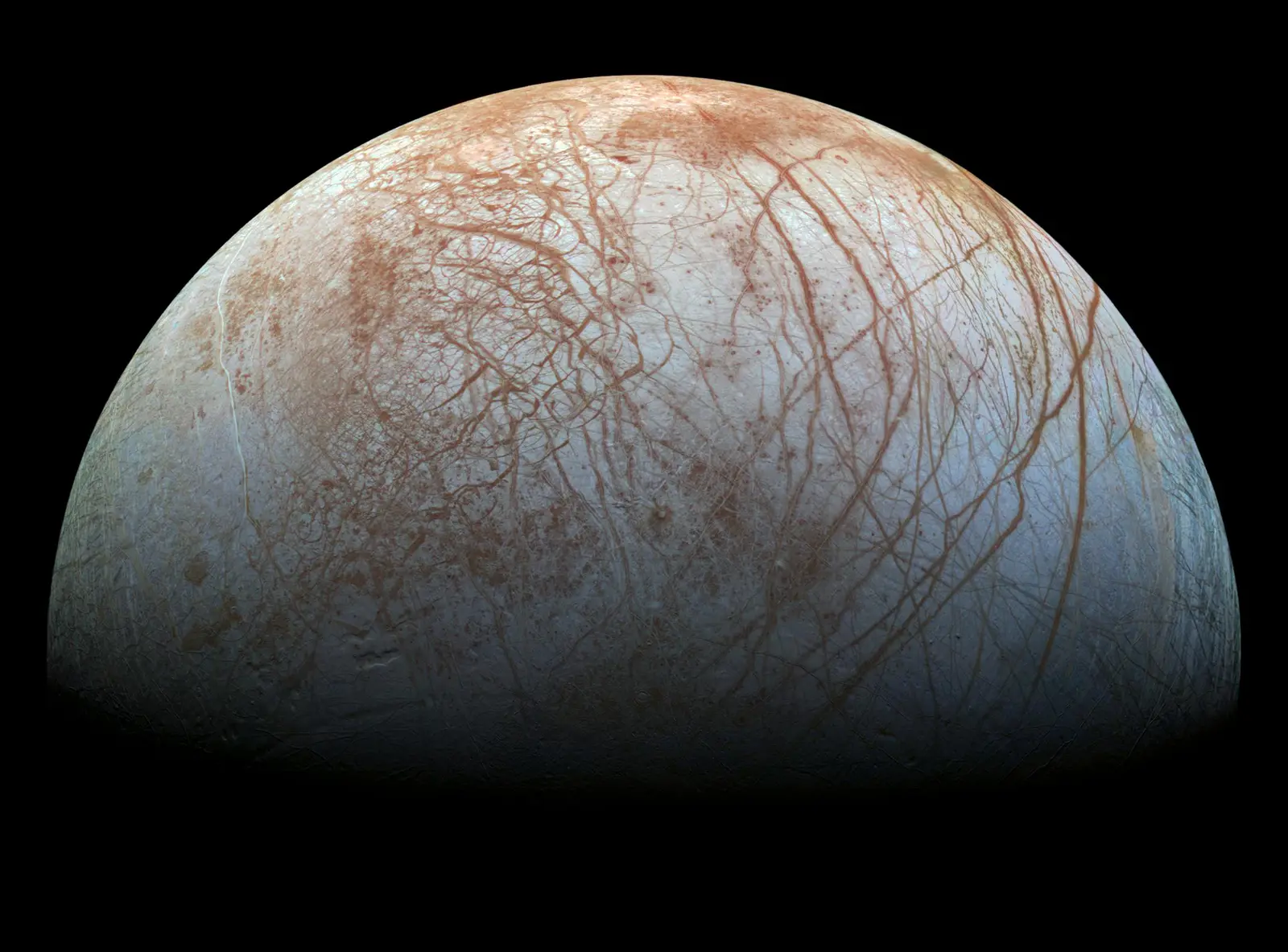
Jupiter's moon Europa filling the frame against black space: a pale blue-white ice world crazed all over with long rust-coloured cracks.

Jupiter's four big moons

Binoculars show up to 4 dots beside Jupiter: moons that rearrange from night to night. Galileo used them against geocentrism in 1610. Europa holds more water than Earth’s oceans.

NASA/JPL-Caltech/SETI Institute

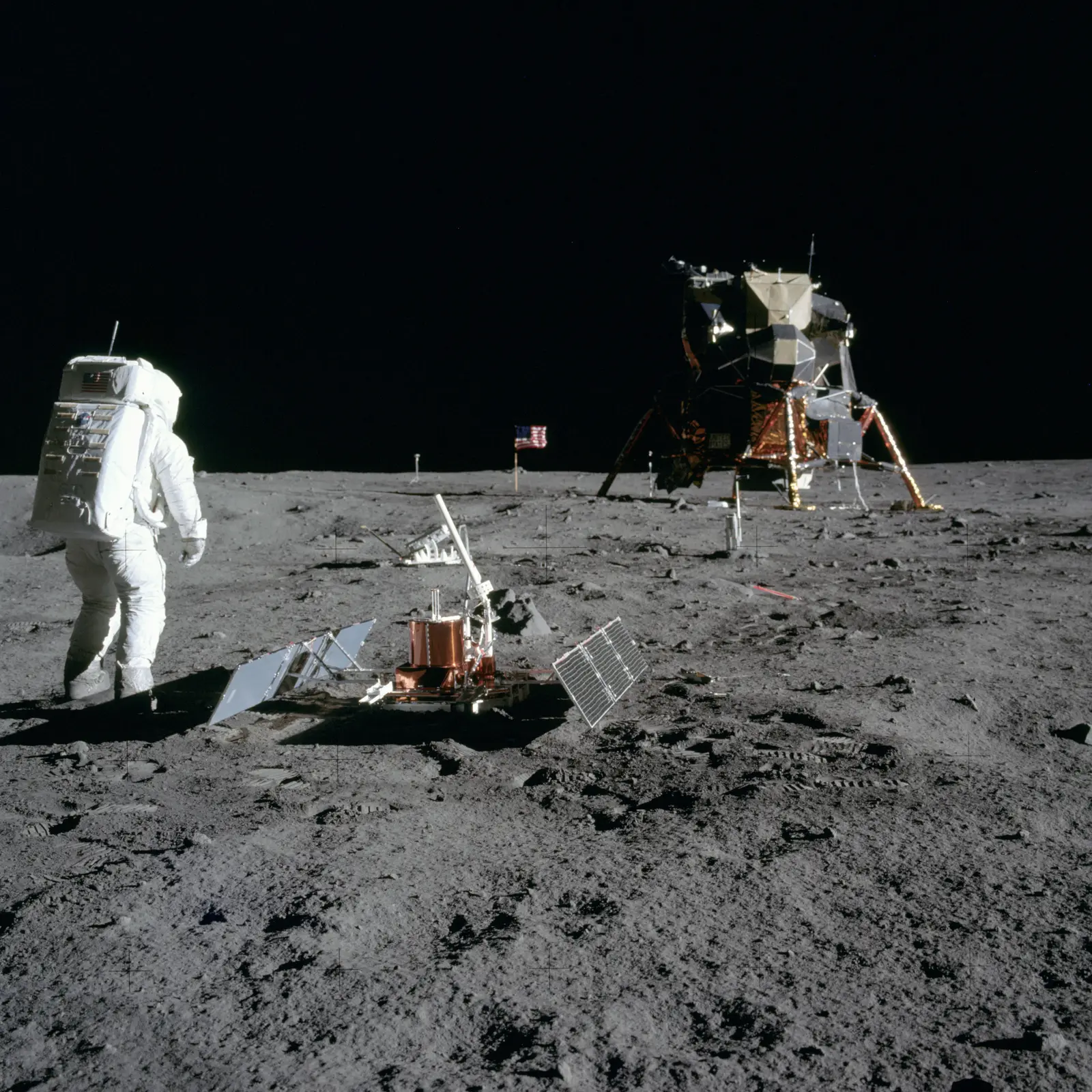
Buzz Aldrin standing on the lunar surface beside the just-deployed Early Apollo Scientific Experiments Package, which includes the laser ranging retroreflector still in use today.

Tranquility Base and the mirrors on the Moon

Apollo 11 landed here. Its footprints remain because the Moon has no weather. Laser reflectors still measure the Moon moving away at 3.8 cm each year.

NASA

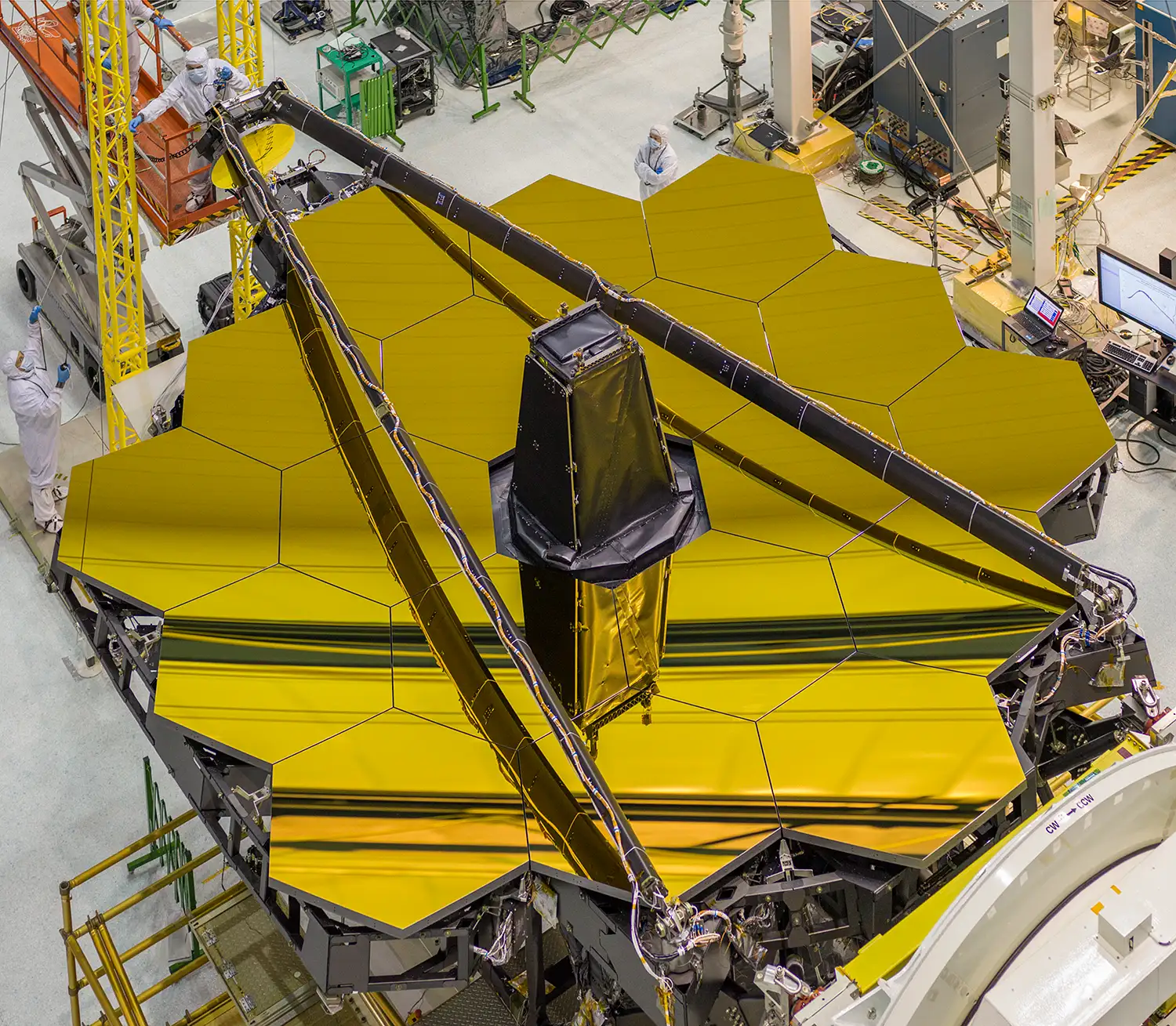
Overhead view of the James Webb Space Telescope in the Goddard clean room: eighteen gold-coated hexagonal mirror segments assembled into one honeycomb, with the black secondary-mirror booms folded across them.

L2 — the telescope hiding in permanent shade

The largest space telescope sits 1.5 million km out, opposite the Sun. Its 18 gold mirrors sit behind a tennis-court sunshield at −230°C. At midnight, it is in the darkest sky.

NASA/Goddard/Chris Gunn

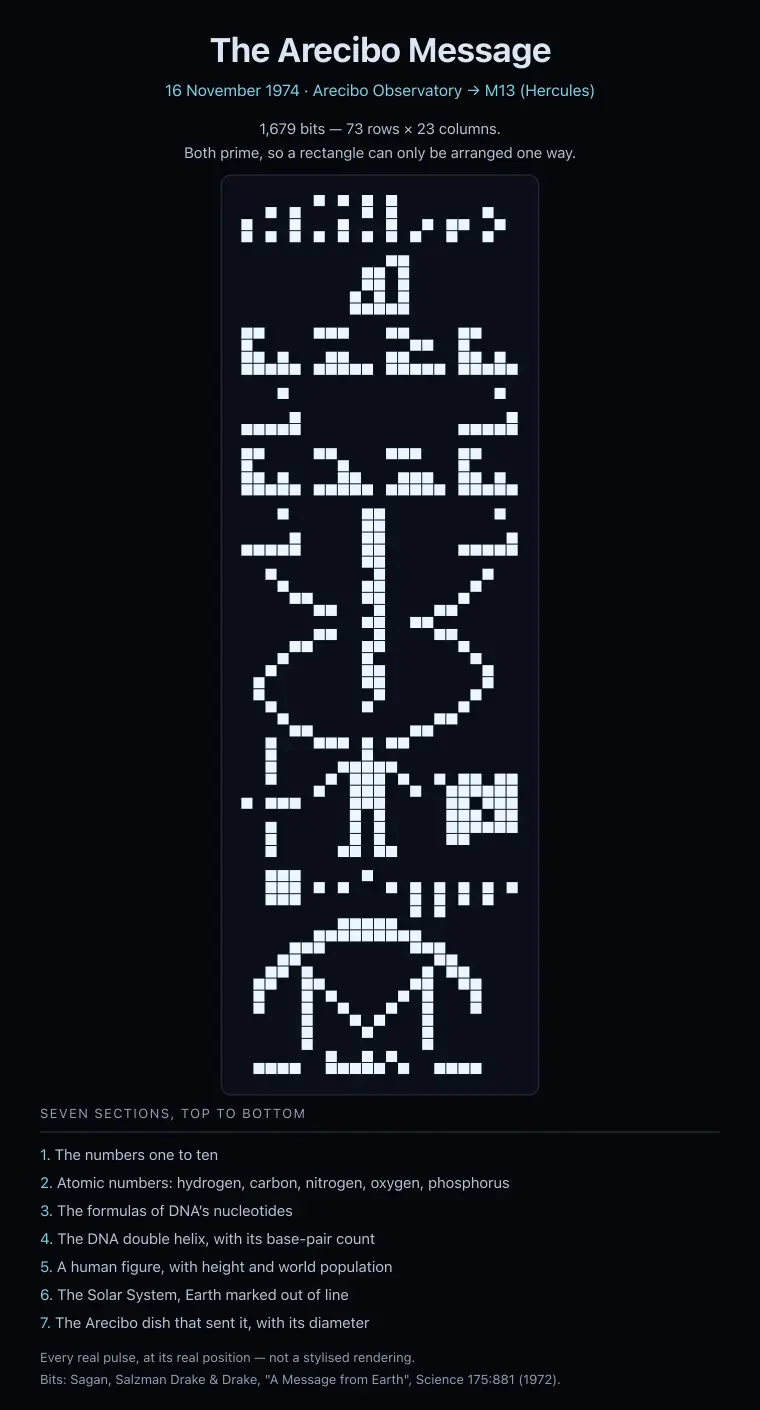
The 1974 Arecibo message rendered as its actual 73×23 binary pixel grid: the numbers one to ten, the chemistry of DNA, the double helix, a human figure, the Solar System with Earth marked out of line, and the telescope that sent it.
Data visualisation

M13 — where we mailed a letter to the aliens

In 1974, Arecibo sent 1,679 bits to this cluster: numbers, DNA, a human figure, and our address. It arrives around the year 27,000.

SkyLumi · Arecibo Observatory, 1974 · public-domain

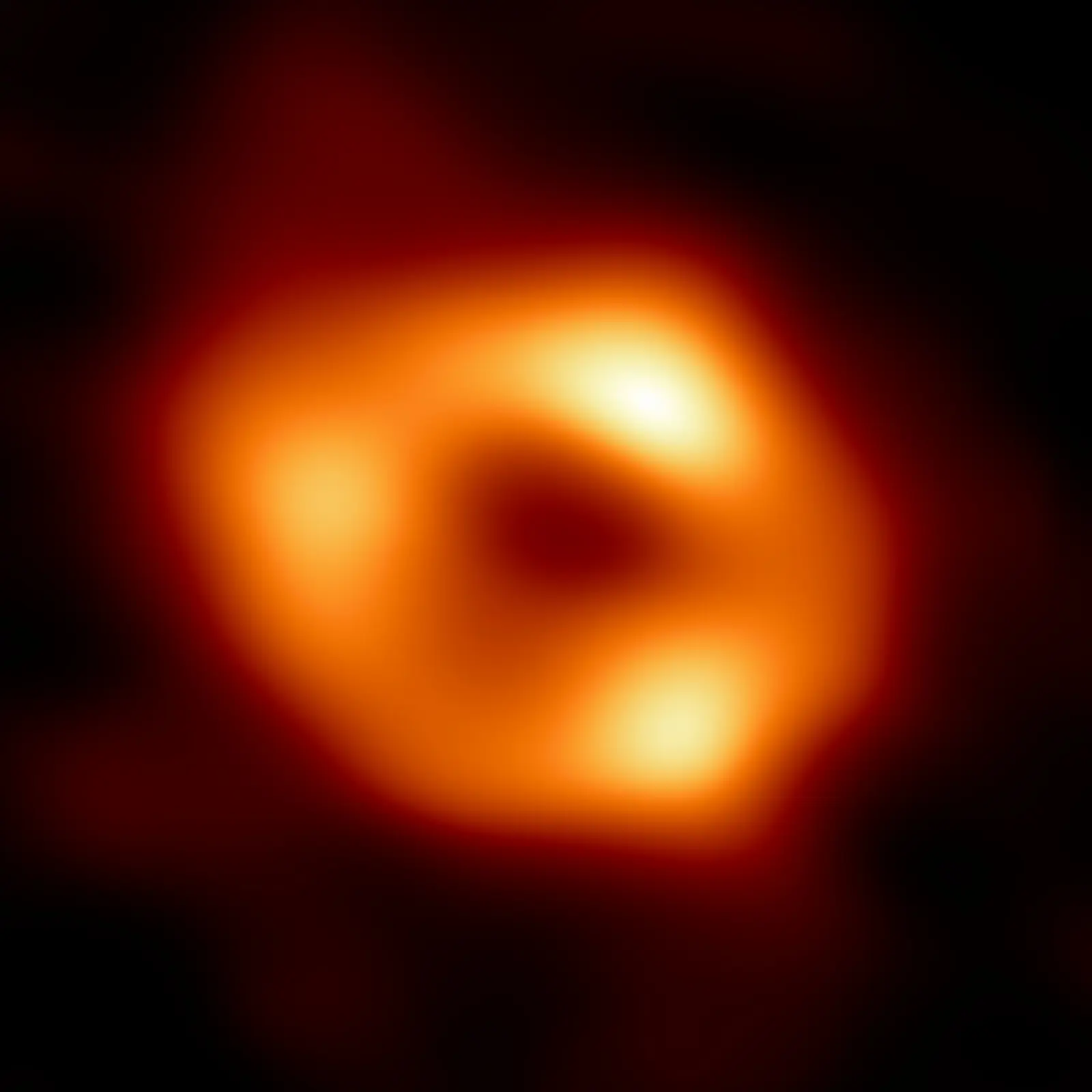
The first image of Sagittarius A*, the Milky Way’s central black hole: a bright uneven orange ring around a dark central shadow.

Sagittarius A* — our own black hole

The Milky Way’s central black hole: 4 million Suns, 26,000 light-years away, just off the Teapot’s spout. It was photographed in 2022.

EHT Collaboration · CC BY 4.0

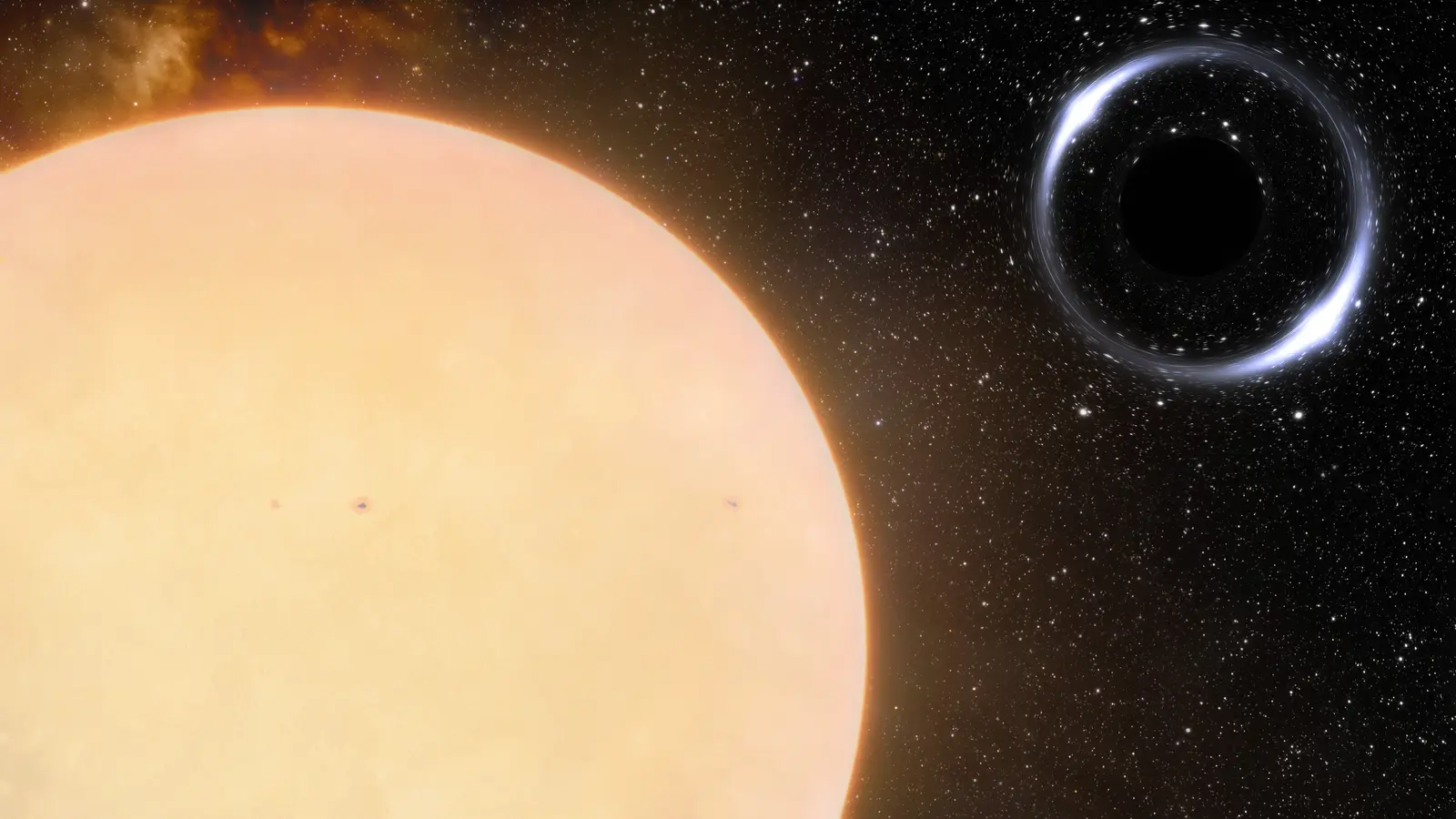
An artist’s impression of the nearest known black hole and its Sun-like companion star, the star’s light drawn into a warped ring around the invisible mass.
Artist's impression

Gaia BH1 — the black hole next door

The nearest known black hole is ~1,560 light-years away. A Sun-like star wobbles around its invisible 10-solar-mass companion. Our galaxy may hold ~100 million more.

International Gemini Observatory/NOIRLab/NSF/AURA · CC BY 4.0

A wide view towards the Great Attractor region in Norma, a crowded star field partly obscured by the dust of our own galaxy’s plane.

The Great Attractor

Everything nearby — the Milky Way, Andromeda, the whole neighborhood — streams toward one region at ~600 km/s. It hides behind our galaxy’s dust. Expansion means we never arrive.

ESO · CC BY 4.0

The open star cluster Messier 47: a loose scattering of bright blue-white stars against a darker field — a cluster of siblings born from one cloud.

HD 162826 — the Sun's long-lost sibling

A leading solar-sibling candidate: it shares the Sun’s chemical fingerprint and likely formed in the same cluster 4.5 billion years ago. It is visible in binoculars.

ESO · CC BY 4.0

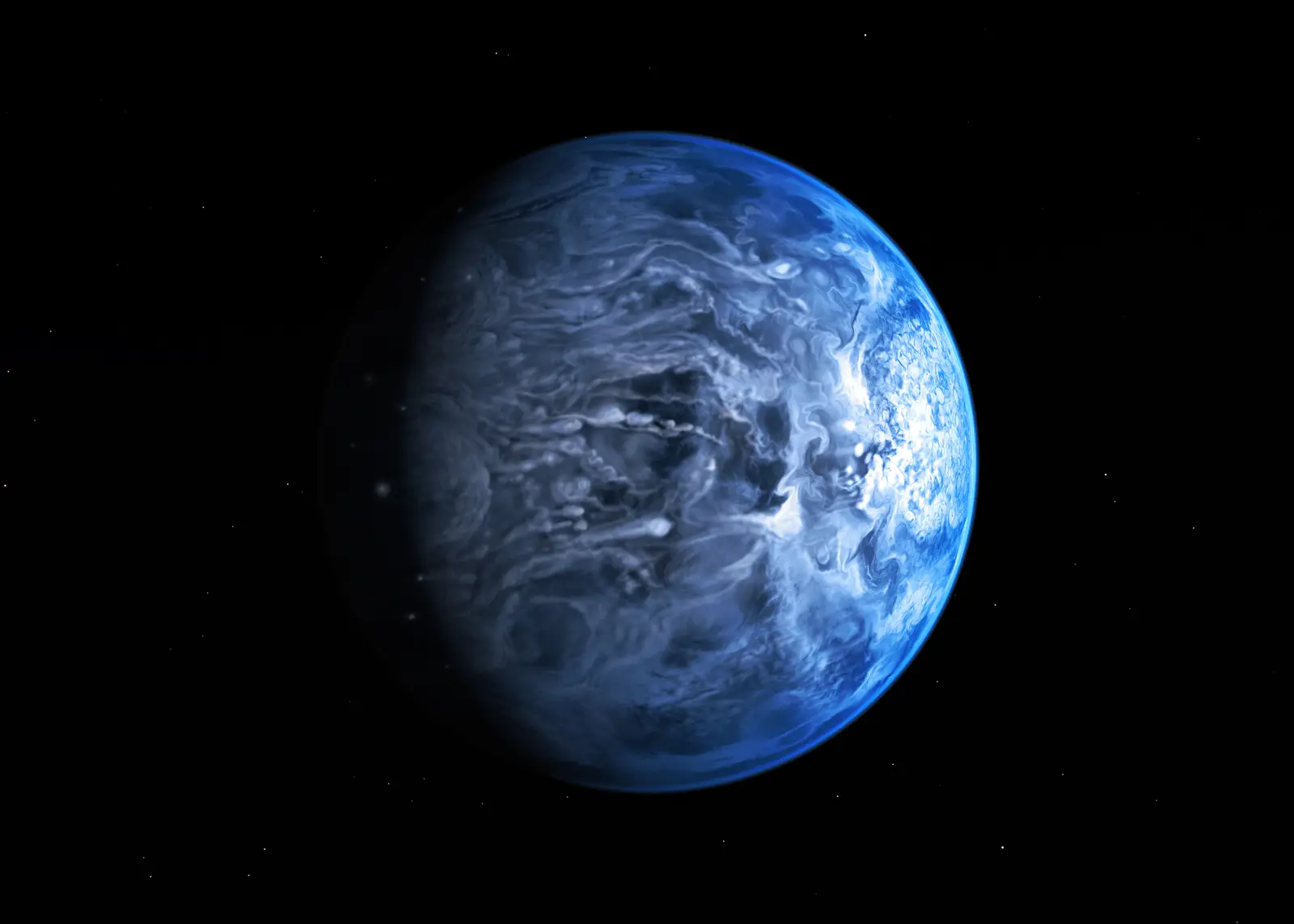
An artist’s impression of the deep cobalt-blue gas giant HD 189733b close to its orange star, its atmosphere streaked by ferocious winds.
Artist's impression

HD 189733b — where it rains glass, sideways

A deep-blue gas giant, colored by silicate (glass) clouds: ~930°C, winds ~8,700 km/h. Its color came from the light lost when it slipped behind its star.

NASA/ESA Hubble · CC BY 4.0

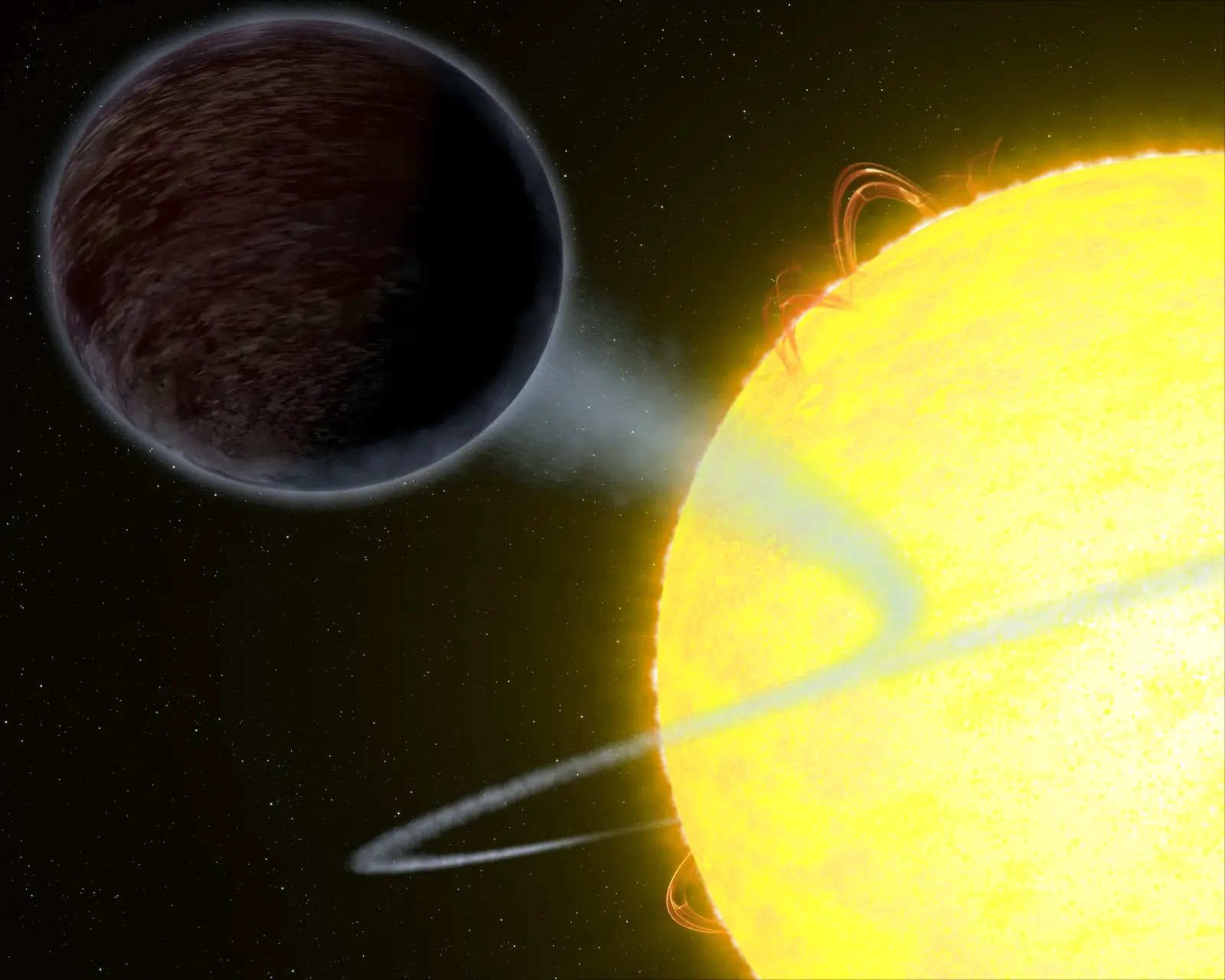
An artist’s impression of WASP-12b: a near-black, egg-shaped planet stretched by its star’s gravity, trailing a stream of stripped material.
Artist's impression

WASP-12b — the planet being eaten alive

A planet on a ~1-day orbit, stretched egg-shaped by its star and losing ~6 billion tonnes each second. Darker than asphalt. It has ~10 million years left.

NASA/ESA Hubble · CC BY 4.0

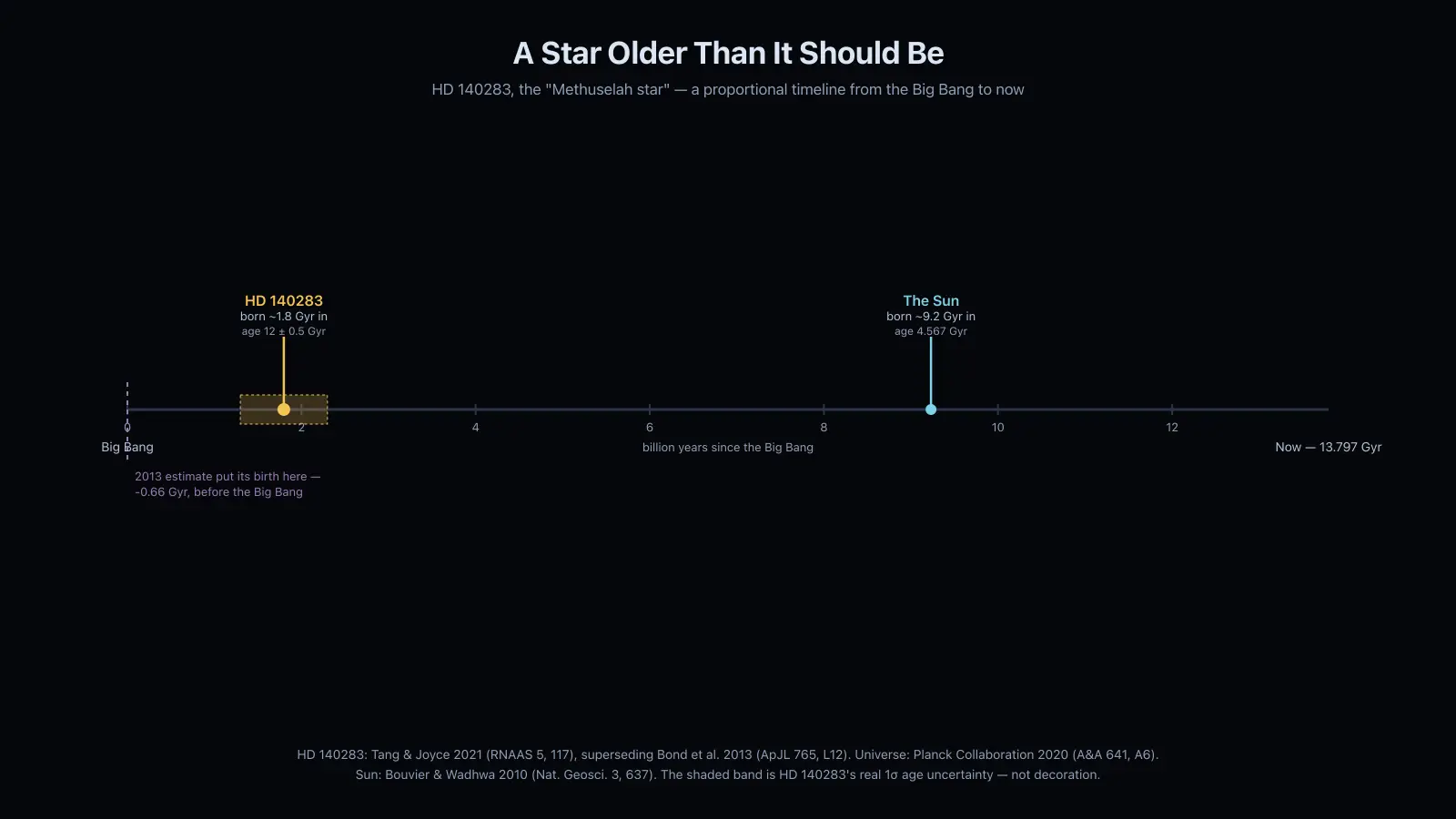
A proportional timeline from the Big Bang to now: HD 140283, the "Methuselah star," born just after the Big Bang with its real measurement-uncertainty band shown, and the Sun born about two-thirds of the way along. A dashed marker at the origin shows where the 2013 measurement put the star’s birth — before the Big Bang.
Data visualisation

HD 140283 — the Methuselah Star

Its estimated age approaches the universe’s 13.8 billion years. It is nearly pure hydrogen and helium, formed before most heavier elements existed.

SkyLumi · published stellar ages · public-domain

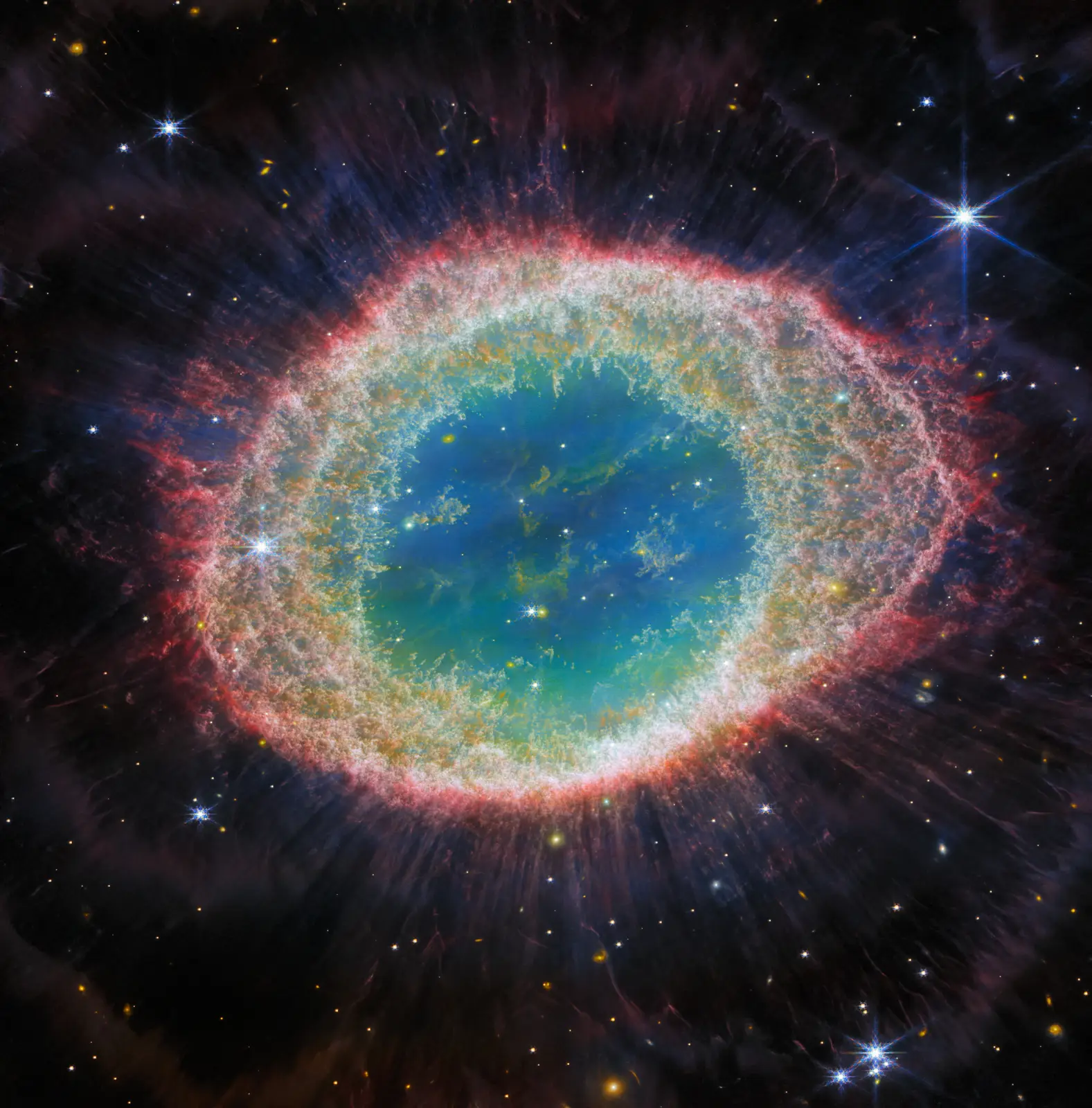
Webb’s NIRCam view of the Ring Nebula: a bright oval of intricately structured gas with a fringe of fine spikes, and the dying white dwarf at its centre.

The Ring Nebula — the Sun's future, on display

A dying Sun-like star’s outer layers: the Sun’s fate in ~5 billion years. Webb shows ~20,000 gas clumps and ~10 outer arcs, spaced ~280 years apart.

ESA/Webb, NASA, CSA · CC BY 4.0

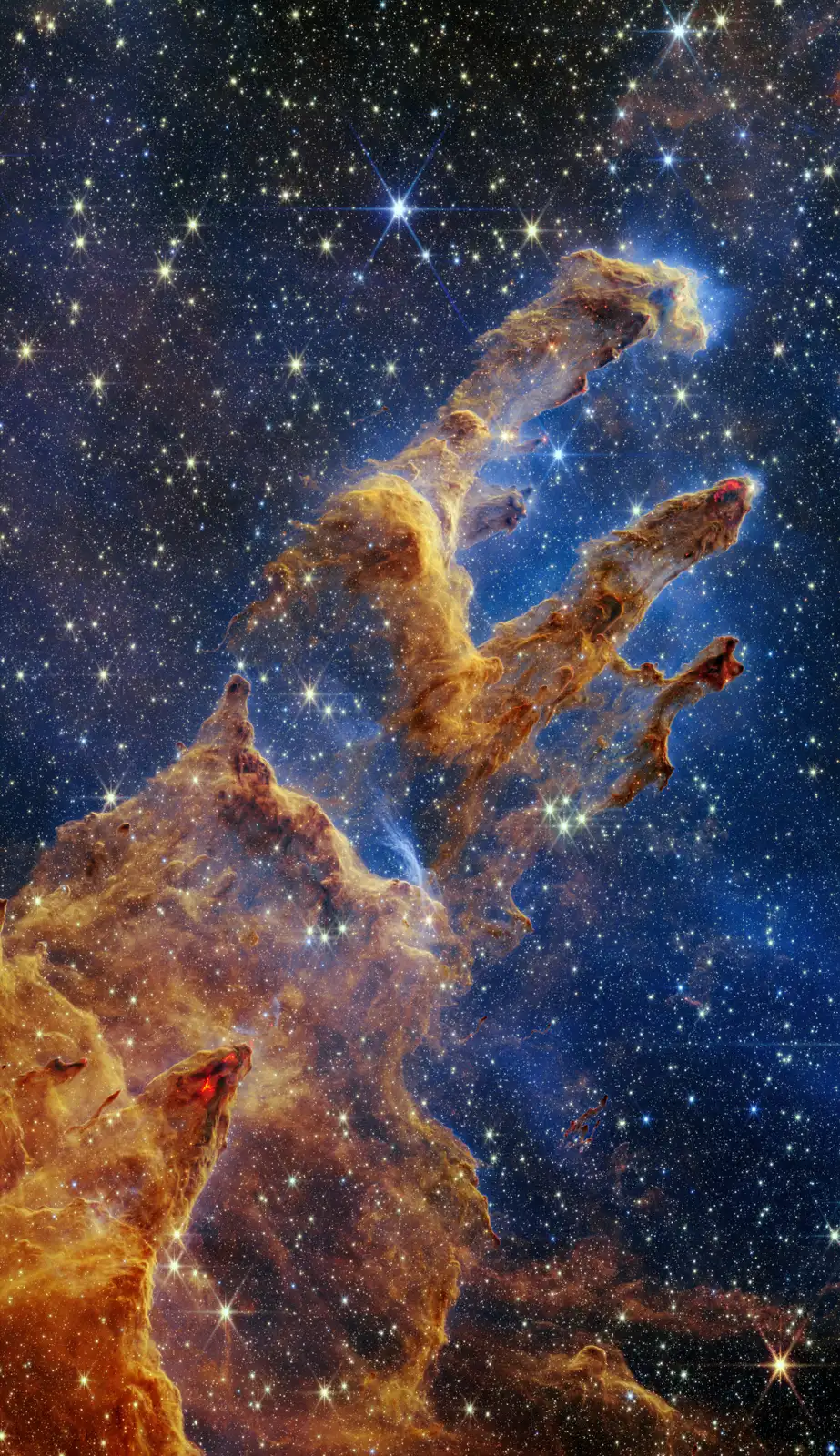
Webb’s full view of the Pillars of Creation: towering rust-and-gold columns of dust rising against a haze of newborn stars.

The Pillars of Creation

Star-forming dust columns in the Eagle Nebula (M16), ~6,500 light-years away, each several light-years tall. Hubble’s 1995 image shows dust; Webb’s infrared reveals newborn stars inside.

NASA/ESA/CSA Webb · CC BY 4.0

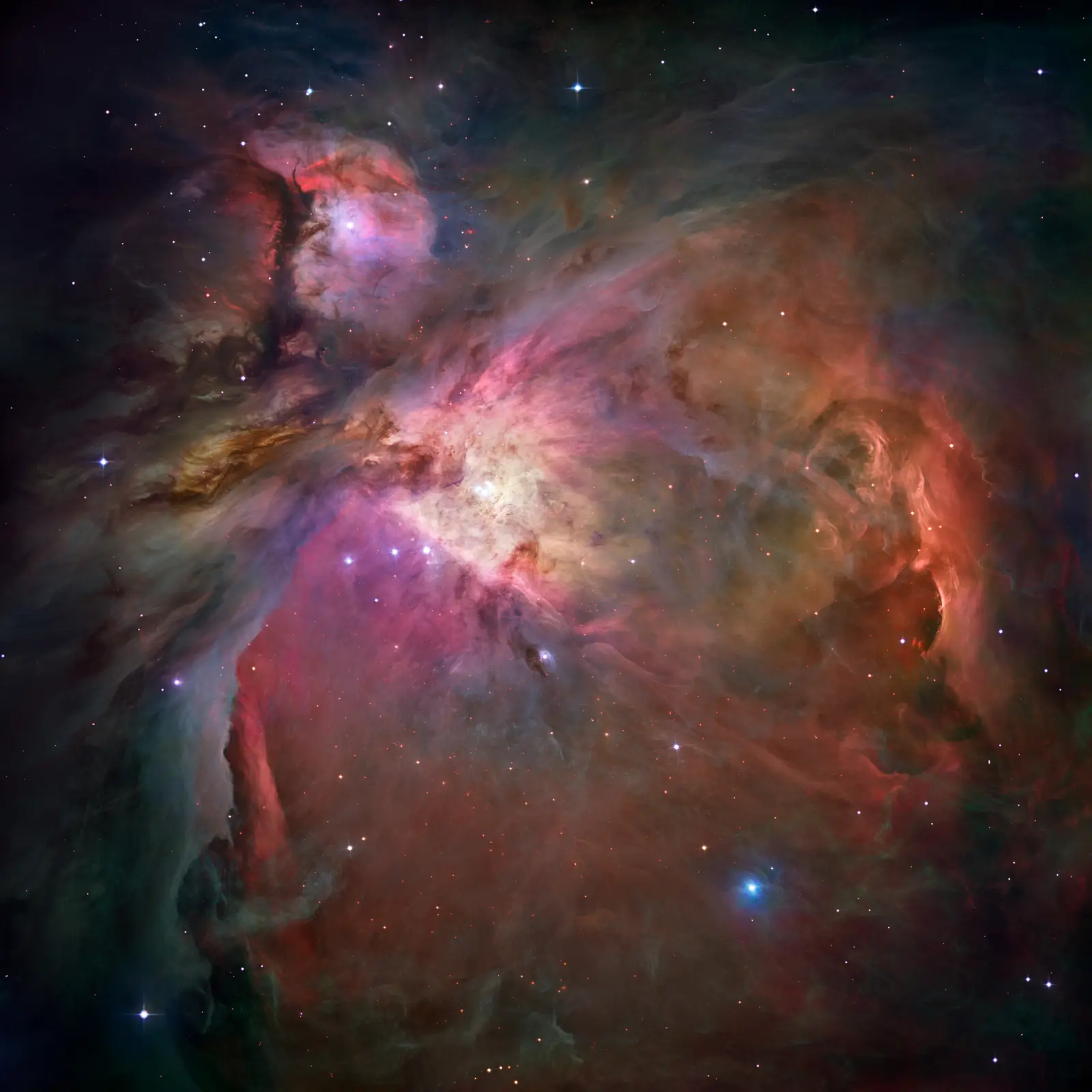
The Orion Nebula: a vast pink and gold cavern of glowing gas carved open by the four bright Trapezium stars at its heart.

The Orion Nebula — the star factory next door

The middle “star” in Orion’s sword is a 24-light-year-wide nebula: the nearest massive star factory, with 1,000+ stars forming now. Webb found hundreds of free-floating planet-mass objects there.

NASA/ESA Hubble · CC BY 4.0

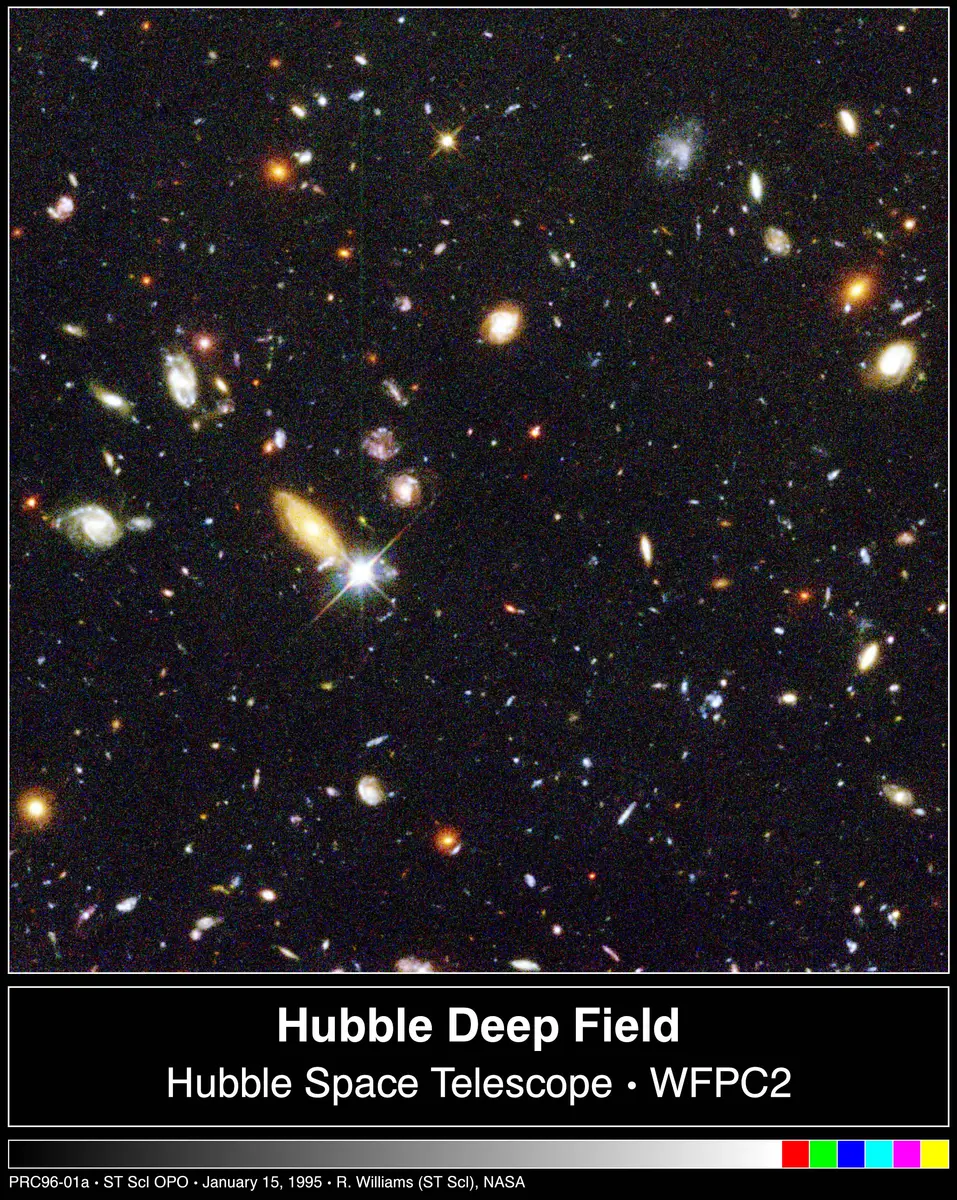
The original 1995 Hubble Deep Field: a small patch of apparently empty sky revealed to hold thousands of galaxies of every shape, size and colour.

The Hubble Deep Field — the empty patch that wasn't

In 1995, Hubble stared for 10 days at an “empty” patch the size of a sand grain at arm’s length. It found ~3,000 galaxies. The patch is one thirty-millionth of the sky.

NASA/ESA Hubble · CC BY 4.0

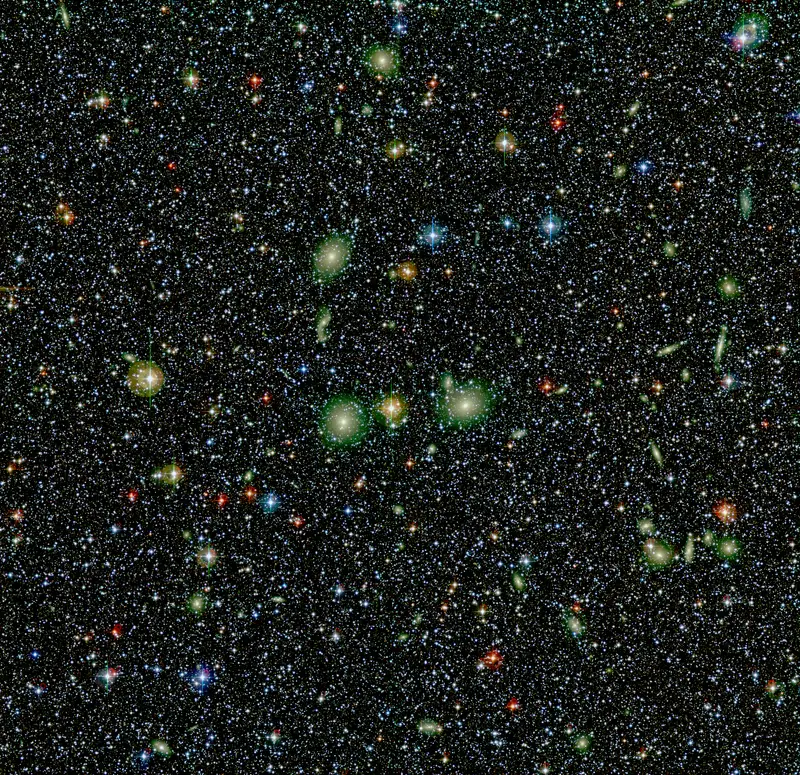
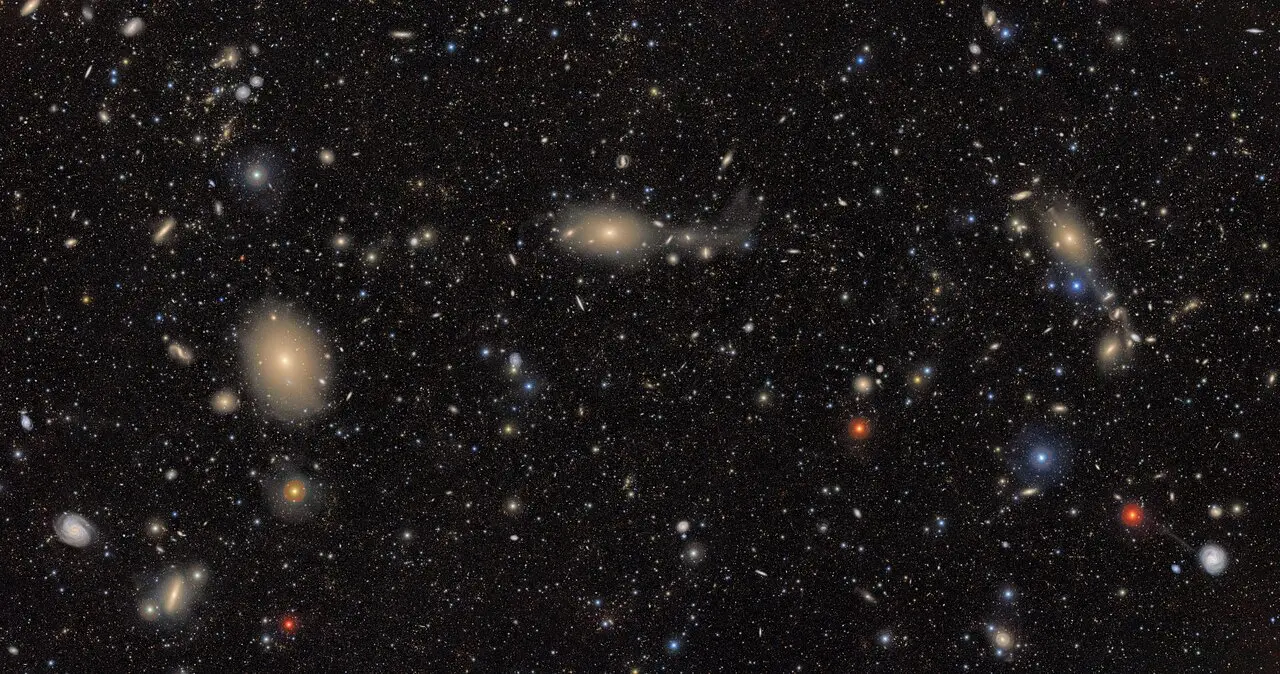
Rubin Observatory’s Cosmic Treasure Chest: the southern Virgo Cluster, a field packed with galaxies of every colour and shape, assembled from 1,185 exposures taken over seven nights in June 2025.

Rubin's first look

In June 2025 the Vera C. Rubin Observatory released its first images. One patch covers the southern Virgo Cluster: millions of galaxies, 55 million light-years away, assembled from 1,185 exposures in seven nights. The tiles you see are that image, laid on this map.

NSF–DOE Vera C. Rubin Observatory/NOIRLab/SLAC/AURA · CC BY 4.0