Andromeda Galaxy (M31).
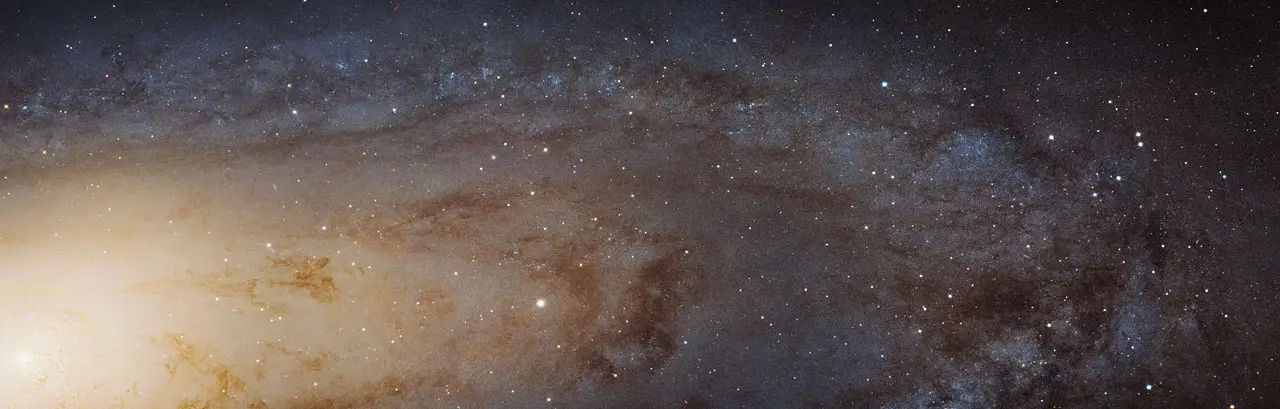
1 trillion stars, 2.5 million light-years away — the farthest naked-eye object. It spans 6 full Moons at its widest; your eye catches only its core. It approaches at 110 km/s.
NASA/ESA Hubble · CC BY 4.0
How to see it tonight
From a dark sky it is a faint smudge. From a city, usually not — streetlight wins.
The photographs are long exposures. Your eye will not see that spiral. SkyLumi shows both on one map: where Andromeda sits tonight, then the observatory image when you pinch in.
No telescope is required to find it on the map. Seeing the smudge takes a dark site, not a gadget.
What SkyLumi does
Find it with search, or Aim the phone at that patch of sky. Pinch into photographic survey imagery from Pan-STARRS, SkyMapper and DSS2 — the same map, closer.
Night Vision is a deep red display that keeps your eyes dark-adapted. No account, no ads.
The core sky works offline. High-resolution survey imagery streams as you zoom, and needs a connection.
A few things to know.
Can I see Andromeda with my naked eye?
From a dark site, as a faint smudge. From a typical city, usually not. The map still knows where it is.
Why do the photos look so bright?
They are long exposures. The eye sees a grey oval, if it sees anything. SkyLumi keeps both on one map rather than pretending the photograph is the view from the pavement.
How far away is it?
About 2.5 million light-years. It spans six full Moons at its widest; your eye catches only the core.
Do I need a telescope?
Not to find it on the map, and not for the smudge from a dark site. A telescope shows more; it is not required.