Orion Nebula (M42).
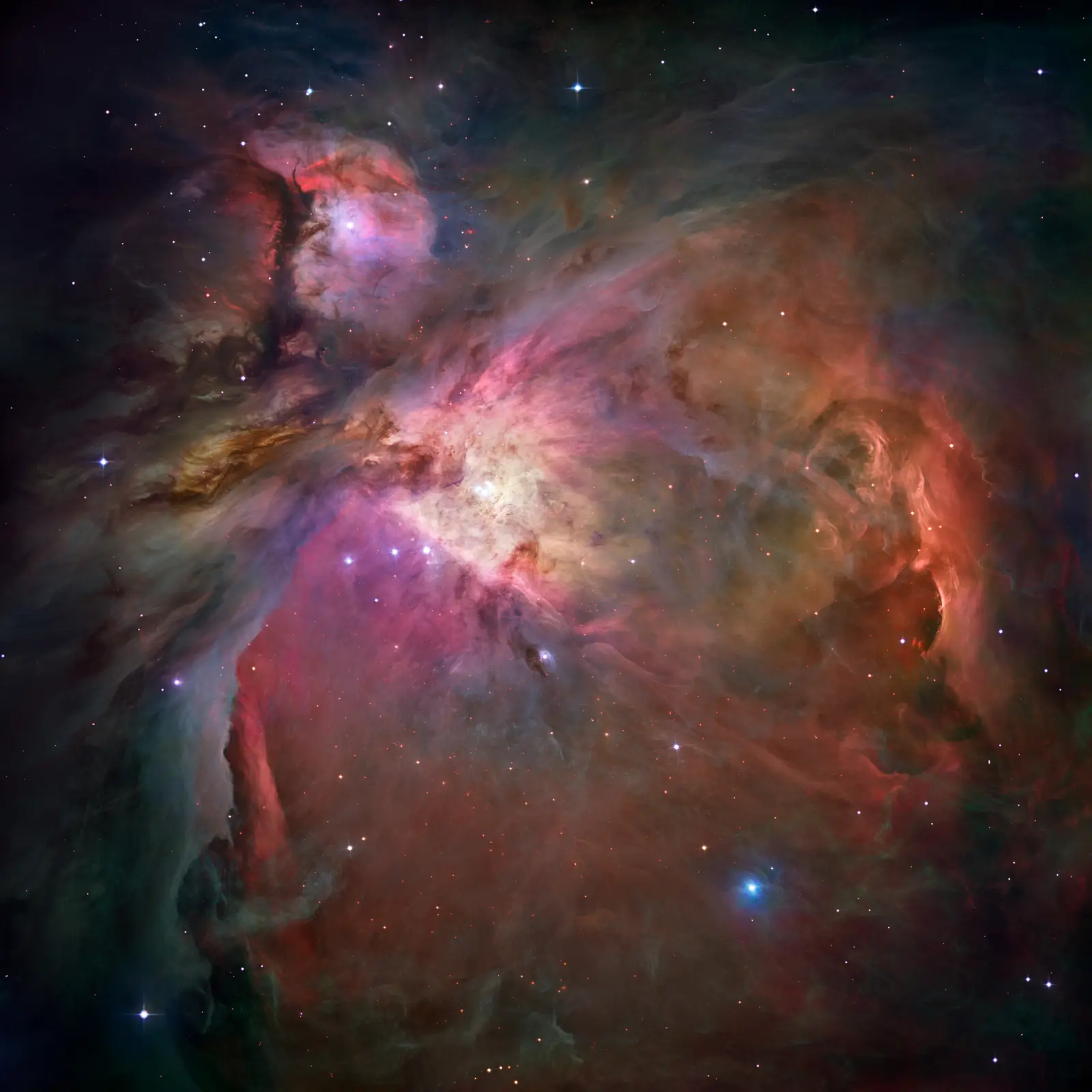
The middle “star” in Orion’s sword is a 24-light-year-wide nebula: the nearest massive star factory, with 1,000+ stars forming now. Webb found hundreds of free-floating planet-mass objects there.
NASA/ESA Hubble · CC BY 4.0
How to see it tonight
Find Orion’s belt, then the short line of the sword beneath it. The middle “star” is not a star: it is the Orion Nebula (M42).
Winter evenings in the north. No telescope is required for the smudge, or for the map.
Pinch in and the map becomes observatory photography of the same place — not a drawing of it.
What SkyLumi does
Find it with search, or Aim the phone at Orion’s sword. Pinch into photographic survey imagery from Pan-STARRS, SkyMapper and DSS2.
Night Vision is a deep red display that keeps your eyes dark-adapted. No account, no ads.
The core sky works offline. High-resolution survey imagery streams as you zoom, and needs a connection.
A few things to know.
Where exactly is it?
The middle “star” in Orion’s sword. The belt is the three bright stars in a row; the sword hangs south of them (from the northern hemisphere).
When can I see it?
Winter evenings in the north. SkyLumi will still place it on the map in other seasons; whether it is above your horizon is a location question, not a page one.
Do I need a telescope?
No. The smudge is a naked-eye object from a reasonably dark site, and the map does not require one.
What am I looking at if I zoom in?
Real observatory survey photography — Pan-STARRS, SkyMapper, DSS2 — credited in the app. Not an illustration, and not a meteor streak. SkyLumi does not draw meteors.