Find the planet before looking for the moons
Jupiter is often one of the brightest objects in the night sky. It usually looks cream-white and steadier than nearby stars. Its direction and viewing hours change through the year, so use the local planet checker instead of a fixed compass direction.
Choose a time when it is well above the horizon. Low-altitude views pass through more atmosphere and are more likely to shimmer. A tree, a neighboring roof or haze can be a bigger obstacle than the size of your binoculars.
What can binoculars show?
Ordinary binoculars can reveal some of the four large Galilean moons: Io, Europa, Ganymede and Callisto. Rest your elbows on something solid or use a tripod. Hand shake can hide points that are otherwise bright enough to see.
Do not expect four neat dots every time. A moon may be in front of Jupiter, behind it, in its shadow or lost in the planet’s glare. One moon can also appear close to another. A small telescope makes the experiment easier and shows Jupiter as a disk rather than a dazzling point.
Draw the arrangement you see, with Jupiter as a circle and the moons as dots. Repeat the sketch on the next clear night. You do not need to know every moon’s name to notice that something systematic is happening.
The little system that changed a big argument
Galileo recorded these moons in 1610. Their changing positions showed that they orbited Jupiter: here were bodies that did not circle Earth. Simon Marius observed the system around the same time; Galileo published first.
The moons are worlds in their own right. Io is intensely volcanic. Europa has an icy shell and strong evidence for a liquid-water ocean beneath it. Ganymede is the largest moon in the solar system, larger in diameter than Mercury. Callisto preserves a heavily cratered surface.
Jupiter has many smaller moons too. New discoveries and confirmations change the count, so the useful observing number is four: the bright ones you have a realistic chance of following with modest equipment.
What is the bright disk made of?
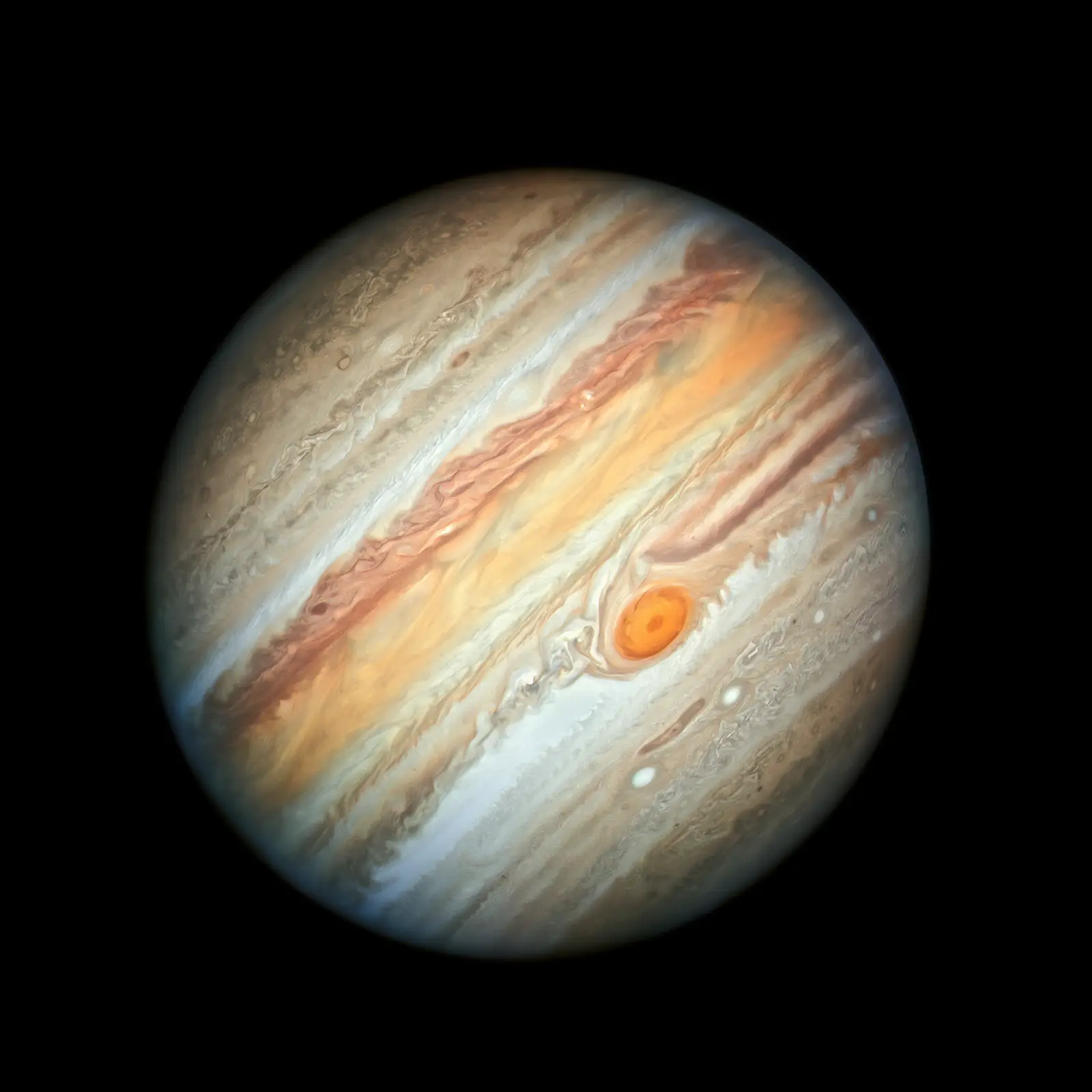
Jupiter is a gas giant composed mainly of hydrogen and helium. The visible bands belong to its atmosphere. Darker belts, paler zones and storms move through a planet that rotates in roughly ten hours.
The Great Red Spot is a huge, long-lived storm. Its size and color change. It is not guaranteed to face Earth when you look, and seeing it requires more than finding the planet: magnification, steady air and its rotation all matter.
The Hubble image above resolves much more than a small telescope will. Start with the moons and the disk. On a good night, try for the two main dark belts. Those are already real details on a world hundreds of millions of kilometres away.
Use the map for the first step
Open Jupiter’s story in SkyLumi, check your location and use Aim or manual panning to match the surrounding sky. Then lower the phone and find the planet with your eyes. For a second look, return to the story about Jupiter’s four big moons.
Bright planets make good city targets. If the faint moonlets are frustrating tonight, keep the observation small: identify Jupiter confidently, and come back when it is higher or the air is steadier.
Sources and image credits
- NASA: Jupiter facts. Composition, rotation, clouds and Great Red Spot.
- NASA: all moons of Jupiter. Galilean moons, historical attribution and changing inventory.
- NASA: binoculars as a first telescope. Practical binocular expectations.
Written for beginners from the sources above. How we research and correct the library. Found an error? Tell us.