Where should I look?
Look toward the west after sunset or toward the east before sunrise, depending on Venus’s current position in its orbit. It is not reliably visible in both places on the same date. Sometimes it is too close to the Sun’s direction for a useful view.
Because Venus orbits closer to the Sun than Earth does, it never wanders into the midnight sky opposite the Sun. The names “morning star” and “evening star” describe the same planet in different parts of its cycle.
Use the planet checker for your time and location. Find the bright point first with your eyes. Do not search near the Sun with binoculars or a telescope.
How can a planet be brighter than a star?
Distance matters. Stars make their own light, but even the nearest are enormously farther away than Venus. Venus is relatively nearby, Earth-sized, and covered in clouds that reflect a large fraction of the sunlight falling on them. Those ingredients make an unusually bright point.
Its brightness changes as the distance and the sunlit fraction we see change. The largest-looking Venus is a thin crescent, because the planet is then relatively close to Earth. A fuller Venus is farther away and looks smaller. Its brightest appearance is a balance between these effects, not simply a full disk.
Your eye sees a point; a telescope reveals a phase
With the naked eye, Venus is a white or slightly warm point. With a suitable telescope, its outline changes through phases, much like the Moon’s. The surface stays hidden beneath cloud. If you see detailed continents or glowing lava in an illustration, you are looking at a reconstruction or data from a different kind of instrument.
Galileo’s observations of Venus’s phases provided strong evidence against the traditional Earth-centered arrangement of the planets. A small changing crescent helped change the way people understood the whole solar system.
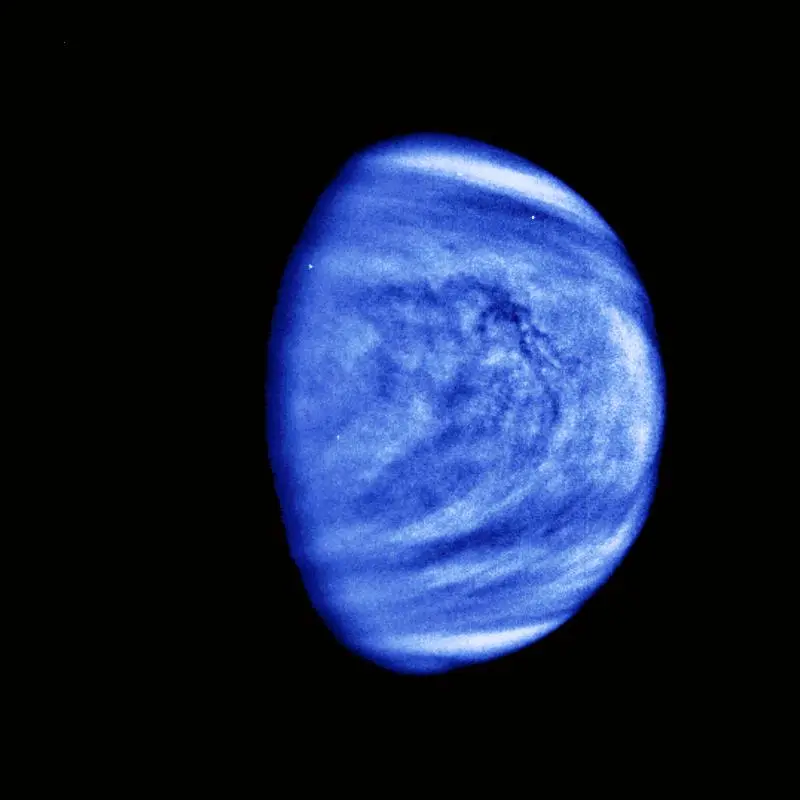
The cloud bands in this page’s image were recorded in ultraviolet. Explaining the wavelength is part of explaining the picture: different instruments reveal different pieces of the same world.
Under the bright cloud is a very different place
Venus’s thick atmosphere is mostly carbon dioxide. Its intense greenhouse effect keeps the surface at roughly 465°C, hotter than Mercury despite being farther from the Sun. Surface pressure is around 90 times Earth’s sea-level pressure. The clouds contain sulfuric-acid droplets.
It also rotates slowly and in the opposite sense to most planets. One rotation takes about 243 Earth days; one orbit takes about 225. That is why “a day is longer than a year on Venus” needs a definition: it refers to its rotation relative to the stars. The interval from one local noon to the next is different.
A simple observing project
When Venus is in a good evening appearance, find a safe spot with a clear western horizon and notice its position after sunset on several clear evenings. Compare at a similar time relative to sunset. Over weeks its changing separation from the Sun becomes easier to appreciate.
SkyLumi can place it among the surrounding stars and open its story. It does not turn a cloudy evening into a visible planet: use the map to know where the light belongs, then check what the real sky permits.
Sources and image credits
- NASA: Venus facts. Atmosphere, temperature, rotation and orbit.
- NASA: Venus overview. Brightness and morning/evening appearances.
- NASA: Galileo ultraviolet image of Venus. Image wavelength and archived image credit.
Written for beginners from the sources above. How we research and correct the library. Found an error? Tell us.