Check a place and time
No sign-up. Coordinates stay in this browser. This checks position and twilight, not weather or a blocked horizon.
Choose a location to begin.
How to read your results
Height is the angle above a flat horizon. Zero degrees is on the horizon; 90 degrees is straight overhead. Your fist at arm’s length covers roughly 10 degrees, although hands and arm lengths vary. A result of 30 degrees is about three fists up.
Direction uses true north. East is 90 degrees, south 180 and west 270. Buildings, trees and hills can hide an object even when the calculation places it above a flat horizon.
Magnitude describes apparent brightness. Smaller numbers mean brighter objects, and negative numbers are especially bright. A magnitude does not account for a cloud, smoke or a streetlamp shining in your eyes.
Pick one target, not all five
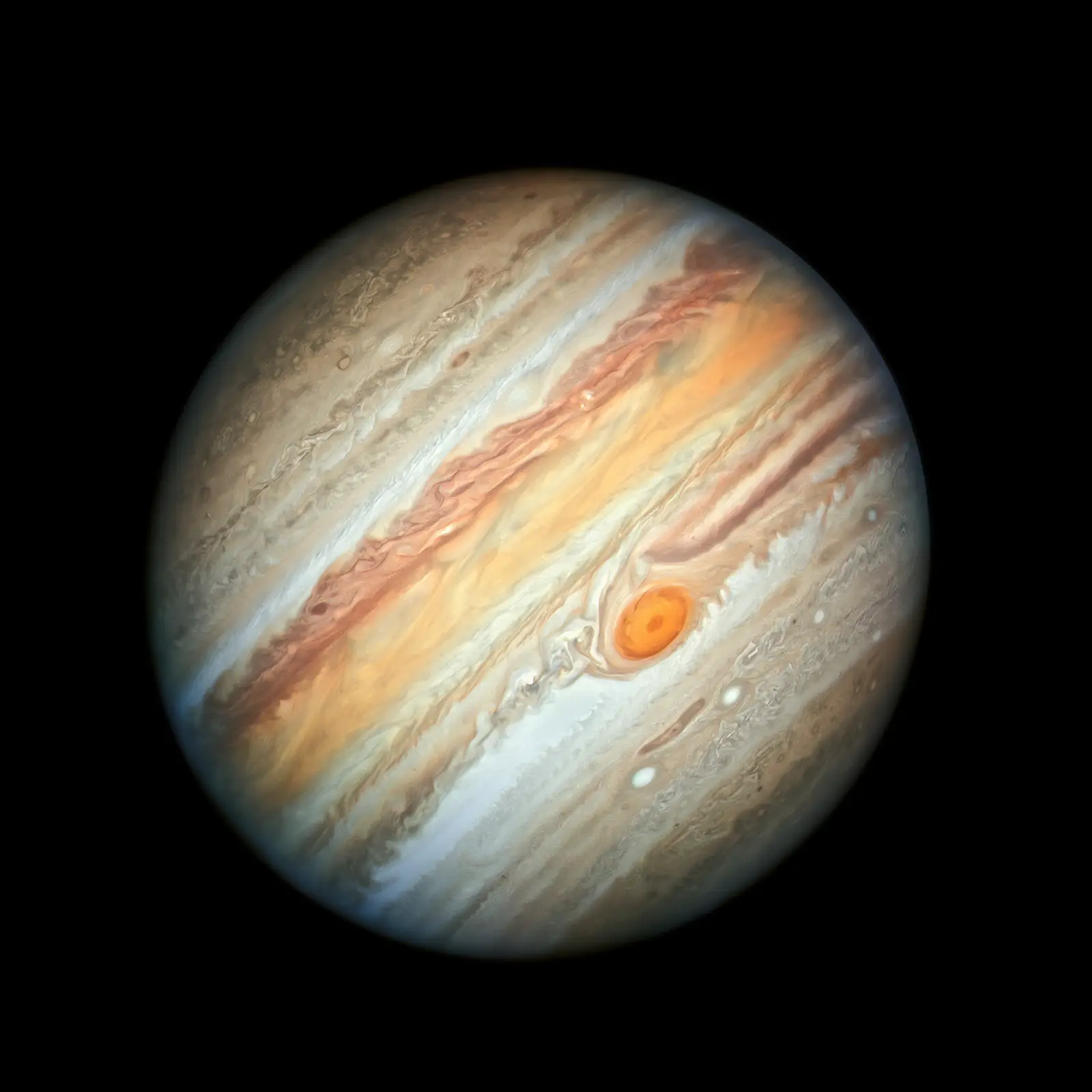
For a first try, choose Jupiter or Venus when one is comfortably above the horizon in a darkening sky. Mars often has a warm orange color. Saturn is usually a steadier, quieter yellowish point. Mercury is more demanding because it stays close to the Sun’s direction.
Never sweep binoculars or a telescope near the Sun to find a planet. For a beginner’s evening search, wait until the Sun has completely set and keep optical equipment away from the sunset position.
The checker does not list Uranus and Neptune as beginner targets. Neptune requires optical aid. Uranus can sometimes be detected without it under exceptional conditions, but “technically possible” makes an unhelpful first observing goal.
What will it actually look like?
| View | Reasonable expectation |
|---|---|
| Eyes alone | Bright points; Mars may look orange. No rings, bands or planetary surfaces. |
| Steady binoculars | Some of Jupiter’s four bright moons when geometry, glare and steadiness allow. |
| Small telescope | Venus’s phase, Jupiter’s disk and sometimes bands, Saturn’s rings when favorably tilted. |
| SkyLumi | A map for finding the object and its context; a displayed photograph is not a live camera feed. |
Why the answer changes through the year
Earth and the other planets move around the Sun at different speeds. Some months we see a planet in the evening, other months before dawn, and sometimes it is lost in the Sun’s glare. An outer planet near opposition lies roughly opposite the Sun in our sky and is available for much of the night. Venus and Mercury orbit inside Earth’s orbit, so they never reach that arrangement.
“Planet parade” headlines often collect objects spread across a wide stretch of sky. They may include worlds too faint for your eyes or too low in twilight. Check the individual targets before making plans.
Where the numbers come from
This page calculates topocentric positions with Astronomy Engine, using your selected coordinates and time. Positions account for your observing location and use a standard atmospheric-refraction model. The calculation happens in your browser; this form does not send your coordinates to a server.
The labels describe geometry and sunlight, not a weather forecast. Close to the horizon, real atmospheric refraction is variable. Check the sky itself before travelling. Change the time to compare the early evening with later in the night, then open SkyLumi for the map around your chosen planet.
Sources and image credits
- NASA: skywatching. Which planets can be seen without a telescope.
- NASA: binoculars as a first telescope. Practical limits for binocular views.
- Astronomy Engine: algorithms and validation. Open-source calculation library also used by SkyLumi; the checker’s method is documented above.
Written for beginners from the sources above. How we research and correct the library. Found an error? Tell us.