Three conditions matter more than equipment
Find a place with little artificial skyglow, choose a time when the Moon is below the horizon, and let your eyes adapt to darkness. You do not need a telescope to see the Milky Way’s broad structure. A telescope actually shows too small a patch to take in the whole band.
Give your eyes roughly half an hour away from bright lights. Turn the phone brightness down before going out, and avoid repeatedly checking a bright screen. SkyLumi’s red Night Vision display can help reduce glare, but a red screen at full brightness is still a light source.
A dark-sky map is a starting point, not a promise. Clouds, haze, smoke and lights on the actual horizon can spoil a site that looks excellent on a map. Check access, weather and the route home before travelling.
“Milky Way season” usually means the bright central region
We can look toward different parts of the galaxy throughout the year. The especially bright region around Sagittarius and Scorpius is what photographers often mean by the Milky Way core. From many northern locations it is an evening target in the warmer months, low toward the south. From southern latitudes it can climb much higher.
That does not make the rest of the year empty. The fainter outer-galaxy direction runs through other familiar constellations, including Cassiopeia and Perseus. At high latitudes, long summer twilight can make the sky too bright even when the galactic center is geometrically above the horizon.
Use SkyLumi with your actual location and time to inspect the band’s position. A calendar month alone cannot tell you whether it clears a mountain, a building or your horizon.
Expect a pale band, not a neon arch
Start by looking for a broad, uneven haze. Once you recognize it, try tracing the darker rifts through it. Under excellent conditions the structure can be impressive, but much of it looks gray or only subtly colored to dark-adapted eyes.
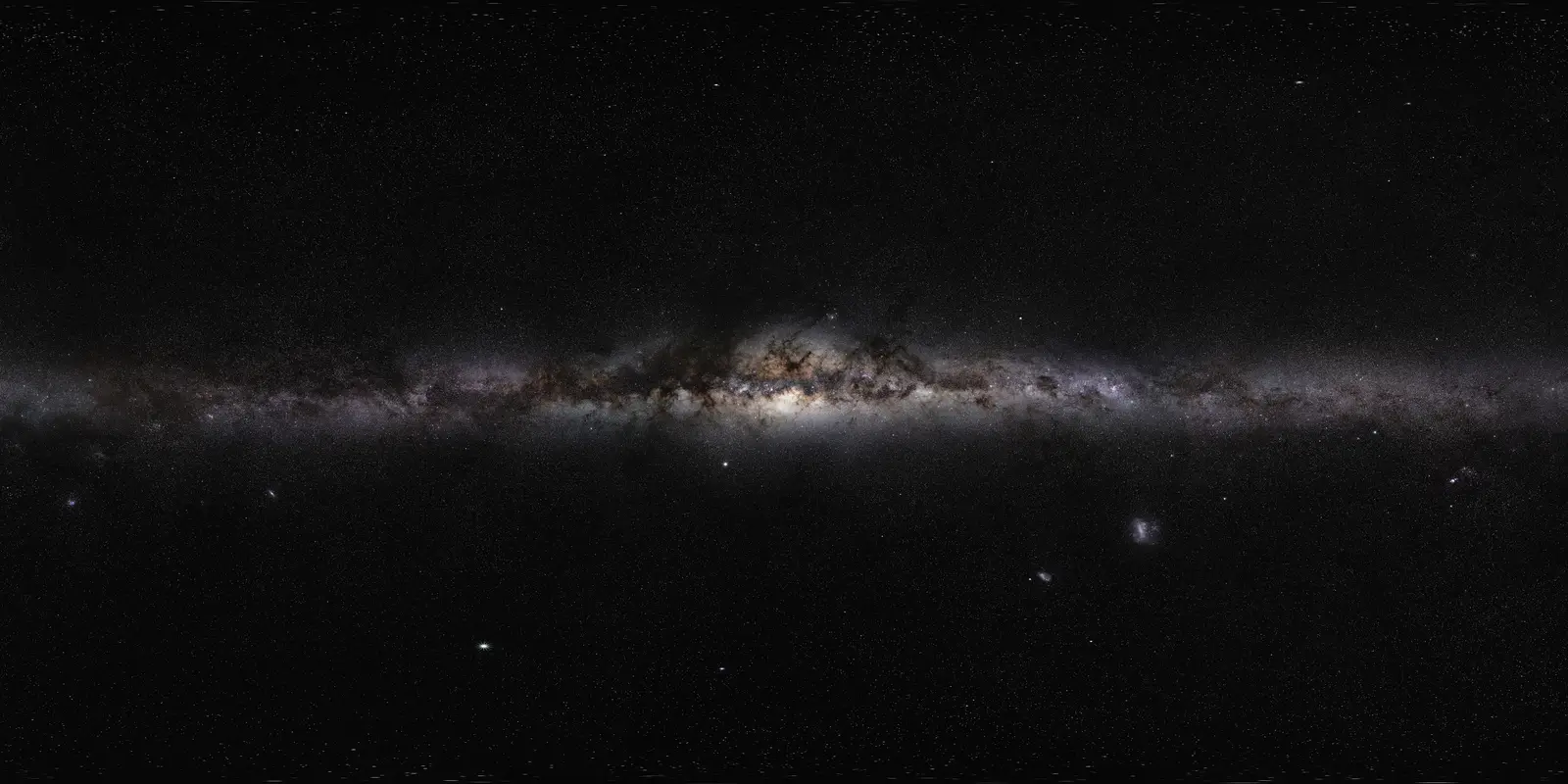
A camera can accumulate light over a long exposure, and processing can bring out faint contrast and color. A panorama may combine many exposures and pointings. None of that makes it fake; it makes the method essential to understanding the result.
The image on this page wraps the entire sky into a rectangle. The app’s photographic survey view is another way to inspect structure, not a prediction that your eyes will see a photograph floating above you.
The dark gaps are part of the galaxy too
Interstellar dust absorbs and scatters visible light. A dark cloud can hide huge numbers of stars behind it. Looking into a gap therefore need not mean looking out of the galaxy: sometimes it means looking into an obstruction inside it.
The brightest visible bulge points us toward the inner galaxy, but visible light cannot give an unobstructed portrait of its very center. Infrared and radio observations reveal things hidden from ordinary optical photographs.
Try this on a good night: find one dark notch with your eyes, then compare that same region in SkyLumi. Instead of counting only the lights, pay attention to what is covering them.
Sources and image credits
- ESO: the Milky Way panorama. All-sky projection, galactic disk, dust lanes and photographic provenance.
- NASA: finding good places to stargaze. Darkness, Moon, adaptation and local conditions.
- NASA: skywatching frequently asked questions. Season, location and observing limitations.
Written for beginners from the sources above. How we research and correct the library. Found an error? Tell us.