Where to look
The cluster lies in Taurus. On Northern Hemisphere autumn and winter evenings it becomes a familiar sight, climbing higher as the season advances. Southern Hemisphere observers see it too, toward the northern part of their sky; the calendar months are similar, but the season names and orientation differ.
Find Orion’s three-star belt when it is up. Extend the belt’s line in the direction of orange Aldebaran, then continue beyond it toward the compact Pleiades group. The other direction along the belt leads toward Sirius. A map helps if Orion is tilted or upside down from your location.
Search “Pleiades” or “M45” in SkyLumi to check which patch is above your horizon now.
It is not the Little Dipper
The confusion is understandable: the brighter Pleiades stars can look like a tiny scoop. The Little Dipper is a much larger pattern in Ursa Minor, close to the north celestial pole, with Polaris at the end of its handle.
The Pleiades move across the sky with Taurus and can be seen from much of both hemispheres. If your “Little Dipper” is a small, sparkling knot near Taurus, you have probably found the Seven Sisters instead.
Why can I only count six?
“Seven Sisters” is a traditional name, not a required eye-test score. How many stars you can separate depends on eyesight, sky brightness, glare and which closely spaced points you count individually. Some people see six readily; under good conditions others count more than seven.
Use binoculars with a wide field rather than trying to magnify the cluster as much as possible. A steady 7× or 10× view is a rewarding beginning. Let the whole group fit in the frame and notice the fainter stars between the famous bright ones.
The cluster contains far more members than the name suggests. It is an open cluster: a family of stars born together and still moving through the galaxy together, rather than an accidental pattern of unrelated foreground and background stars.
Young stars passing through old dust
The Pleiades are roughly 100 million years old and about 440 light-years away. Those rounded numbers are more useful here than pretending the cluster is a single point with one exact age and distance.
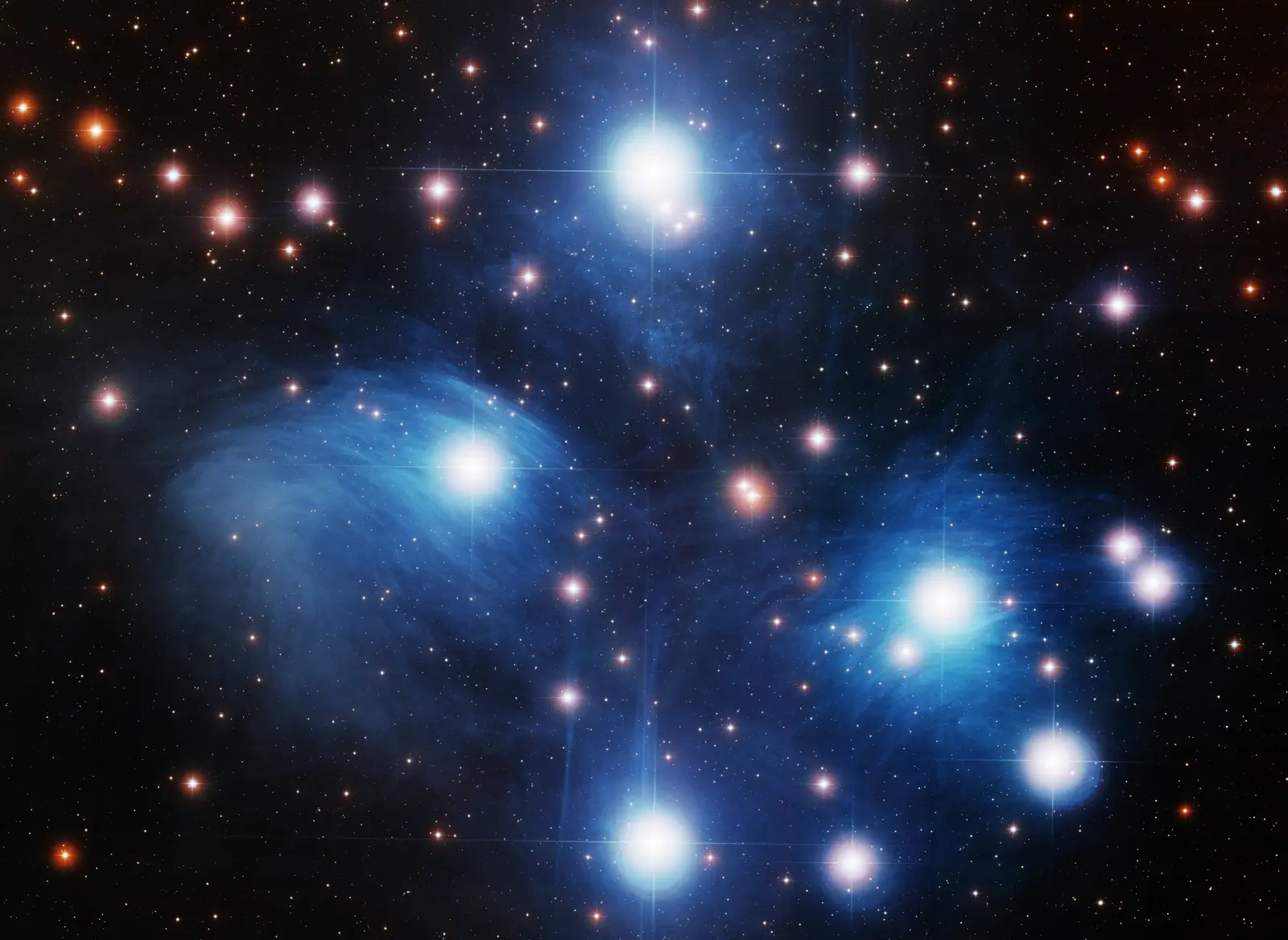
Its bright blue-white stars are hot. In photographs, blue wisps around them are dust scattering their light. This is a reflection nebula. The dust is generally understood to be a cloud the cluster is passing through, rather than simply leftover material from the stars’ birth.
Do not expect that blue glow in ordinary binoculars. The photograph gathers light for longer and records faint structure your eyes struggle to distinguish. The stars are the realistic observing target; the image explains the environment around them.
Try three views of the same place
Count the stars with your eyes, then with binoculars if you have them. Finally, open the photographic view in SkyLumi and inspect the cluster again. Keep those three experiences separate: naked-eye pattern, magnified star field, and accumulated light in a photograph.
That comparison makes a useful first deep-sky observation. You learn what your equipment adds without needing to turn every faint patch into the bright picture on a screen.
Sources and image credits
- NASA WISE: Seven Sisters. Open cluster, approximate age and distance, and unrelated dust cloud.
- NASA: the larger Pleiades family. Recent work on membership; the eye-visible cluster and wider stellar family are distinct.
- NASA: binoculars as a first telescope. Pleiades as a practical wide-field target.
Written for beginners from the sources above. How we research and correct the library. Found an error? Tell us.