Source review: . Reviewer and owner: SkyLumi editorial owner. Next review: . Recheck sooner if a linked source or tool changes. To report errors, email hello@skylumi.app.
The decision before the specification table
Choose the S50 Pro when carrying weight, published examples and a smaller financial commitment matter more than chasing the highest announced capability. Investigate DRACO when compact galaxies, finer sampling and extra capture controls justify a heavier instrument and you can live with preorder uncertainty.
If you already own a Seestar, the decision is narrower. First work out whether your limitation is framing, usable detail, noisy data or post-processing control. DRACO changes several hardware variables at once, and none of them guarantees that its app will solve an editing problem you have not yet defined.
A return deadline is a real constraint, and an untested performance promise is not evidence. Keeping the current telescope, returning it and waiting, or preordering the new one are three different choices that should not be compressed into “buy the more powerful one”.
This is a technical, source-based comparison rather than a hands-on DRACO review. We did not find an independent test of a production DRACO by the check date. Where this page infers something from a specification it says so, instead of turning it into a score.
Verified specifications and their evidence status
| Factor | Seestar S50 Pro | DWARFLAB DRACO | How to read it |
|---|---|---|---|
| Main aperture / focal length | 50 mm / 260 mm | 90 mm / 340 mm | Manufacturer specifications |
| Focal ratio | f/5.20 | f/3.78 | Focal length divided by aperture |
| Main sensor | OmniVision OS08B10 | OV50Q40 in the technical table | Model names, not measured noise |
| Deep-sky output | 3840 × 2160, 8.3 MP | About 12 MP after 2 × 2 binning | Do not compare 8.3 MP with an unqualified “50 MP” |
| Pixel pitch | 2.9 µm | 2.394 µm effective when binned; 1.197 µm native | Effective pitch sets the sampling |
| Body mass | 2.8 kg | 5.5 kg | Excludes support and accessories |
| Advertised longest exposure | Up to 60 s in EQ mode | Up to 300 s with built-in guiding | Capabilities, not measured success rates |
| US listing, 9 September 2026 | $899 launch price, $999 after | $1,299 Standard launch price, $1,399 after | Tax, bundle and delivery need checking |
| Purchase status | Shipping, with published independent images | Preorder | Hardware existing is not the same as verified production performance |
Hardware figures come from ZWO and from DWARFLAB’s overview and specification table. Commercial terms are from the DRACO listing, and the independent S50 Pro examples are Trevor Jones’s review.
DRACO’s SHO launch edition is $1,499, with $1,599 shown as the price after the offer. The launch offers were advertised to end on 14 September for DRACO and at 00:00 Pacific time on 15 September for the S50 Pro. DWARFLAB’s estimate for September orders was shipment within two months of ordering. Those statements describe the listings on the check date rather than a guaranteed delivery.
Aperture: a real advantage, without invented multipliers
The entrance-area ratio is simple arithmetic. An unobstructed 90 mm pupil has (90 / 50)², or 3.24 times, the geometric area of a 50 mm pupil under the same sky. That is a genuine optical difference, and it falls well short of a 3.24 times better photograph. It also says nothing about how many minutes a particular result will take.
The finished image depends on how that light is spread across pixels and how much sky background arrives with it. It also depends on what the sensor records and how well the mount holds the scene still. A comparison that mentions aperture and ignores those variables is incomplete. One that multiplies an aperture gain by a separate focal-ratio gain usually counts the same optical change twice.
For small targets the larger aperture also shrinks the theoretical diffraction limit. At 550 nm the Rayleigh criterion, 1.22 × wavelength / aperture, gives about 2.77 arcseconds for 50 mm and 1.54 arcseconds for 90 mm. Atmospheric blur, focus and tracking usually stop either telescope short of that limit, and DWARFLAB’s own aperture page uses the same criterion.
Focal ratio: why f/3.8 already includes the aperture
Focal ratio is focal length divided by aperture. DRACO’s 340 mm and 90 mm give f/3.78, and the Seestar’s 260 mm and 50 mm give f/5.20. The faster ratio concentrates an extended scene more strongly per unit of sensor area, all else being equal.
All else is not equal, because the two cameras use different output pixels. For an extended patch of sky, a simplified per-pixel signal comparison scales with (pixel pitch / focal ratio)², assuming equal throughput, quantum efficiency and exposure. Putting in the stated effective pitches gives about 1.29 in DRACO’s favour.
That 1.29 is an illustration under deliberately equal assumptions and not a measured sensitivity ratio. Each DRACO output pixel also covers less sky, so the two pixels are not looking at the same patch, and a comparison at matched angular sampling comes out differently again.
This is why slogans about aperture, speed and pixel size contradict each other. They compare different quantities, whether total light from an object, light per square millimetre of sensor or light per output pixel, and a useful claim names which one it means.
Image scale: more samples across a galaxy
Using 206.265 × pixel pitch / focal length, the S50 Pro samples at about 2.30 arcseconds per pixel and DRACO’s binned mode at about 1.45. A feature spanning 60 arcseconds therefore covers about 26 S50 Pro pixels or 41 DRACO output pixels along one axis.
Those are calculated sample counts. They do not establish that all 41 samples contain independent detail, or that processing can recover detail lost to a blurred exposure. The difference is still useful, because a camera that undersamples what its optics deliver cannot record it in a single frame. Finer sampling gives a well-behaved system more room to record compact structure, and it asks more of focus, tracking and the signal in each sample.
A practical test should publish a common angular crop rather than two images both stretched to fill a screen. Show the same patch of sky, state the output scale and share the original files. Otherwise one photograph looks more detailed simply because it is displayed larger.
The sensor comparison has an easily missed shape difference
The S50 Pro’s active rectangle is 11.14 × 6.26 mm from its listed array and pitch. For DRACO, the published 50.33 MP, 4:3 ratio and 1.197 µm native pitch imply about 9.81 × 7.35 mm. That DRACO rectangle is a reconstruction; nobody outside DWARFLAB has confirmed it from a production file yet.
The two areas are close, 69.8 against about 72.1 square millimetres, while the shapes differ. That is more informative than assuming the nominal 1/1.2 inch and 1/1.3 inch format labels describe a large gap. A wider sensor can be shorter, and a smaller nominal diagonal can coexist with a similar rectangular area.
None of this establishes which sensor has better read noise, full-well capacity, colour response or pattern noise at the gain used for astronomy. Those need a documented measurement or suitable raw data, and a component model name is a starting point for research rather than a performance score.
What 2 × 2 binning does to the image
A 2 × 2 grouping maps four input samples into one output sample. The count along each axis halves, so the total falls to a quarter. That is how a roughly 50 MP sensor supplies a roughly 12 MP deep-sky output with no change to the silicon behind the lens. DWARFLAB lists the native and binned pitches separately.
Do not assume that every CMOS binning mode combines charge before a single readout. Summing or averaging samples that have already been read has a different read-noise consequence from combining charge before a single read. The word “binning” alone does not say which DRACO does. This comparison therefore uses the stated effective pitch for angular sampling and assigns DRACO no invented noise improvement.
Binning does not create detail and does not enlarge the aperture. It trades a finer output grid for more signal in each output sample. Whether that helps depends on the blur in the exposure, the noise and the scale at which the final image will be judged.
Native framing: DRACO’s tighter field changes the project
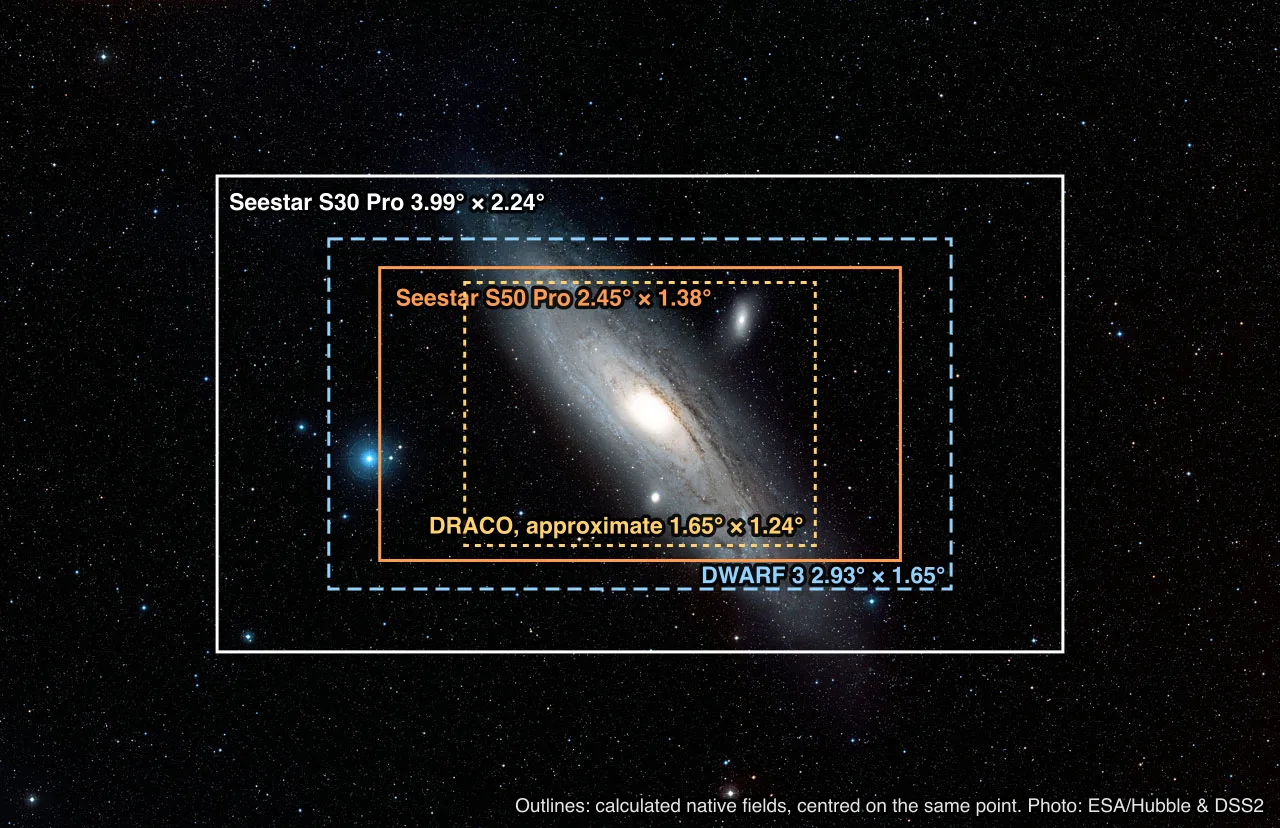
The S50 Pro’s native field calculates to 2.45° × 1.38° before stacking crop, and the DRACO reconstruction gives about 1.65° × 1.24°. That DRACO rectangle has a diagonal consistent, within rounding, with DWARFLAB’s stated astronomy-mode field of about 2.06°.
For a compact galaxy a tighter field is welcome. For a long nebula or for Andromeda it changes the project, because you may need a different orientation, a mosaic or a deliberate crop. No amount of sharpening puts a missing part of the target back inside the exposure.
Mosaics extend coverage by pointing at different parts of the sky in turn. They are not a free increase in sensor size. With a fixed session, time is shared among panels and overlap, and depth can vary across the final frame. An honest mosaic claim states the total elapsed time and the coverage as well as the final pixel dimensions.
What 300-second exposures could improve
DWARFLAB advertises built-in guiding and exposures up to 300 seconds. That could matter, especially when the signal and the filter make repeated readout noise significant. It does not prove that a long sequence will keep every five-minute frame.
Suppose both systems collect for one hour. Sixty 60-second exposures and twelve 300-second exposures have the same total open-shutter time, and the second sequence contains a fifth as many readouts. In a deliberately ideal, read-noise-dominated model with identical per-read noise and everything else equal, that produces a square-root-of-five advantage in signal-to-noise. In a sky-background-dominated model, fewer readouts help far less.
Those models are explanatory limits rather than a comparison of these two cameras. Their read noise need not match, their pixels cover different patches of sky and their filters need not pass the same spectrum. Long subs also clip bright stars sooner and lose more integration when one frame is spoiled. The best exposure is rarely the longest the app allows.
What to request from a DRACO reviewer
Ask for a complete unattended run with the number of exposures attempted, the number accepted and the elapsed time. Ask for the exposure length, gain, filter, altitude, alignment procedure, wind and firmware version too. A single clean five-minute frame establishes much less than a sequence that survives a changing sky.
Ask too whether the result depends on an equatorial setup, physical field rotation, software registration or some combination, because those mechanisms solve different problems. A specification that lists “guiding” does not say which motion is corrected, at what cadence or with what residual error.
Cooling and field rotation: where the evidence stops
DWARFLAB’s pages describe “CMOS cooling” that reduces thermal noise, reuse of sensor heat to keep dew off the lens, and “physical field derotation” with a listed derotation speed range. The phrase “rotating sensor” comes from third-party coverage rather than from DWARFLAB’s own product pages and specification table. For this comparison they stay manufacturer-described features whose production behaviour needs confirming.
We found no specified regulated sensor set point, no below-ambient temperature figure and no measured dark-current curve. It would therefore be wrong to call DRACO equivalent to a regulated cooled astronomy camera, because heat removal, lens dew prevention and a temperature-controlled sensor are three separate engineering properties.
In the same way, physical framing rotation and continuous field compensation need not share operating limits. A useful demonstration shows long exposures at several target positions and reports frame acceptance. The absence of that data is a reason to leave the performance claim open rather than to invent a penalty or a near-perfect score.
The S50 Pro should not be described as lacking dew control just because it lacks a regulated sensor cooler. Trevor Jones’s review discusses an integrated dew heater, and a heater protecting the front optic does a different job from a cooler regulating the imaging sensor.
Software: separate the finished picture from the stack underneath it
There are at least three layers to evaluate. Capture controls determine what is recorded, stack controls determine which frames contribute and how they combine, and image editing changes the appearance of the resulting master or presentation file.
A star-removal button belongs to the third layer. It does not prove that the software lets you set rejection thresholds or inspect every original exposure. Equally, an instrument can offer excellent data export without a sophisticated editor inside its phone app.
ZWO’s listing describes FITS output and an ASCOM Alpaca path to third-party software. DRACO advertises Pro-mode exposure, gain and filter controls plus FITS and TIFF export. These are useful declared routes. The word “RAW” should never replace a check of file type, bit depth, calibration state and whether the export is one exposure or a combined master.
DWARFLAB’s existing DWARF 3 manual gives a concrete workflow example. Mega Stack runs locally on the telescope, can use selected original frames and requires compatible target and filter data, while Stellar Studio uploads stacks for cloud processing. That documents the DWARF 3, and it does not prove that every option and restriction is identical on production DRACO firmware.
A five-file test is more useful than a menu tour
For an instrument you own, keep an original exposure, a known bad exposure, the automatic master, the presentation JPEG and a separately generated stack, and record which operation produced each. Then attempt the exact improvement you want, such as removing a trailed frame or keeping faint structure while protecting bright stars.
This turns “the software is not good enough” into an answerable requirement. It can reveal that the missing tool is a different stretch, that the data needed more exposure, or that the app does not expose the stack control you want. Only the last case is a limitation of the stack editor. Siril provides documented stacking methods and rejection controls for the desktop route, and the right starting point still depends on what the export contains.
Standard versus SHO: the extra filter records sulfur
DRACO Standard and DRACO SHO both advertise hydrogen-alpha plus oxygen-III filtering. The SHO edition adds a sulfur-II plus oxygen-III combination used in sequence, and it changes how the solar filter is supplied. The advertised narrowband widths are about 13 ± 3 nm.
The distinction is physical acquisition. Mapping an existing image into a blue-and-gold palette does not create sulfur data that were never recorded. Capturing the extra channel supports a different narrowband composition, at the cost of exposure time and processing, and it does nothing for broadband galaxies.
A buyer mainly interested in galaxies should justify the extra filter against a real emission-nebula project. A buyer who specifically wants sulfur, hydrogen and oxygen information has a direct reason to consider it. Neither should buy the edition because the letters sound more professional.
For solar use, follow the exact instructions for your model and edition and confirm the solar protection before pointing at the Sun. A nebula filter is not a solar filter. The SHO edition’s external solar filter must be fitted physically as instructed, and a menu setting does not replace that step.
Portability and power deserve their own decision
The two bodies differ by 2.7 kg. The right comparison then adds each support, cable, tilt arrangement, case and power supply. A low tabletop tripod and a full-height field support make very different setups even when both are listed as “tripod included”.
DRACO’s five-hour and the Seestar’s up-to-nine-hour runtime statements are manufacturer claims under their own conditions rather than a shared test. A milliamp-hour figure also does not establish stored energy without the battery voltage, so do not infer an efficiency ranking from those labels.
For a long project, write a power plan instead of trusting a maximum runtime. Establish whether your external source supplies the required voltage and current and whether the telescope runs while powered from it. Cold, dew control and network use belong in your own acceptance test.
Real S50 Pro photographs, and their limits as evidence
Trevor Jones’s published S50 Pro session on M31 uses 261 exposures of 30 seconds, or 130.5 minutes, in equatorial mode with the UV/IR-cut filter. His review also shows automatic against separately processed results for NGC 7822 and the Crescent Nebula.
Those same-data processing panels are especially useful to anyone unhappy with a telescope’s automatic output, because they separate what was acquired from what a different workflow can make of it. They do not prove that another camera would improve the data by the same amount.
The images stay at their original publication rather than being copied here without a reuse grant. There is no independently verified DRACO counterpart in this article, so it contains no S50 Pro versus DRACO photographic shootout. Be suspicious of any page that claims one before production units are in independent hands.
Our purchase interpretation
For a new buyer, the S50 Pro is easier to evaluate from existing outside images and easier to carry. For someone chasing smaller targets who is prepared to wait for evidence, DRACO’s announced geometry deserves serious attention. Neither gets a fabricated score out of 100 in place of a test.
For an S50 Pro owner, keep it only if the workflow and the images meet your needs, and do not keep it just because DRACO is uncertain. Equally, do not preorder DRACO on the assumption that larger optics guarantee the editing behaviour you want. Returning and waiting is a rational third option when the current product is unsuitable and its replacement is unproven.
Before choosing either, find your targets in the SkyLumi sky map and check them against the calculated native fields above. SkyLumi does not control these telescopes and this guide does not claim that it does.
Questions this comparison can answer
Is DRACO better for small galaxies?
Its advertised aperture and calculated binned sampling give it more potential for compact structure. The actual gain depends on optics, tracking, signal and processing, and only a controlled raw-data comparison turns that potential into a measured conclusion.
Is the S50 Pro sensor a Sony IMX585?
No. ZWO lists an OmniVision OS08B10 for the S50 Pro’s main camera. The S30 Pro uses a Sony IMX585, and similar pixel dimensions do not make them the same sensor.
Does DRACO shoot 50-megapixel deep-sky images?
The advertised deep-sky output is about 12 MP after 2 × 2 binning. The 50 MP figure describes the underlying sensor, and native sampling is described for other imaging modes.
Is DRACO’s cooling proven to be better?
Not by the evidence used here. Heat-management language is not a measurement of regulated sensor temperature or dark current, and those remain questions for production documentation and independent testing.
Calculation notes
Every formula and input is in the dataset. DRACO dimensions are approximate reconstructions. Fields exclude stacking crop and optical distortion. The aperture illustration assumes unobstructed entrance pupils and does not measure transmission. The noise examples hold unmeasured variables equal on purpose, to explain a concept rather than to estimate product performance.
Sources and image credits
- ZWO: Seestar S50 Pro product page and specifications
- Seestar: S30 Pro product page and specifications
- DWARFLAB: DRACO preorder listing
- DWARFLAB: DRACO technical overview
- DWARFLAB: DRACO regional product page
- DWARFLAB: DRACO specification table (Italian regional page)
- DWARFLAB: DWARF 3 user manual, app interface, Stellar Studio and Mega Stack
- Siril documentation: stacking
- AstroBackyard, Trevor Jones: Seestar S50 Pro review
- ESA/Hubble: wide-field view of the Andromeda Galaxy (heic1112f)
- ESA/Hubble: usage of images, videos and web texts