Source review: . Reviewer and owner: SkyLumi editorial owner. Next review: . Recheck sooner if a linked source or tool changes. To report errors, email hello@skylumi.app.
The differences worth paying for
| Factor | Seestar S50 Pro | Seestar S30 Pro | DWARF 3 |
|---|---|---|---|
| US price, 9 September 2026 | $899 launch price, then $999 | $699 | $549 |
| Main aperture | 50 mm | 30 mm | 35 mm |
| Main focal length | 260 mm | 160 mm | 150 mm |
| Main sensor | OmniVision OS08B10 | Sony IMX585 | Sony IMX678 |
| Main output | 3840 × 2160 | 3840 × 2160 | 3840 × 2160 |
| Pixel pitch | 2.9 µm | 2.9 µm | 2.0 µm |
| Body mass | 2.8 kg | 1.65 kg | 1.35 kg |
| Wide camera | 8.3 MP | 8.3 MP | 2 MP |
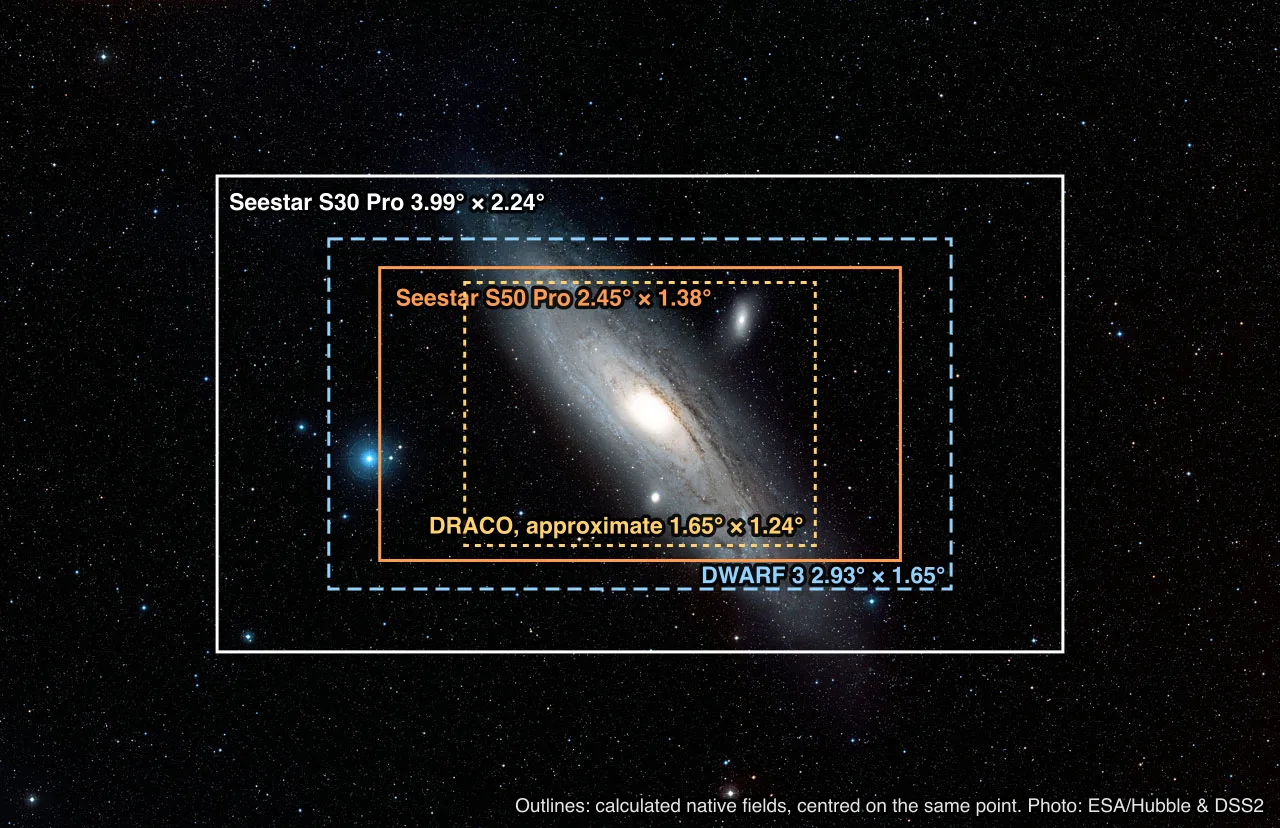
| Native field, calculated | 2.45° × 1.38° | 3.99° × 2.24° | 2.93° × 1.65° |
| Sampling, calculated | 2.30 arcseconds per pixel | 3.74 arcseconds per pixel | 2.75 arcseconds per pixel |
Figures are as listed by ZWO, Seestar and DWARFLAB on the check date. The one exception is the S30 Pro’s pixel pitch, which Seestar’s page omits; it is the Sony IMX585’s figure from ZWO’s own camera listing. The last two rows are our calculations from those inputs rather than manufacturer-tested performance. The price gaps at the listings we checked were $200 between the Seestars and $350 between the S50 Pro and the DWARF 3. The S50 Pro figure is a time-limited launch price.
There is no single ranking hiding inside the table. The S50 Pro collects light through the largest entrance pupil and the S30 Pro records the widest native field. The DWARF 3 pairs an intermediate field with the lowest body mass. Your target list decides which trade is the useful one.
This comparison uses manufacturer specifications, official software documentation and clearly identified outside image examples. SkyLumi has not tested the three side by side, and software behaviour should be tied to the app and firmware version you actually install.
Equal megapixels, different pictures
An 8.3 MP output describes the number of pixels in the saved frame. It does not say how much sky each pixel represents, which depends on pixel pitch and focal length.
Take a target 20 arcminutes across, or 1,200 arcseconds. Along the relevant axis, the listed geometry puts it across about 522 pixels on the S50 Pro and 321 on the S30 Pro. The DWARF 3 puts it across about 436. That is a framing and sampling calculation which assumes the object fits, and it does not claim that every sample holds resolved detail.
Now imagine a composition that nearly fills the S30 Pro frame. The S50 Pro cannot necessarily capture it in one exposure, and the larger-aperture instrument may need a mosaic to deliver the same picture. At that point the comparison is about time and panel coverage, and pixel counts drop out of it.
The mistake to avoid is comparing three exported images, each resized to the same website width, without noting the original field. Equal display size is not equal angular scale. One picture may show a galaxy and its surroundings while another is an enlarged crop of its centre.
The native field can decide the purchase before image quality does
The S30 Pro’s native sky area calculates to about 2.64 times the S50 Pro’s, and the DWARF 3 covers about 1.43 times the S50 Pro’s. The ratios use the rectangular field dimensions and describe coverage rather than collected signal from any particular object.
A larger field earns its keep when you want a whole object plus its surroundings in one composition. It also helps when the clear spell is short and you would rather not split it across a mosaic. It is worth less when the object is tiny and the surrounding frame adds nothing to the picture you had in mind.
Do not let a catalogue name hide that choice. “Andromeda” can mean the bright core, the full disk or a wide composition with both companion galaxies. Each framing goal can point to a different telescope for the same named object.
Use the SkyLumi sky map to look at a target before buying, then decide the composition from the native field or a mosaic plan. That is a planning workflow. SkyLumi does not send a target to any of these mounts.
Aperture matters, and its benefit has to be named
The S50 Pro’s 50 mm entrance pupil has 2.78 times the geometric area of a 30 mm pupil and 2.04 times that of 35 mm. The DWARF 3’s 35 mm pupil has 1.36 times the area of 30 mm. These are diameter-squared calculations before transmission and camera efficiency.
Those ratios do not rank the brightness of three phone previews. Different image scales spread an object’s light across different numbers of pixels, and automatic stretches make very different datasets look similarly bright. The larger pupil creates potential that has to be judged in the data rather than in a presentation JPEG.
For a compact target, the larger pupil and finer sampling make the S50 Pro the strongest candidate on paper. For a wide composition the S30 Pro may match the intended photograph better. The DWARF 3 does not fall neatly below both, since its sampling is finer than the S30 Pro’s and its field is wider than the S50 Pro’s.
A useful field test reports star widths in arcseconds as well as pixels, and shows corner crops. A sharp centre with poor outer stars is fine for a small target and much less fine for a field full of stars. That is a target-dependent judgement rather than a reason to crown one body.
Physical sensor area and pixel scale are separate variables
Both Seestar Pro output rectangles calculate to 11.14 × 6.26 mm at the listed pitch, and the DWARF 3’s to 7.68 × 4.32 mm. The Seestar rectangle therefore has about 2.10 times the active area. That result should not be stretched into a claim that the two Seestar sensors share noise characteristics, because they are different parts.
At the same focal length the larger rectangle would cover more sky, and these instruments do not share a focal length. The S50 Pro’s longer optics more than cancel its wider sensor against the DWARF 3, which is why it ends up with the tighter field in the table.
That is a useful way to read any spec sheet. Calculate the field first, then the angular sampling, and treat the sensor model and the output count as inputs rather than as the answer.
Do not confuse the S50 Pro with the original S50
The original S50 saves a 2 MP frame, 1920 × 1080 pixels from its Sony IMX462, through a 250 mm focal length. Its calculated image scale of about 2.39 arcseconds per pixel is close to the Pro’s 2.30, while its recorded field is far smaller at 1.28° × 0.72°. Seestar’s own S50 versus S50 Pro page lists the generation differences.
Moving from the original to the Pro therefore changes native coverage dramatically and the sampling of a small target hardly at all. A fourfold pixel count is mostly a larger canvas rather than four times the detail along the same galaxy.
That distinction matters when you read older comparisons. An original S50 versus DWARF 3 Andromeda image cannot be relabelled “S50 Pro versus DWARF 3”. The original can clip a composition the Pro handles differently, even though their per-pixel sampling is similar. Generation names belong in every caption, filename and table, as evidence rather than branding.
Wide cameras: a different reason to choose a Seestar Pro
Both Pro models list a much higher-resolution wide camera than the DWARF 3, which matters to someone who wants wide sky scenes as well as deep-sky targets. It says nothing about which main lens is sharper, and the two cameras need separate evaluation.
For a nightscape comparison, ask for the same evidence you would ask for on a nebula. Exposure settings, whether the sky was tracked, how the foreground was handled and whether the result is a mosaic. A polished composite can be an excellent photograph without being a single exposure.
Then decide how often you will use that camera. Paying for a capability that never enters your observing plan is worth less than a lighter body or a better support. Someone who wants Milky Way context as well as individual targets has a concrete reason to weight it.
Software: the specific controls matter more than an app-store score
There is no reliable universal software score in this comparison. App-store ratings mix phones, operating-system versions, telescope generations and individual expectations, and giving one app 94 and another 83 would be invention. A capability matrix tied to official documentation is more useful.
| Task to verify | Why it matters | What the documentation establishes |
|---|---|---|
| Keep data beyond the phone preview | Future processing and backup | Seestar lists FITS output; inspect the exact files produced |
| Remove one bad exposure and restack | Trails, poor focus or cloud spoil single frames | The DWARF 3 manual documents single-frame selection and Mega Stack |
| Restack without internet | Travel and independence from a service | Mega Stack is documented as local, on the telescope |
| Enhance the completed stack | Noise reduction, star work and presentation | DWARF 3’s Stellar Studio uses cloud processing |
| Combine filters or arbitrary mosaics | The stack engine has rules | The DWARF 3 manual describes same-filter requirements and mosaic limits |
| Drive it from a desktop | Automation outside the phone app | The S50 Pro listing advertises ASCOM Alpaca; verify the supported operations |
Seestar’s declared formats and integrations are on its S50 Pro and S30 Pro pages, and the DWARF 3 workflow is in sections 3.6 and 3.7 of DWARFLAB’s manual. An item missing from this table is not automatically absent from the product. It is something to test before you choose on that basis.
The key distinction is between controlling the stack and editing its appearance. Adjusting saturation or removing stars does not let you change which input frames are accepted. A plain-looking editor can still leave a route to sophisticated desktop processing if the data are preserved correctly.
A workflow test for an owner deciding whether to return a telescope
Capture one manageable target and keep its files. Try to exclude one exposure, restack, compare the result and export the intermediate data. Then open the files in the processing application you expect to use long term. The answer should be a repeatable sequence rather than a feeling that the app is advanced.
Record the file state as you go. Does the exported FITS contain a raw colour-mosaic exposure, a calibrated image, a debayered image or a stacked master? The extension alone does not say. Keep an untouched copy and note which operation created each file before applying a new calibration or colour process.
Siril’s documentation is a reference for stacking options and rejection methods, and no single script suits every smart-telescope export. A workflow has to match what the file actually contains. The question that decides a purchase is whether you can reach your intended final image from the data you can save. That separates an acquisition limit from a presentation limit.
Tracking: compare usable sessions
All three belong to the automated-imaging category, and “EQ mode” is not the same as a ready-made precision equatorial setup. Alignment, support geometry, stability and the chosen exposure still matter, and the mode name supplies no shared measurement of tracking quality.
A good comparison includes the support and alignment procedure used for each instrument. Testing one unit on a rigid low support and another on a wobbly tall tripod turns a support problem into a supposed telescope limitation. The whole setup is part of the result.
Report accepted seconds divided by elapsed session seconds alongside the finished image, and say where the clock started, because that ratio includes setup, settling, rejection and interruptions. The same data can otherwise be used to advertise incompatible ideas of efficiency.
For owners, an imperfect session is useful diagnostic evidence. Was a frame rejected because of cloud, poor focus, movement, a blocked view or a tracking error? Counting rejections without recording the reason produces a misleading reliability conclusion.
Filters: separate emission targets from broadband targets
The Seestar specifications list an internal light-pollution filter alongside UV/IR-cut and dark options. DWARF 3 lists VIS, Astro and dual-band options. These are named capture modes with different spectral choices rather than interchangeable “make the sky dark” buttons.
An emission-line target and a broadband galaxy should not automatically get the same filter just because the site is light-polluted. A filter can reduce background while also rejecting useful target signal. Read the manufacturer’s intended use and compare results with a stated filter rather than inferring quality from a dark background.
A dramatic palette is also not proof of extra spectral information. Editing colours can help communicate structure, and it does not establish that sulfur, hydrogen and oxygen were recorded separately. For a genuine extra narrowband channel in this price bracket, see the DRACO Standard versus SHO explanation.
Real same-object examples worth inspecting
S50 Pro and S30 Pro on M31
Trevor Jones’s S50 Pro review includes an Andromeda illustration comparing the two Seestar Pro models. His separately documented S50 Pro M31 session contains 261 exposures of 30 seconds, or 130.5 minutes. The adjacent comparison does not state a matched S30 Pro integration in its caption, so read it as a framing illustration rather than an equal-time sensitivity test.
DWARF 3 and the original S50 on M31
Wido’s DWARF 3 versus S50 review contains a genuine same-object comparison. Its Seestar is the original S50 rather than the Pro. It gives you an outside photographer’s experience with both, and it cannot answer the Pro comparison by substitution.
Same data, different processing
The AstroBackyard review also publishes automatic-stack against independently processed nebula panels. That is the most directly relevant example for an owner unhappy with automatic rendering, because the telescope is held fixed while the processing changes. It does not promise that every dataset holds the same recoverable detail.
These photographs stay linked at their original publications. Reproducing them on SkyLumi needs permission and unchanged attribution. The reference image above carries a separate, documented reuse licence.
How a fair three-way image test should be run
A useful group test needs two comparisons. First, compare what each complete setup produces during the same elapsed observing interval, which is the user-experience result. Second, compare selected data at similar accepted integration and a common angular presentation, which isolates imaging differences while keeping the selection visible.
Use a shared target, the same night where possible, documented filter choices and matched framing intent. Keep one version from each app’s ordinary automatic output and another from a disclosed common processing procedure, and never claim that procedure is perfectly neutral. Colour response, calibration and sampling can still call for different treatment.
Publish the original files or a representative sample with session metadata. Show the whole field, the centre and the corners, identify resampling and any sharpening, denoising or star correction, and report elapsed and accepted time separately with app and firmware versions.
A test still has value when weather prevents perfect matching. The correct response is to describe the mismatch rather than hide it behind a split-screen image, so readers can see which conclusions stand and which must wait.
Weight and cost: price your own complete kit
The body-weight difference between the S50 Pro and the DWARF 3 is 1.45 kg, and between the S50 Pro and the S30 Pro it is 1.15 kg. That is immaterial on a patio and decisive in a bag carried a long way, and there is no universally correct weighting for it.
Use a complete-cost calculation: telescope, required support, power, storage and any paid processing tool you actually plan to use. Do not price an optional accessory as essential unless your workflow needs it, and do not call two bundles equivalent when one omits a necessary support.
Judge service at the seller level. Keep the receipt, confirm the return terms and test promptly. A handful of enthusiastic or furious forum posts cannot establish a company-wide failure rate, and this guide does not turn anecdotes into support scores.
Which one fits your observing plan?
For small targets in a compact setup, the S50 Pro is the strongest fit of these three on the specifications. Its larger entrance pupil and finer sampling are the reasons; the word Pro in its name is decoration.
For broad nebula compositions and fewer mosaics, the S30 Pro deserves the first look. Its wide native field is a measurable difference that survives every change in retail pricing, so it is a choice in its own right rather than the cheaper Seestar.
For a light kit at the lowest cost, the DWARF 3 has a clear case. Its documented local frame-management workflow will also appeal to an owner who wants to revisit a stack on the device. Confirm the exact operation and its current restrictions rather than assuming the app is a desktop processing suite.
The most expensive of the three is not automatically the one that will produce your favourite photograph. A successful choice lines up the target, the field, the support and the editing workflow. The wider smart-telescope guide adds Vaonis, Origin and the DRACO launch for buyers whose needs point outside this group.
Questions readers ask
Which has the widest main-camera field?
The S30 Pro, at about 3.99° × 2.24° from the listed geometry. That compares native frames rather than mosaic modes. The DWARF 3 is next, then the S50 Pro.
Will the S50 Pro make a small galaxy larger than the S30 Pro?
At native sampling, yes. A given angular feature spans about 1.63 times as many pixels along an axis. Whether those extra samples reveal real detail depends on the data and the sky.
Can I edit a Seestar stack outside the app?
Seestar specifies FITS output. Check what your chosen export contains and keep the original session files, because a file format alone does not guarantee that every intermediate or calibration product is available.
Does DWARF processing always need the cloud?
No. The documented DWARF 3 Mega Stack runs locally on the telescope, while Stellar Studio’s enhancement uploads a stack to cloud services. Treat them as two separate operations.
Should existing S50 owners upgrade just for 4K?
Not without deciding what they want to improve. The Pro gives a much larger native field, while its calculated sampling stays close to the original S50’s. That is a strong framing reason and no evidence of four times the small-target detail.
Method and update policy
Calculations use the manufacturers’ stated output dimensions, pixel pitch and focal length, and exclude optical distortion, stacking crop and unit-to-unit variation. Source-based recommendations are not hardware test results. The inputs and calculations can be downloaded and checked independently.
Prices, software controls and stock need rechecking after significant firmware or product changes. New field evidence will change a recommendation when it changes the underlying decision, and the source-review line at the top of this page records when the sources were last checked.
Sources and image credits
- ZWO: Seestar S50 Pro product page and specifications
- Seestar: S30 Pro product page and specifications
- ZWO: ASI585MC camera page (Sony IMX585 sensor data)
- DWARFLAB: DWARF 3 checkout page
- Seestar: S50 vs S50 Pro
- Sony Semiconductor Solutions: IMX462LQR flyer
- DWARFLAB: DWARF 3 user manual, app interface, Stellar Studio and Mega Stack
- Siril documentation: stacking
- AstroBackyard, Trevor Jones: Seestar S50 Pro review
- AstroForum, Wido: DWARF 3 vs Seestar S50 review
- ESA/Hubble: wide-field view of the Andromeda Galaxy (heic1112f)
- ESA/Hubble: usage of images, videos and web texts