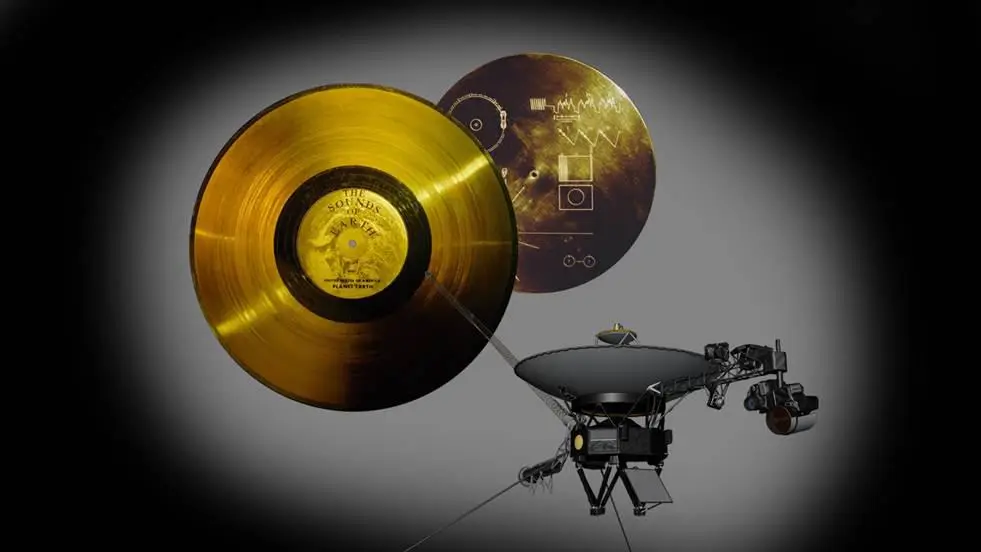
Voyager 1 carries a playable gold record: greetings in 55 languages, music, a heartbeat, and player instructions. Its first stellar flyby is Gliese 445, in ~40,000 years.
NASA/JPL-Caltech · Original image and terms. Web-sized reproduction.
Point at its first stop.


How to see it tonight
Gliese 445 is faint. Even in binoculars it can be hard to pick out from a dark sky. Voyager 1 itself, now far beyond Pluto’s orbit, is far too small and dim to see at all. This page points toward a direction and a very long journey, not a sighting.
Gliese 445 sits in Camelopardalis, a faint constellation near the north celestial pole. From northern latitudes it never sets below the horizon; from far southern latitudes it stays out of view.
Voyager 1 launched in 1977. It carries a gold-plated record: greetings in 55 languages, sounds of Earth, and a human heartbeat. Its cover is engraved with instructions for building a player. Voyager is not traveling toward Gliese 445 on purpose. The star simply lies near the spacecraft’s existing outbound path.
In about 40,000 years, NASA’s tracking shows, Voyager 1 will pass closer to Gliese 445 than to our own Sun. Nobody who worked on the record will be remembered by then. The record, built to survive, still will be.
Voyager 1 launched to study Jupiter and Saturn, then kept going. It crossed into interstellar space in 2012, the first human-made object to leave the Sun’s immediate influence. Its instruments still send data back today, decades after launch.
NASA credits astronomer Carl Sagan with assembling the record’s contents. NASA gave him the freedom to choose the format and what to include. His team filled it with sound, not just pictures.
What SkyLumi does
Search for Gliese 445, or let SkyLumi’s Aim mode point your phone toward its faint patch of sky in Camelopardalis. Search also finds Polaris nearby, a brighter reference point before you hunt for the fainter star.
AR lines the sky map up with your phone’s camera. Night Vision keeps a deep red display so your eyes stay dark-adapted while you search.
The core sky works offline, no account, no ads. Deep survey imagery from Pan-STARRS, SkyMapper and DSS2 needs a connection and streams in as you zoom. A star this faint shows little more up close.
A few things to know.
Can I see Gliese 445 without a telescope?
It’s very faint. Under a genuinely dark sky, some observers can pick it out with binoculars; from most locations it needs a telescope. SkyLumi still shows you exactly where to look.
Is Voyager 1 actually flying toward that star?
No. Voyager 1 is not aimed at Gliese 445. The star happens to lie near the spacecraft’s existing path, so it will pass unusually close in about 40,000 years.
What’s actually on the Golden Record?
Greetings in 55 languages, music, and sounds of Earth, including a human heartbeat. NASA describes the full contents on its Golden Record pages.
Will anyone ever play it?
Nobody knows. The record was built to be playable by whoever might find it, with instructions engraved on its cover. Whether anyone ever does is an open question.
More in the Sky Library
Sources and image credit
Image attribution and original terms are linked beneath the image. Use of imagery does not imply endorsement of SkyLumi.