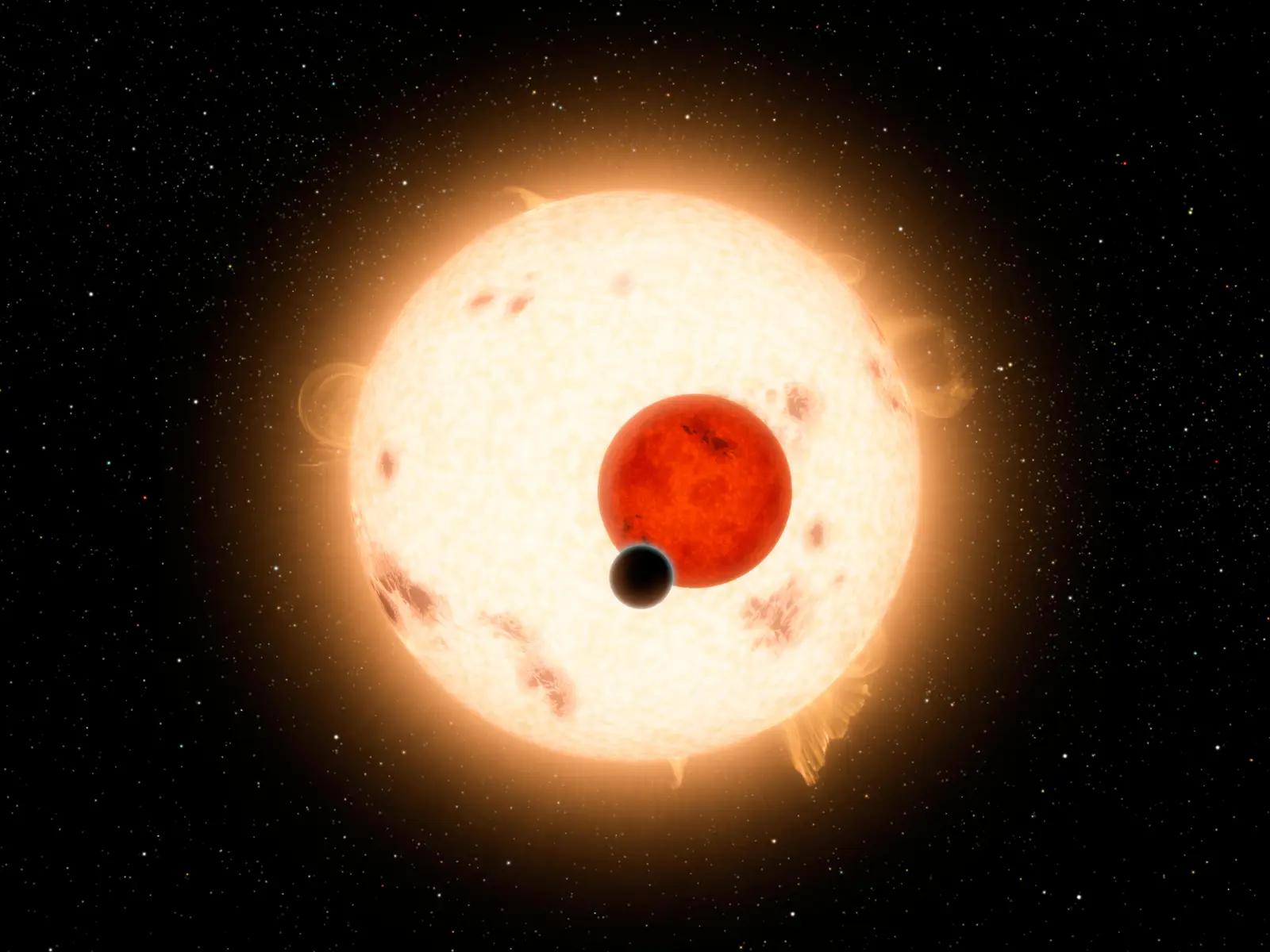
A confirmed planet orbiting two stars: a real double sunset. On its moons, you would cast two shadows. NASA’s travel poster says: “where your shadow always has company.”
NASA/JPL-Caltech · Original image and terms. Web-sized reproduction.
Find the real system.


How to see it tonight
Kepler-16b cannot be seen, by eye or by any backyard telescope. It is a real gas giant, confirmed by NASA in 2011. It orbits two stars at once, in the constellation Cygnus. The double sunset from science fiction is real there. Stand on one of its moons and you would cast two shadows. They would cross and separate as the pair of stars moved apart.
Cygnus climbs high through northern hemisphere evenings across summer and early autumn. Southern observers see it lower on the horizon, in that same season. Neither star in the Kepler-16 pair is bright enough to pick out on its own. Together they sit around magnitude 12, well past naked-eye and binocular range.
A large amateur telescope could show two faint dots close together where the system sits. It could not show the planet, and it could not show the two-sun sunset. That part only exists as an animation.
Astronomers did not photograph Kepler-16b to find it. NASA’s Kepler space telescope watched the pair’s combined light dim slightly, twice over. That happened each time the planet crossed in front of one star, then the other. The method works by measuring brightness to a fraction of a percent. It has no equivalent through an eyepiece.
The planet itself is close to Saturn’s size. It is about three-quarters of Jupiter’s radius, and roughly a third of its mass. It orbits the pair once every 228.8 days, in a nearly circular path. That path keeps it clear of both stars’ combined gravity. Since 2011, dozens more circumbinary planets have turned up. A real two-sun world is no longer unique to this one system.
Kepler-16A and Kepler-16B, the two stars themselves, are an ordinary pairing. One is a smaller, cooler star than the Sun. The other is an even smaller, cooler companion. The planet circles both from well outside their own mutual orbit. That layered structure, planet around pair, is what makes a stable double sunset possible.
What SkyLumi does
Search for Kepler-16 in SkyLumi. The map points at the real patch of sky in Cygnus where the system sits. Aim the phone at that patch, or open AR to see it marked against the sky. Tapping the marker opens this same story, with the numbers behind it.
Pinch in and the view moves into real observatory survey imagery of that region, from Pan-STARRS, SkyMapper and DSS2. The two stars stay unresolved at that resolution, which is honest: no photograph of them exists split apart either. The map still tells you exactly where to look, which a photograph cannot replace.
Night Vision keeps your eyes dark-adapted with a deep red display. There is no account and no ads. The core sky works offline; survey imagery needs a connection.
A few things to know.
Can I actually see Kepler-16b?
No. It is too small, too dim and too far for any eye or backyard telescope to reach. It was found by watching starlight dim, not by looking at it directly. That is true of most confirmed exoplanets.
Is Kepler-16b really like Tatooine from Star Wars?
The double-sunset idea is real. NASA confirmed a planet orbiting two stars at once in 2011. Kepler-16b is a cold gas giant, not a desert world, and nobody lives there. NASA’s own travel poster carries a fitting tagline: your shadow there always has company.
How far away is the Kepler-16 system?
A few hundred light-years away, in Cygnus. Distance estimates vary slightly between sources, which is normal for a star this faint. NASA’s exoplanet catalog, linked below, carries the figure it currently uses.
Does SkyLumi show the planet itself?
No app or photograph can. SkyLumi shows you where the system is, and lets you reach the same patch of sky in survey imagery. That is the same treatment as any other star field.
More in the Sky Library
Sources and image credit
Image attribution and original terms are linked beneath the image. Use of imagery does not imply endorsement of SkyLumi.