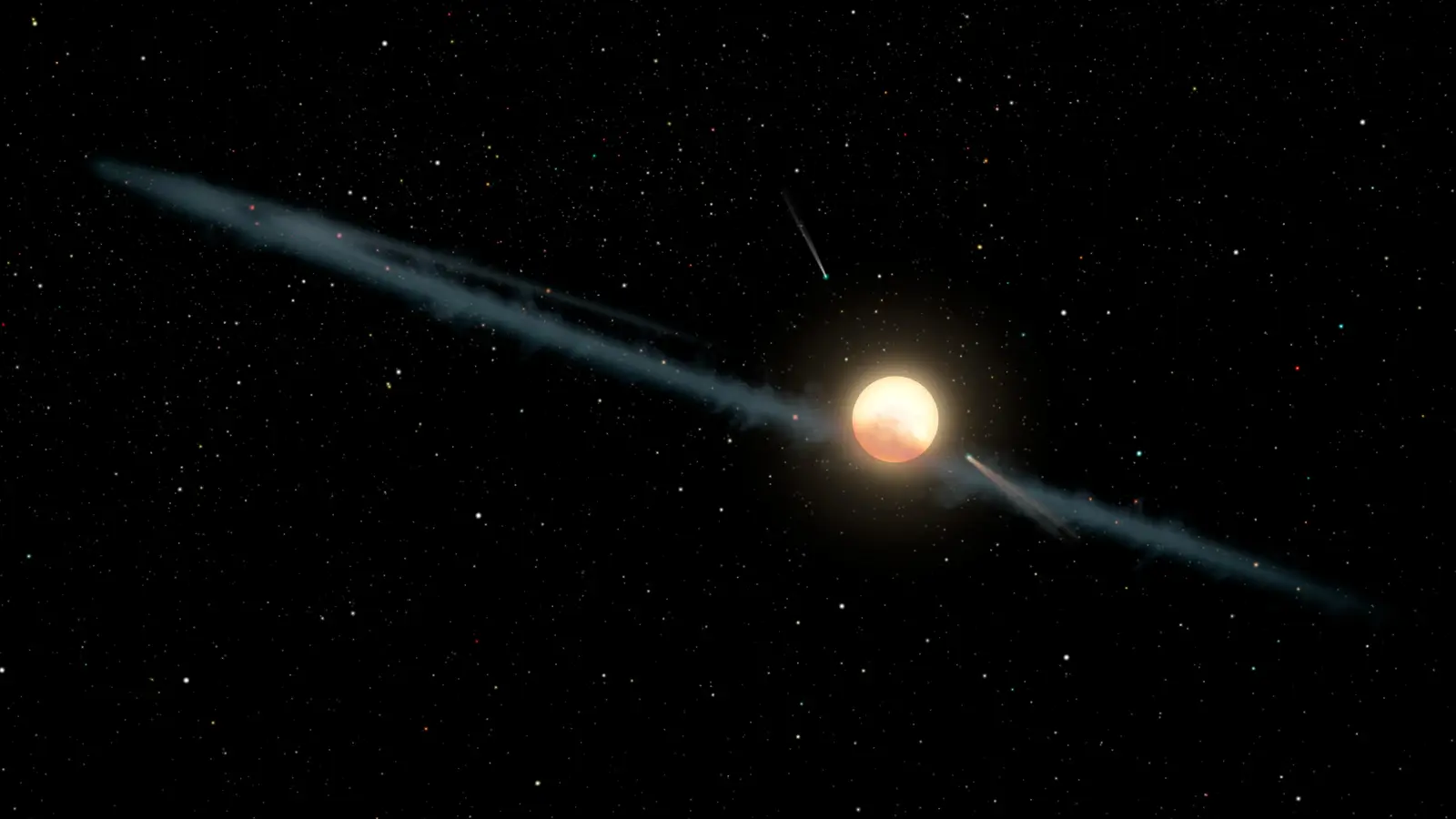
From 2015, this star dimmed by up to 22% at random. For comparison, a planet blocks about 1%. Astronomers seriously tested the alien-megastructure idea. The best answer is uneven dust.
NASA/JPL-Caltech · Original image and terms. Web-sized reproduction.
Find the star.


How to see it tonight
Tabby’s Star sits in Cygnus, well up for the Northern Hemisphere on summer evenings. It is low or hard to reach from much of the far south.
It is too faint for the naked eye or ordinary binoculars. Under a dark sky, a telescope in roughly the 6 to 8 inch range typically picks it out.
What a telescope shows is an ordinary-looking point of light. This star’s dramatic dimming happens over days at a time, on no fixed schedule. A single night’s look is unlikely to catch it mid-dip.
The brightness dips were found by a space telescope monitoring the star continuously, not by any single visual observation. SkyLumi shows where to point, not a live brightness reading.
NASA JPL puts the dust particles at no more than a few micrometres across, orbiting on a roughly 700-day cycle. That is dust, not a structure.
What to expect: eyes, binoculars, telescope, photograph
What you actually see changes completely with equipment. Here is each view, sourced.
| View | What you can expect |
|---|---|
| Naked eye | Nothing. The star is well beyond naked-eye brightness. This compares against the roughly magnitude 6 naked-eye limit. NASA’s coverage of the star does not itself state a magnitude figure. |
| Binoculars | Still out of reach for ordinary binoculars under most skies. This is the same brightness estimate as above, not a specific claim from a NASA source. |
| Telescope | A mid-size amateur telescope under a dark sky can find it as an ordinary point of light. Nothing about its dramatic dimming shows in a casual look. NASA JPL describes dips of “up to 20 percent over a matter of days,” tracked by continuous monitoring. |
| Photograph | The image above is an artist’s illustration of an uneven dust ring partly veiling the star, not a captured photograph. NASA/JPL-Caltech credits this specific illustration. |
What SkyLumi does
Search jumps to Tabby’s Star’s marked position in Cygnus. Aim the phone at that patch of sky, and the app tracks it as you move.
The story panel explains why the dimming was strange. Astronomers seriously tested an artificial-megastructure idea before the evidence pointed to uneven dust instead.
Night Vision keeps your eyes dark-adapted for the rest of Cygnus nearby. No account, no ads. The core sky works offline; the story content needs a connection the first time.
A few things to know.
Can I see Tabby’s Star with a small telescope?
Under a dark sky, a mid-size amateur telescope can find it as an ordinary point of light. It is too faint for the naked eye or ordinary binoculars.
Was it really considered an alien megastructure?
Yes, seriously, for a period. Telescopes worldwide tracked the star once its dimming pattern ruled out an ordinary planet crossing in front of it.
What is the current explanation?
Uneven clouds of fine dust, most likely from a shredded moon or comet. The clue was how the dimming differs between infrared and ultraviolet light.
Can I catch it dimming if I look tonight?
Almost certainly not. The dips happen on no fixed schedule. A space telescope watching continuously caught them, not a single visual observation.
More in the Sky Library
Sources and image credit
Image attribution and original terms are linked beneath the image. Use of imagery does not imply endorsement of SkyLumi.