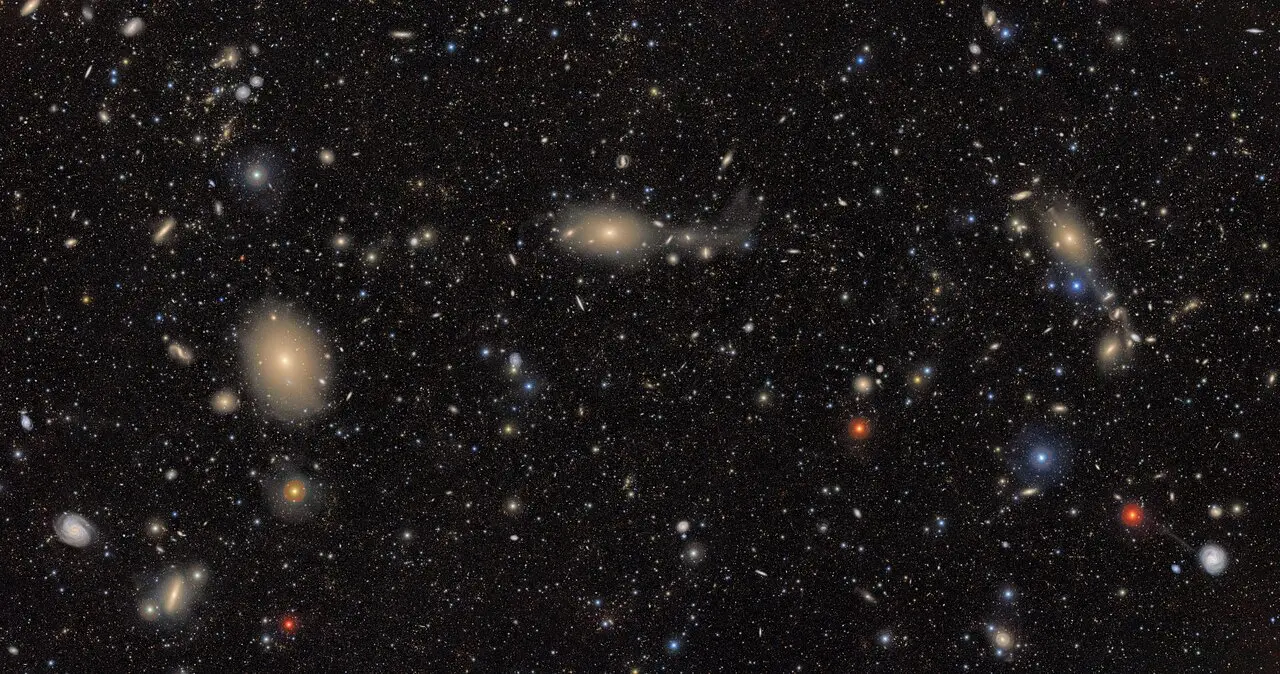
In June 2025 the Vera C. Rubin Observatory released its first images. One patch covers the southern Virgo Cluster: millions of galaxies, 55 million light-years away, assembled from 1,185 exposures in seven nights. The tiles you see are that image, laid on this map.
NSF–DOE Vera C. Rubin Observatory/NOIRLab/SLAC/AURA · Original image and terms · CC BY 4.0. Web-sized reproduction.
See the tiles for yourself.


How to see it tonight
The Virgo Cluster itself is a real telescope target, faint smudges of individual galaxies. The image the Rubin Observatory released in June 2025 is a separate thing. It is a processed mosaic, not something your eye or a telescope reproduces. This page is about that image.
The Virgo Cluster sits high in the sky on spring evenings from the north and autumn evenings from the south. It holds thousands of galaxies, though only its brightest members show up in amateur equipment.
In June 2025 the Vera C. Rubin Observatory in Chile released its first public images. One covers the southern part of the Virgo Cluster, about 55 million light-years away. It was built from 1,185 exposures taken over seven nights.
Point a small telescope at the cluster’s brightest members, such as M87 or M49, and you’ll find faint, fuzzy patches. None of the color or crowd of galaxies the Rubin image reveals shows up that way. That depth comes from stacking over a thousand exposures, far more than any single night of amateur observing can match.
What to expect: eyes, binoculars, telescope, photograph
What you actually see changes completely with equipment. Here is each view, sourced.
| View | What you can expect |
|---|---|
| Naked eye | The Virgo Cluster is far too faint to see without equipment. At roughly 55 million light-years, none of its galaxies register to the unaided eye. NOIRLab describes the cluster’s distance and scale. |
| Binoculars | Under an exceptionally dark sky, the cluster’s very brightest members can appear as extremely faint smudges. This is a cautious estimate; most binocular users will see nothing here at all. |
| Telescope | A small telescope can find bright members like M87 or M49 as faint, fuzzy patches. Individually resolving the thousands of fainter galaxies in Rubin’s frame is beyond any amateur telescope. |
| Photograph | The Rubin First Look mosaic is what SkyLumi overlays on the map: real observatory tiles, not a drawing. It was assembled from 1,185 exposures over seven nights. NOIRLab details the image and its scale. |
What SkyLumi does
SkyLumi lays the actual Rubin First Look tiles onto the map at the Virgo Cluster’s position. Pinch in and explore the real released image, not a drawing of it.
Search jumps straight to the target. AR lines the map up with your camera; Night Vision keeps a deep red display for dark adaptation.
The core sky works offline, no account, no ads. The Rubin tiles and other survey imagery stream in as you zoom and need a connection.
A few things to know.
Can I actually see the Virgo Cluster with my own telescope?
Its brightest members, like M87, appear as faint, fuzzy patches in a small telescope. The thousands of fainter galaxies in Rubin’s image stay well beyond amateur equipment.
What exactly did Rubin release in June 2025?
Its first public images, including a mosaic of the southern Virgo Cluster built from 1,185 exposures taken over seven nights.
Is the image on SkyLumi a real photograph?
Yes. SkyLumi overlays the actual Rubin First Look tiles on the map, not an illustration.
Why does the image show so many more galaxies than a telescope would?
It stacks over a thousand exposures taken over several nights. That depth reveals galaxies far too faint for a single look through any eyepiece.
More in the Sky Library
Sources and image credit
Image attribution and original terms are linked beneath the image. Use of imagery does not imply endorsement of SkyLumi.