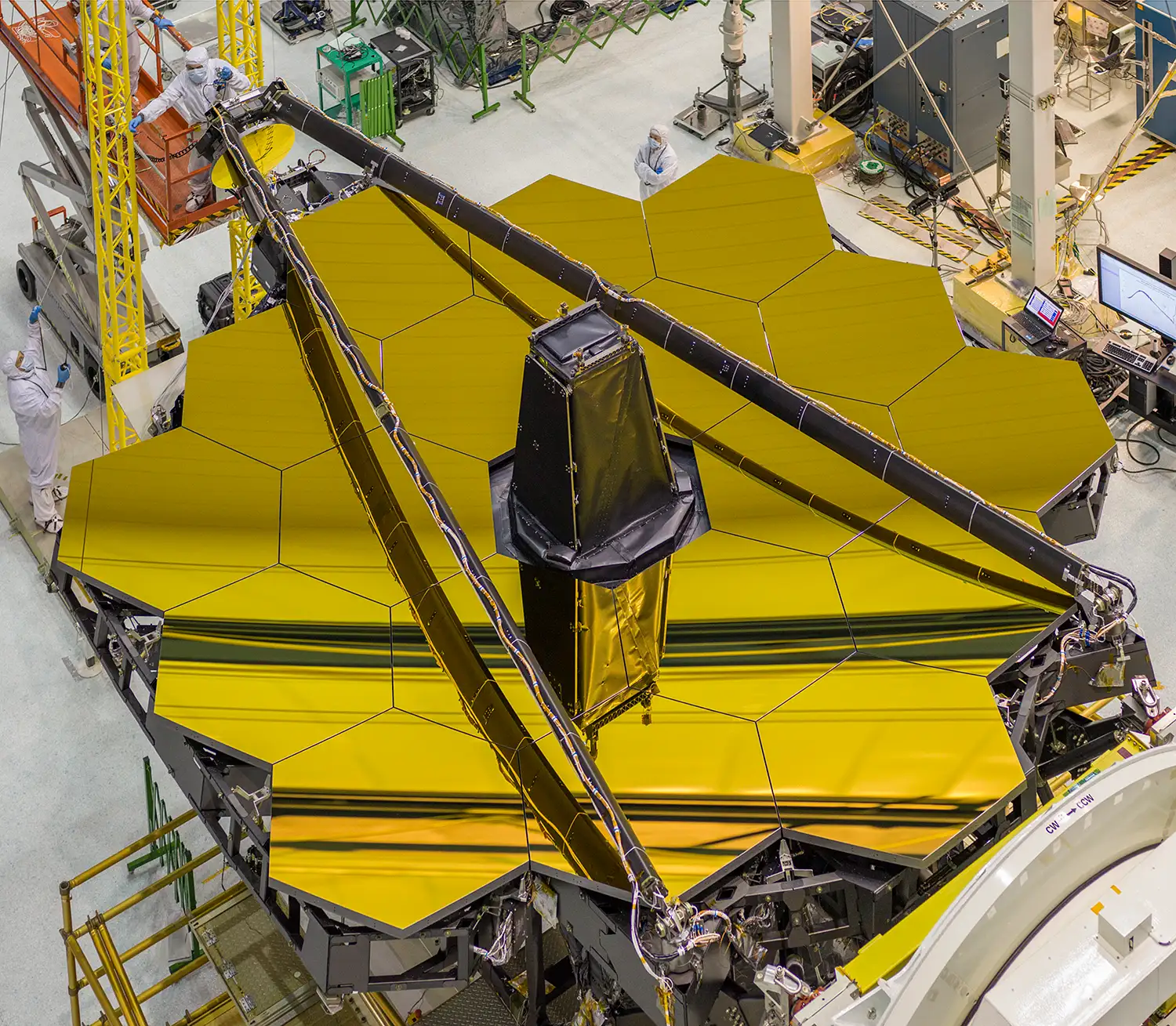
The largest space telescope sits 1.5 million km out, opposite the Sun. Its 18 gold mirrors sit behind a tennis-court sunshield at −230°C. At midnight, it is in the darkest sky.
NASA/Goddard/Chris Gunn · Original image and terms. Web-sized reproduction.
Point at midnight.


How to see it tonight
You cannot see the James Webb Space Telescope. It carries no light bright enough to spot, and no amateur telescope can find it either. This page points you toward its direction, not toward a sighting.
Webb orbits a fixed point 1.5 million kilometers from Earth, called the second Lagrange point, or L2. NASA describes it as a spot where gravity lets a spacecraft stay in line with Earth. Both then circle the Sun together. L2 sits on the side of Earth facing away from the Sun. So its direction is also the direction of the darkest part of your sky.
That darkest point sits highest overhead at local midnight. Face away from where the Sun set, then look up. At midnight, you are pointing close to Webb, within a few degrees.
What sits there is 18 gold-coated hexagonal mirror segments, a little over six meters across altogether. They fold out behind a five-layer sunshield roughly the size of a tennis court. The shield keeps the mirrors near minus 230 degrees Celsius. That is cold enough to detect the faint heat of the first galaxies.
The anti-solar point exists every night, from every location, so there is no season or hemisphere to wait for. What changes through the night and the year is exactly where midnight sky sits.
Webb launched on December 25, 2021, and reached L2 about a month later. It studies the whole history of the universe, from the first galaxies to planets forming around nearby stars. Thousands of astronomers worldwide use its data.
Hubble, by comparison, circles Earth just 560 kilometers up. That is close enough that Earth’s own heat and light would swamp Webb’s infrared instruments. L2’s distance is what makes the cold, dark view possible.
What SkyLumi does
Open Aim and hold your phone toward the sky. The map follows your hand and marks the anti-solar direction, where Webb orbits, at any hour.
Search jumps to any named target. AR lines the sky map up with your camera. Labels then sit over the real sky when you hold your phone up. Night Vision keeps a deep red display so your eyes stay dark-adapted.
The core sky, stars, planets and constellations, works offline. No account, no ads. Pinching into deep survey imagery from Pan-STARRS, SkyMapper and DSS2 needs a connection. It shows other objects, not Webb itself, since Webb has no visible glow to photograph from Earth.
A few things to know.
Can I see the James Webb Space Telescope with a telescope?
No amateur telescope can find it. It orbits far past the Moon, roughly 1.5 million kilometers out, and reflects no light bright enough to spot from Earth. SkyLumi shows the direction, not a sighting.
Where exactly is L2?
L2 sits on the side of Earth facing away from the Sun, in line with both. That makes its direction the same as your local midnight sky, roughly overhead when the Sun is at its lowest.
Why does Webb need to be so cold?
It detects infrared light, essentially heat, from the first galaxies. Its own warmth would drown that signal out. A sunshield the size of a tennis court keeps it near minus 230 degrees Celsius.
Do I need a telescope to find the direction?
No. SkyLumi’s Aim mode draws the direction on your phone from any location, any night, using only your phone’s own sensors.
More in the Sky Library
Sources and image credit
Image attribution and original terms are linked beneath the image. Use of imagery does not imply endorsement of SkyLumi.