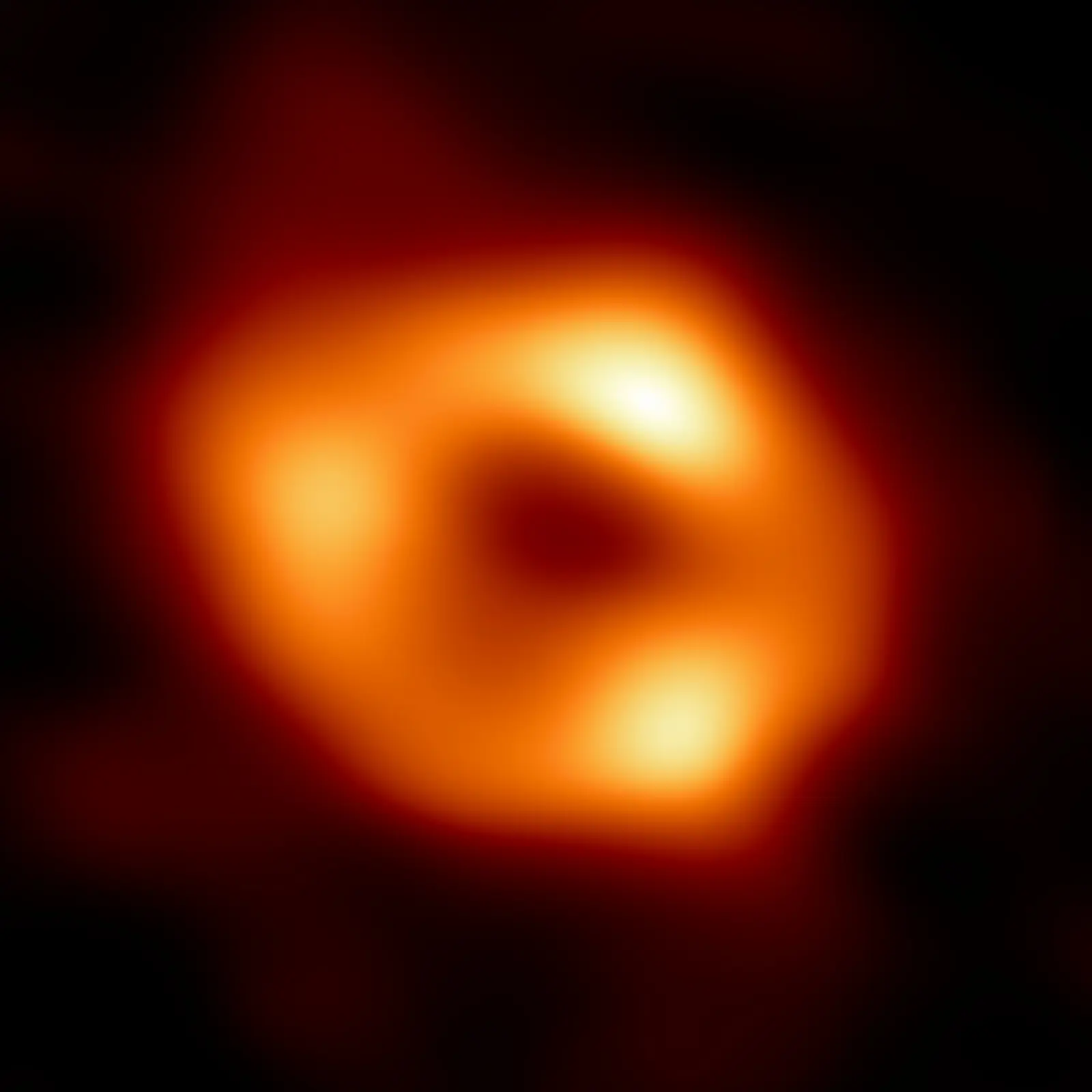
The Milky Way’s central black hole: 4 million Suns, 26,000 light-years away, just off the Teapot’s spout. It was photographed in 2022.
EHT Collaboration · Original image and terms · CC BY 4.0. Web-sized reproduction.
Find the galaxy’s center.


How to see it tonight
Sagittarius A* sits behind the Teapot shape in Sagittarius. It is best seen from May through October, much higher from the Southern Hemisphere.
You cannot see it, by eye or by any telescope. Thousands of light-years of dust block visible light from the galaxy’s center entirely.
From a dark site you can see the star field and glow of the Milky Way’s core in that direction. The black hole itself sits hidden behind it.
In 2022 astronomers produced the first image of it anyway. They linked radio telescopes worldwide into one Earth-sized instrument. The Event Horizon Telescope project made this possible.
Pinch in on the map and that radio image appears, a bright uneven ring around a dark shadow. It was not made by any conventional telescope, and no amateur instrument could ever reproduce it.
What to expect: eyes, binoculars, telescope, photograph
What you actually see changes completely with equipment. Here is each view, sourced.
| View | What you can expect |
|---|---|
| Naked eye | The Milky Way’s dense star field near the Teapot’s spout is visible from a dark site. The black hole itself emits no light a naked eye can catch. ESO confirms Sagittarius A* cannot be seen directly at any wavelength our eyes detect. |
| Binoculars | Binoculars deepen the same star field and the Milky Way’s glow, not the black hole. This is a cautious estimate. No source measures a specific binocular appearance for this crowded field, since it is simply dense starlight. |
| Telescope | A backyard telescope shows the same crowded star field in more detail, never the black hole. ESO confirms no optical telescope, at any size, can image Sagittarius A* directly. |
| Photograph | This page’s photograph is the 2022 Event Horizon Telescope image, made from radio data collected by telescopes worldwide. It is not from ordinary observatory survey imagery. ESO confirms it shows a black hole with about 4 million times the Sun’s mass, 26,000 to 27,000 light-years away. |
What SkyLumi does
Search jumps to the galaxy’s center, or Aim the phone toward the Teapot in Sagittarius. AR lines the sky over your camera, pointing at exactly where it sits.
SkyLumi’s own sky shows the crowded star field around it, the same field a telescope would show. The 2022 radio image on this page came from a dedicated global project, not from the app’s survey imagery.
Night Vision is a deep red display that keeps your eyes dark-adapted. No account, no ads. The core sky works offline.
A few things to know.
Can I see the black hole at the center of our galaxy?
No, never directly, by eye or by any telescope. Dust blocks the visible light, and a black hole itself emits none to see.
How was Sagittarius A* photographed, then?
With radio telescopes, not an ordinary camera. The Event Horizon Telescope linked observatories worldwide into one instrument the size of Earth.
How big is Sagittarius A*?
About 4 million times the mass of the Sun, roughly 26,000 to 27,000 light-years away. It is far smaller than M87’s black hole. Both appear a similar size from Earth, because M87’s black hole is much farther away.
Why is it called Sagittarius A*?
It sits in the direction of the constellation Sagittarius. The asterisk marks it as an exceptional radio source, the naming convention astronomers use for it.
More in the Sky Library
Sources and image credit
- ESO: the Event Horizon Telescope and the Milky Way’s black hole
- ESO: Sagittarius A* and M87*, compared to scale
Image attribution and original terms are linked beneath the image. Use of imagery does not imply endorsement of SkyLumi.