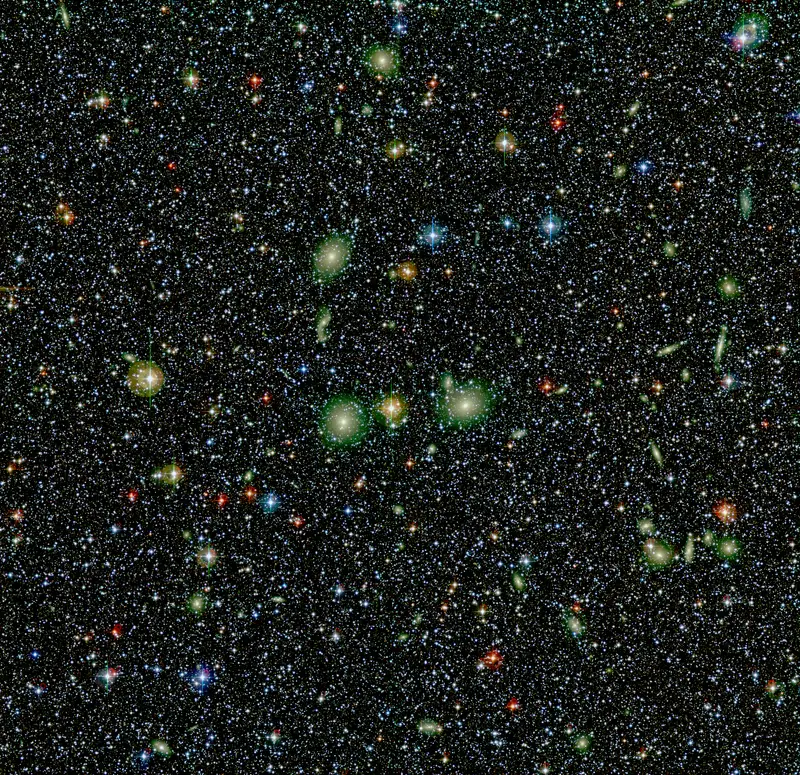
Everything nearby, the Milky Way, Andromeda, the whole neighborhood, streams toward one region at ~600 km/s. It hides behind our galaxy’s dust. Expansion means we never arrive.
ESO · Original image and terms · CC BY 4.0. Web-sized reproduction.
Find the hidden direction.


How to see it tonight
The Great Attractor is not a single object you can point a telescope at. It is a region, dominated by an enormous concentration of galaxy clusters. It pulls our entire galactic neighborhood toward it at roughly 600 kilometers a second. It cannot be seen, by eye, binoculars or any consumer telescope.
The direction lies toward the constellations Centaurus and Norma. That is best placed for southern hemisphere observers, low or unreachable from much of the north. Even a large observatory struggles here. Thick dust and dense star fields, in our own galaxy’s disk, sit directly in the way. Astronomers call that band the Zone of Avoidance.
The Norma Cluster sits at the heart of the pull, an enormous grouping of galaxies. It is about 220 to 250 million light-years away. Its brightest members are far too faint, and too obscured by foreground dust, for any amateur telescope. Even professional optical surveys see only a fraction of what radio and infrared telescopes map through the dust.
Nothing about this is a failure of equipment. The obscuring dust belongs to our own galaxy, sitting directly between us and the target. Astronomers only pieced together the Great Attractor’s existence in the 1980s. They noticed that galaxies around us were all drifting the same way.
The pull was first reported in 1987, by a group of seven astronomers nicknamed the Seven Samurai. They measured the motions of about 400 elliptical galaxies, and found them all streaming one way. It took until the 1990s to find the cluster driving it. Infrared and radio surveys, which see through dust more easily, finally did the job.
That survey identified the Norma Cluster as the center of the pull. A 1999 survey of one small patch of this obscured region used modern electronic detectors, instead of older photographic plates. It still turned up previously undetected dwarf galaxies, and roughly 200,000 foreground stars from our own galaxy, in one image. Most of what lies behind the dust remains unmapped.
What SkyLumi does
Search for the Great Attractor and SkyLumi points the map at the real direction, toward Centaurus and Norma. Aim your phone that way, or open AR to see the direction marked against the stars above you tonight.
Pinch in and the view moves into real observatory survey imagery of that patch, from Pan-STARRS, SkyMapper and DSS2. It is dominated by the dense star fields and dust of our own galaxy’s disk. That crowded, dusty view is the honest picture: it is what stands between us and the Great Attractor.
Night Vision keeps your eyes dark-adapted with a deep red display. No account, no ads. The core sky works offline; survey imagery needs a connection.
A few things to know.
Can I see the Great Attractor?
No, not with any telescope. It is a region hidden behind our own galaxy’s dust, not a single visible object. Even professional surveys only partly see through that dust, using infrared and radio light.
Is our galaxy actually falling into it?
Our galaxy and its neighbors stream toward that region at roughly 600 kilometers a second. That motion was first reported in 1987. The universe’s own expansion carries everything apart faster than that pull draws things in, so nothing is expected to arrive.
What is actually there?
An enormous concentration of galaxy clusters, centered on the Norma Cluster, roughly 220 to 250 million light-years away. Its full extent behind the Milky Way’s dust is still being mapped.
Why is it hidden?
The direction toward the Great Attractor happens to pass straight through the thickest part of our own galaxy’s disk. Dust and crowded star fields there block most of the light from anything farther out.
More in the Sky Library
Sources and image credit
Image attribution and original terms are linked beneath the image. Use of imagery does not imply endorsement of SkyLumi.