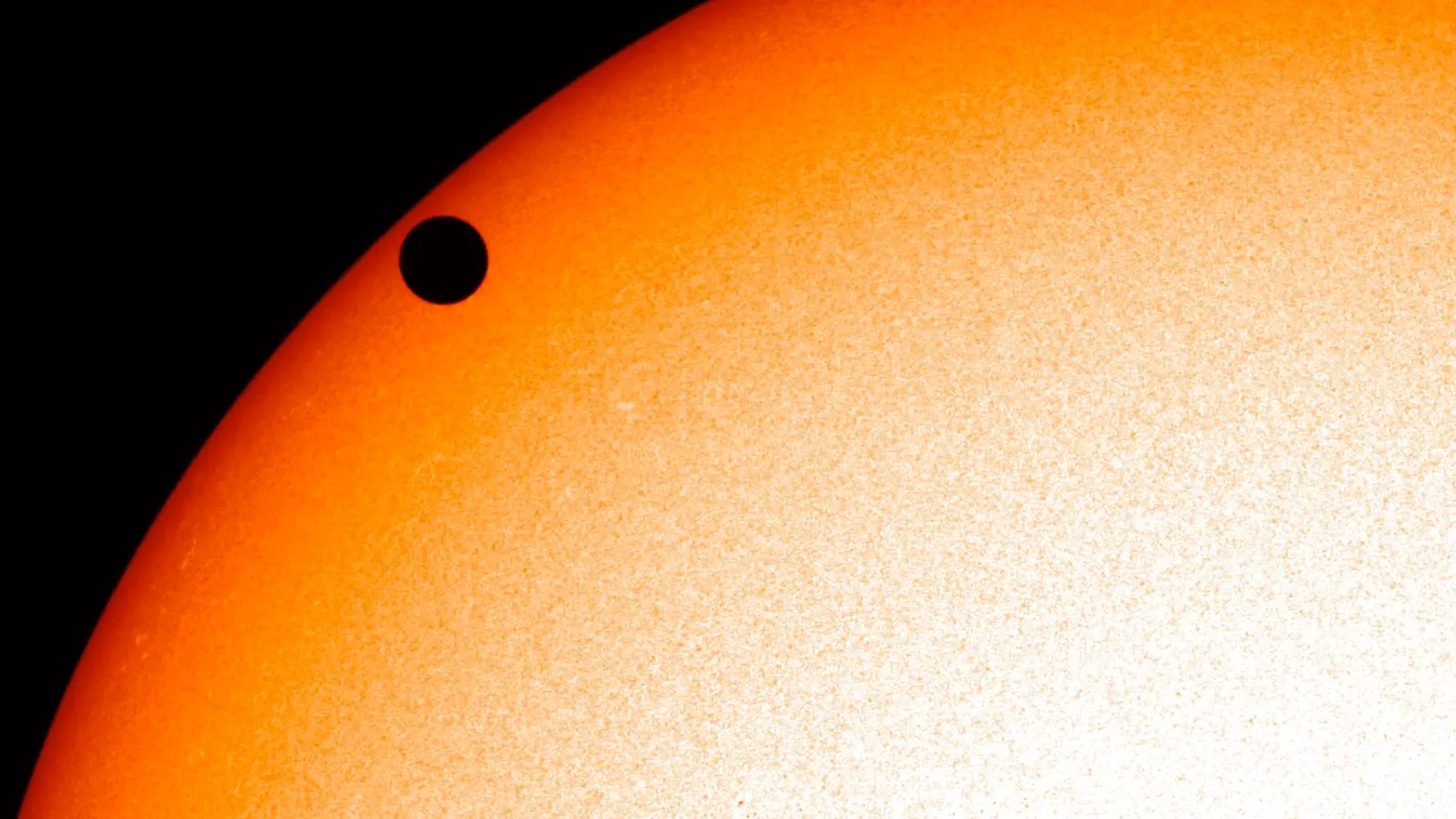
The thin sky band where Earth's transit across the Sun is detectable. ~1,700 star systems have had that view in 5,000 years; ~75 are close enough to have received our broadcasts.
NASA/SDO, HMI · Original image and terms. Web-sized reproduction.
Find the ribbon.


How to see it tonight
The Earth Transit Zone is not something you can see. It’s a narrow band of sky. A star system inside it would see Earth cross the Sun, the way we spot planets around other stars. This page marks the direction, not a sighting.
Astronomers find most known planets by watching a star’s light dip slightly as a planet passes in front of it. The Earth Transit Zone is the reverse. It’s the strip of sky from which someone else could watch Earth make that same crossing.
A 2021 study estimated that roughly 1,700 star systems have had that view of Earth over the last 5,000 years. Around 75 of the closest ones are near enough to have already picked up Earth’s radio and television broadcasts.
The band tracks the ecliptic, the same path the Sun, Moon and planets follow across the sky. Some part of it is above the horizon on every clear night. Which stars sit inside it depends on precise position, not on anything visible to the eye.
Membership changes over time, since stars drift. The same 2021 study found that TRAPPIST-1, a well-known planet-hosting star, will enter the zone in about 1,642 years. Others are already leaving it.
The researchers also project forward. Another 319 stars are expected to enter the zone over the next 5,000 years. That adds to the roughly 1,700 that already had the view.
What SkyLumi does
SkyLumi draws the Earth Transit Zone as a thin band along the ecliptic on the live sky map. You can see exactly where that strip of sky runs tonight.
Search, Aim and AR work the same way across the rest of the app. Point your phone and the map lines up with the real sky. Night Vision keeps a deep red display for dark adaptation.
The core sky works offline, no account, no ads. Deep survey imagery of individual stars in the zone needs a connection and streams in when you pinch to zoom.
A few things to know.
Can I see the Earth Transit Zone in the sky?
No. It’s a calculated band of sky, not a visible feature. SkyLumi draws it as a marked ribbon so you can see where it runs.
How many star systems could actually detect Earth this way?
A 2021 study put the number at roughly 1,700 over the last 5,000 years. The researchers themselves treat this as an estimate, not a precise count.
Has anyone out there actually heard from us?
Nobody knows. The study identified around 75 nearby systems close enough to have already received Earth’s radio and television broadcasts. Whether anyone is listening is a separate question.
Does the zone move?
The band tracks the ecliptic and stays fixed relative to the stars. Which part sits above your horizon changes through the night and the year, like the rest of the sky.
More in the Sky Library
Sources and image credit
- Kaltenegger & Faherty, “Past, present and future stars that can see Earth as a transiting exoplanet,” Nature (2021), preprint
- NASA: how astronomers detect exoplanets
Image attribution and original terms are linked beneath the image. Use of imagery does not imply endorsement of SkyLumi.