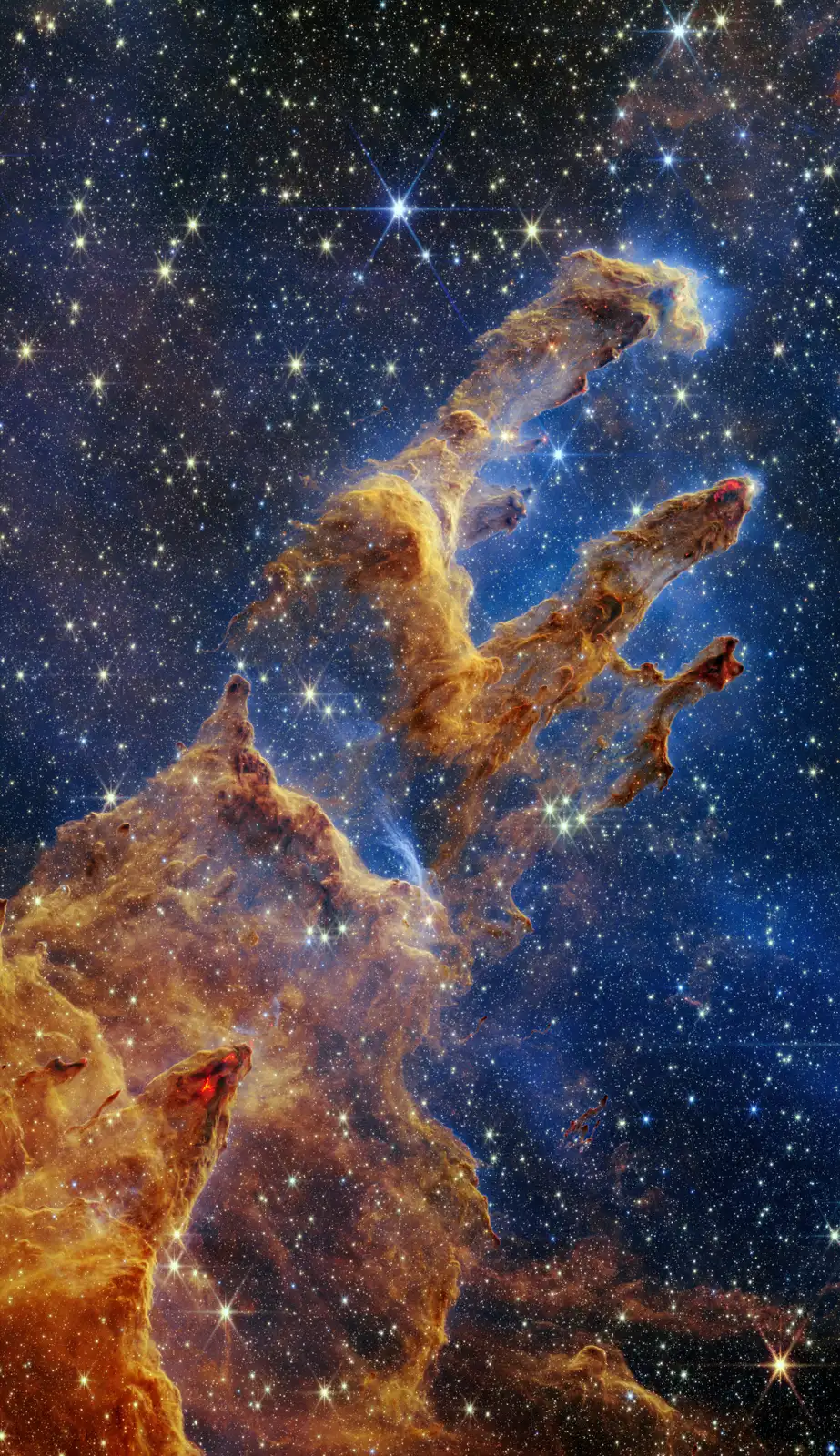
Star-forming dust columns in the Eagle Nebula (M16), ~6,500 light-years away, each several light-years tall. Hubble’s 1995 image shows dust; Webb’s infrared reveals newborn stars inside.
NASA, ESA, CSA, STScI; J. DePasquale, A. Koekemoer, A. Pagan (STScI). · Original image and terms · CC BY 4.0. Web-sized reproduction.
See the photograph.


How to see it tonight
The Pillars of Creation sit inside the Eagle Nebula, in Serpens, part of the summer Milky Way band. They are best placed on summer evenings.
There is no way to see the pillars themselves by eye. Even from the darkest sky, no telescope, amateur or otherwise, resolves that structure visually.
What you can see is the Eagle Nebula’s wider star cluster, and under dark skies, a faint glow around it. The famous pillar shapes exist only in long-exposure photographs from Hubble and Webb.
Hubble photographed the pillars in visible light in 1995, and the image became one of astronomy’s most recognized. Webb later imaged the same pillars in infrared, light that passes through dust, revealing young stars hidden inside.
Pinch in on the map and the sky becomes that photograph. Nothing about this object is visible to an eye at the eyepiece. The picture is the whole point.
What to expect: eyes, binoculars, telescope, photograph
What you actually see changes completely with equipment. Here is each view, sourced.
| View | What you can expect |
|---|---|
| Naked eye | The wider Eagle Nebula star cluster sits at magnitude 6, near naked-eye visibility from a dark site. The pillars themselves are never visible by eye, at any size. ESA/Webb and Hubble imagery is the only way to see their structure. |
| Binoculars | Binoculars under a dark sky may show the cluster’s brighter stars and a faint haze around them. This is a cautious estimate. The pillar structure inside that haze is never resolved by eye, at any magnification. |
| Telescope | A telescope under dark skies can deepen the faint nebulosity around the cluster. The pillar shapes themselves, several light-years tall, are not something any amateur telescope resolves visually. NASA confirms the pillars are roughly 5 light-years tall, a scale only a space telescope’s long exposure can capture. |
| Photograph | SkyLumi’s photographic view uses real observatory survey imagery, from Pan-STARRS, SkyMapper and DSS2. The Sky Library photograph above is Webb’s dedicated image of the pillars, not from that live survey. NASA confirms Webb’s infrared view reveals stars forming inside the dust that Hubble’s visible-light image could not show. |
What SkyLumi does
Search jumps to the Eagle Nebula, or Aim the phone toward Serpens, in the summer Milky Way band. Pinch in on the map to see the same patch of sky.
SkyLumi’s own survey imagery shows the wider nebula and its cluster, not the resolved pillar structure. The dedicated Hubble and Webb photograph on this page is what actually shows the pillars.
Night Vision is a deep red display that keeps your eyes dark-adapted. No account, no ads. The core sky works offline.
A few things to know.
Can I see the Pillars of Creation through a telescope?
No. No telescope, amateur or professional and used visually, resolves that structure. Only long-exposure photographs from Hubble and Webb show it.
What does the naked eye actually see in that part of the sky?
At best, a faint star cluster and a hint of nebular glow from a dark site. The famous pillar shape is invisible to the eye.
Why do the Hubble and Webb photographs of the pillars look so different?
Hubble used visible light, which dust blocks, and shows the pillars as solid columns. Webb used infrared, which passes through dust and reveals young stars hidden inside.
How far away are the Pillars of Creation?
About 6,500 light-years. Light left them long before recorded history began, so the pillars we see are as they looked millennia ago.
More in the Sky Library
Sources and image credit
- NASA: Hubble goes high-def to revisit the Pillars of Creation
- ESA/Webb: the Pillars of Creation in mid-infrared
Image attribution and original terms are linked beneath the image. Use of imagery does not imply endorsement of SkyLumi.