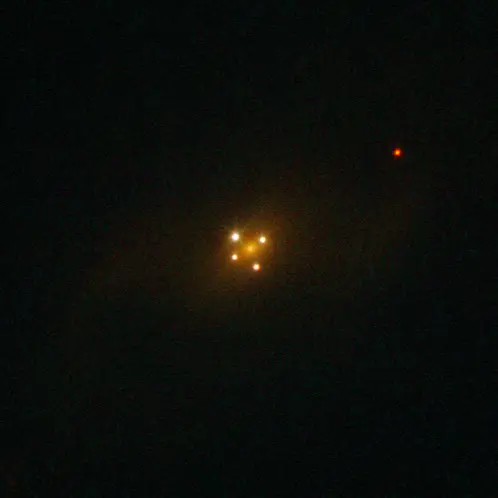
One quasar, 8 billion light-years away, appears 4 times because a foreground galaxy bends its light along different paths. This is gravitational lensing, exactly as Einstein predicted.
ESA/Hubble & NASA · Original image and terms · CC BY 4.0. Web-sized reproduction.
Find the real spot.


How to see it tonight
The Einstein Cross is a real object, not an illustration. It sits at the very edge of what any ground telescope can reach. A single distant quasar appears four times around a much closer foreground galaxy. That galaxy’s gravity bends the quasar’s light along four different paths to reach us.
It lies in Pegasus, well placed for northern hemisphere autumn evenings. Many southern observers can find it in that season too, though lower on the horizon. The lensing galaxy glows around magnitude 15 to 16. The four quasar images are fainter still, and change brightness unpredictably as stars in the foreground galaxy drift past.
Seeing any part of the cross through an eyepiece takes a telescope with a mirror of 18 inches or larger. It also takes genuinely dark skies and patience. That places it well past ordinary amateur equipment, in territory usually reserved for large observatory-club instruments. A smaller telescope, or a camera lens, will not resolve the four images.
The foreground galaxy is about 400 million light-years away. The quasar behind it is roughly 8 billion light-years away, twenty times farther. Einstein’s general relativity predicted that gravity could bend light this way, decades before anyone found a real example.
Astronomer John Huchra found the system in 1985, during a survey mapping galaxy distances rather than searching for lenses. That is why it is sometimes called Huchra’s Lens. Only a handful of lensed quasars were known then; astronomers have since cataloged several hundred.
The Einstein Cross also holds another first. Astronomers directly detected microlensing here, the extra flicker caused by a foreground star drifting across one image’s line of sight. That technique, discovered on this exact object, is now used across astronomy.
What SkyLumi does
Search for the Einstein Cross and SkyLumi points the map at its real coordinates in Pegasus. Aim your phone at that patch, or open AR to see it marked against the sky tonight.
Pinch in and the view moves into real observatory survey imagery of that patch, from Pan-STARRS, SkyMapper and DSS2. At that resolution the four quasar images blur into the lensing galaxy’s glow, rather than splitting apart. Most amateur images show the same blur.
Night Vision keeps your eyes dark-adapted with a deep red display. No account, no ads. The core sky works offline; survey imagery needs a connection.
A few things to know.
Can I see the Einstein Cross with my telescope?
Only with a very large amateur instrument, roughly 18 inches of aperture or more, under excellent dark skies. Even then it is a serious challenge. The lensing galaxy alone is already a stretch, at magnitude 15 to 16.
What am I actually looking at?
One single quasar, 8 billion light-years away, whose light has been bent into four separate images. A much closer galaxy, 400 million light-years away, sits almost exactly in front of it, doing the bending.
Did Einstein predict this exact object?
He worked out that gravity could bend light, and produce multiple images of a background object. That was decades before this case was found. The Einstein Cross is a real, observed example of it.
Why do the four images change brightness?
Individual stars in the foreground galaxy drift across our line of sight to each image. That briefly magnifies it further, a process called microlensing, and makes the four images flicker independently over months and years.
More in the Sky Library
Sources and image credit
- ESA/Hubble: the gravitational lens G2237+0305 (Einstein Cross)
- NASA: first ESA Faint Object Camera images of the gravitational lens G2237+0305
Image attribution and original terms are linked beneath the image. Use of imagery does not imply endorsement of SkyLumi.