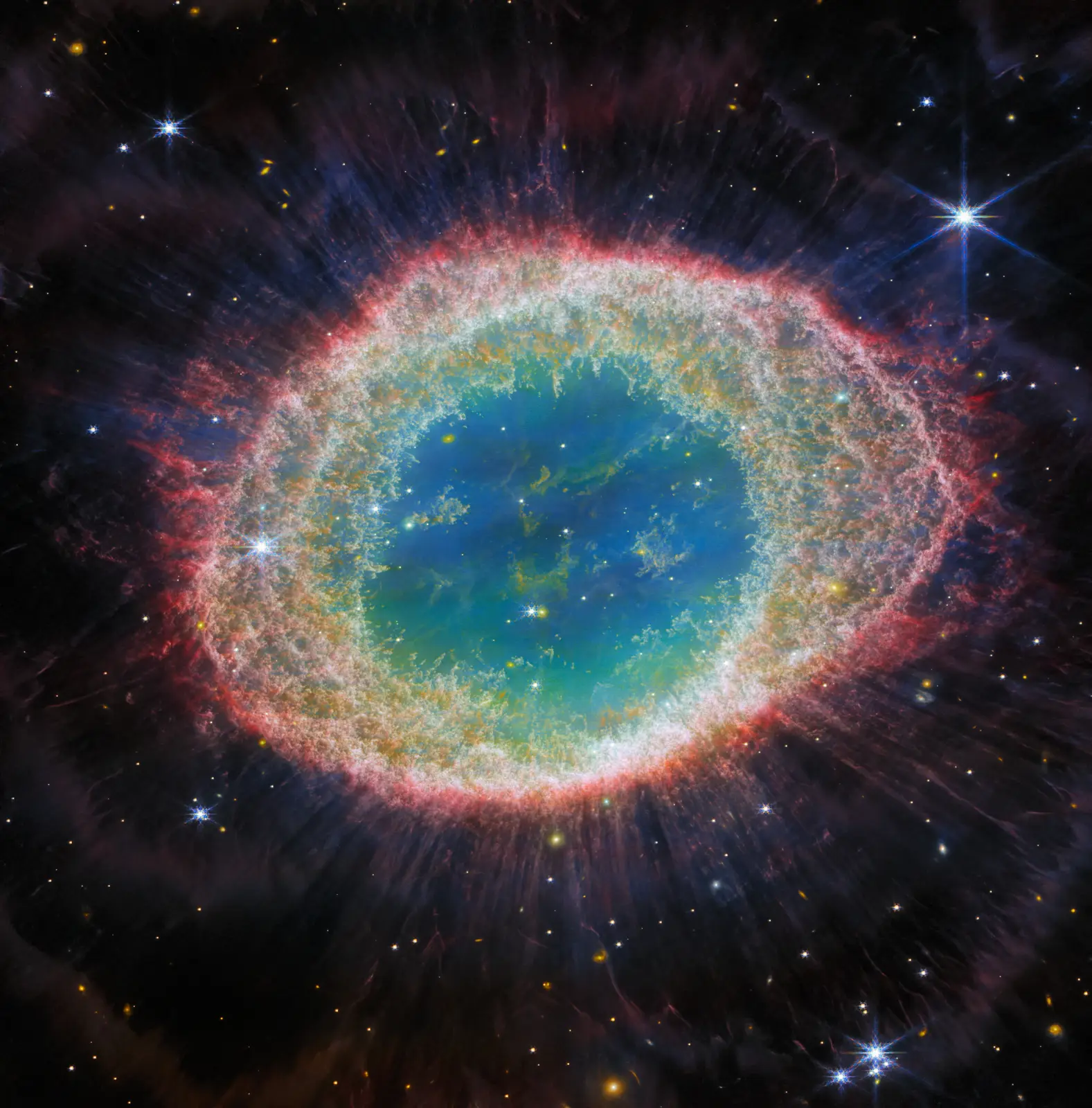
A dying Sun-like star’s outer layers: the Sun’s fate in ~5 billion years. Webb shows ~20,000 gas clumps and ~10 outer arcs, spaced ~280 years apart.
ESA/Webb, NASA, CSA, M. Barlow, N. Cox, R. Wesson · Original image and terms · CC BY 4.0. Web-sized reproduction.
See our Sun’s future.


How to see it tonight
The Ring Nebula sits in Lyra, close to the bright star Vega. From mid-northern latitudes it is well placed on summer evenings.
It is too faint for the naked eye and too small for binoculars to show clearly. A small telescope, though, is enough to see it.
Through a telescope it looks like a tiny, pale smoke ring, one of the classic targets for a first telescope. Larger apertures show more structure, but even the biggest backyard scope will not match a space telescope’s detail.
This is a dying star like our Sun, caught in the act of shedding its outer layers. NASA calls it a preview of the Sun’s own fate, roughly five billion years from now.
Pinch in on the map and the smoke ring becomes Webb’s photograph. It shows about 20,000 dense clumps of gas and faint outer arcs left by a companion star’s orbit.
What to expect: eyes, binoculars, telescope, photograph
What you actually see changes completely with equipment. Here is each view, sourced.
| View | What you can expect |
|---|---|
| Naked eye | At magnitude 8.8, the Ring Nebula is well below naked-eye visibility. NASA’s Hubble Messier catalog lists it at that brightness. |
| Binoculars | Ordinary binoculars mostly fail to show it as more than a faint star-like point, if anything. This is a cautious estimate. The nebula’s small size, under an arcminute, is the limiting factor, not just its faintness. |
| Telescope | A small telescope shows a distinct pale ring, one reason it is a favorite beginner target. NASA describes it as the glowing remains of a Sun-like star. |
| Photograph | SkyLumi’s photographic view uses real observatory survey imagery, from Pan-STARRS, SkyMapper and DSS2, not a drawing. ESA/Webb’s infrared image resolves about 20,000 individual gas clumps within the ring, detail no eye or backyard telescope reaches. |
What SkyLumi does
Find it with search, or Aim the phone toward Lyra, near Vega. Pinch into photographic survey imagery from Pan-STARRS, SkyMapper and DSS2.
Night Vision is a deep red display that keeps your eyes dark-adapted. No account, no ads.
The core sky works offline. High-resolution survey imagery streams as you zoom and needs a connection.
A few things to know.
Can I see the Ring Nebula with the naked eye?
No. At magnitude 8.8 it needs at least a small telescope. Binoculars mostly cannot show it clearly.
Why is the Ring Nebula shaped like a ring?
It is the ejected outer layers of a dying, Sun-like star. Seen roughly end-on, the shell looks like a ring rather than a shell.
Will our Sun really become something like this?
Yes. In about five billion years the Sun is expected to shed its outer layers the same way. It will leave a small, hot core behind.
What are the faint arcs around the outside of the ring?
Roughly ten faint arcs, spaced by a companion star’s orbit. Webb resolved them. They are far too faint for any backyard telescope.
More in the Sky Library
Sources and image credit
Image attribution and original terms are linked beneath the image. Use of imagery does not imply endorsement of SkyLumi.