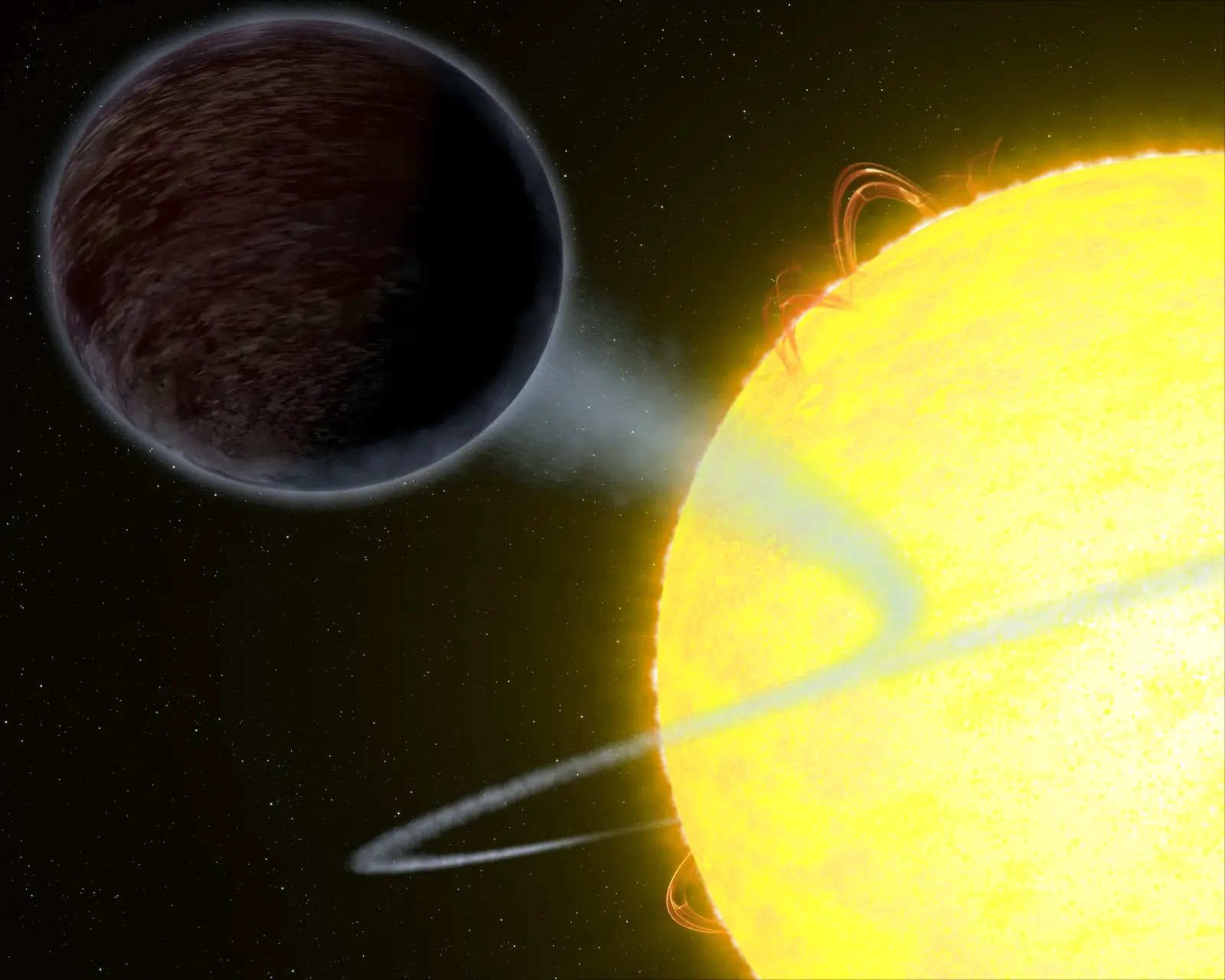
A planet on a ~1-day orbit, stretched egg-shaped by its star and losing ~6 billion tonnes each second. Darker than asphalt. It has ~10 million years left.
NASA, ESA, and G. Bacon (STScI) · Original image and terms · CC BY 4.0. Web-sized reproduction.
Find the real spot.


How to see it tonight
WASP-12b cannot be seen by any telescope available to an amateur, or most professional ones. It orbits so close to its star that a year there lasts about one Earth day. The star’s gravity has stretched the planet into an egg shape.
Its host star, WASP-12, sits in Auriga at magnitude 11.6, roughly 1,300 light-years away. That is well past naked-eye and binocular range. It needs a telescope of at least 8 inches of aperture, and dark skies, to find at all.
Through that telescope, WASP-12 looks like an unremarkable faint star. Nothing visible marks it as special. The real drama is a stream of atmosphere spiraling off the planet, into the star. It runs at roughly six billion tonnes a second. Space telescopes measured that in ultraviolet light, not by sight.
NASA estimates WASP-12b has around 10 million years left before it is fully consumed. On any human timescale that is unreachable. That is also why nobody will ever watch it happen.
The planet is nearly twice Jupiter’s width, but not close to twice its mass. It is a puffed-up, inflated planet, typical of the hottest gas giants found this close to their stars. It was found in 2008 by the transit method, watching WASP-12 dim slightly every 1.1 days. The same technique found Kepler-16b.
Daytime temperatures on WASP-12b reach roughly 2,200 degrees Celsius, hot enough to vaporize most metals. That heat is part of why the planet absorbs so much light rather than reflecting it back. WASP-12 itself is not alone, either. Two faint companion stars, both red dwarfs, share a slow, distant orbit around it. That pair plays no role in the doomed planet’s own fast one.
What SkyLumi does
Search for WASP-12 and SkyLumi points the map at the real star in Auriga. Aim your phone at that patch, or open AR to see it marked against the sky tonight.
Pinch in and the view moves into real observatory survey imagery of that patch, from Pan-STARRS, SkyMapper and DSS2. That is the same faint point a large telescope would show. The stretched, doomed planet is not visible in it, because it has never been directly photographed.
Night Vision keeps your eyes dark-adapted with a deep red display. No account, no ads. The core sky works offline; survey imagery needs a connection.
A few things to know.
Can I see WASP-12b being destroyed?
No. The mass loss was measured with ultraviolet spectroscopy from Hubble, not seen through any eyepiece. Even the host star needs a fairly large amateur telescope to find, at magnitude 11.6.
How is the planet shaped like an egg?
Tidal forces from the star stretch WASP-12b along the line pointing at it. That is the same kind of force that raises ocean tides on Earth. The effect is extreme this close in, at 1.1 days per orbit.
How long until it is gone?
NASA estimates roughly 10 million years. That sounds long, and for a planet on a one-day orbit, it is a short remaining lifetime.
Why is the planet so dark?
WASP-12b reflects very little of the light that hits it, among the least reflective planets measured. Most incoming light is absorbed rather than bounced back, part of why it runs so hot.
More in the Sky Library
Sources and image credit
Image attribution and original terms are linked beneath the image. Use of imagery does not imply endorsement of SkyLumi.