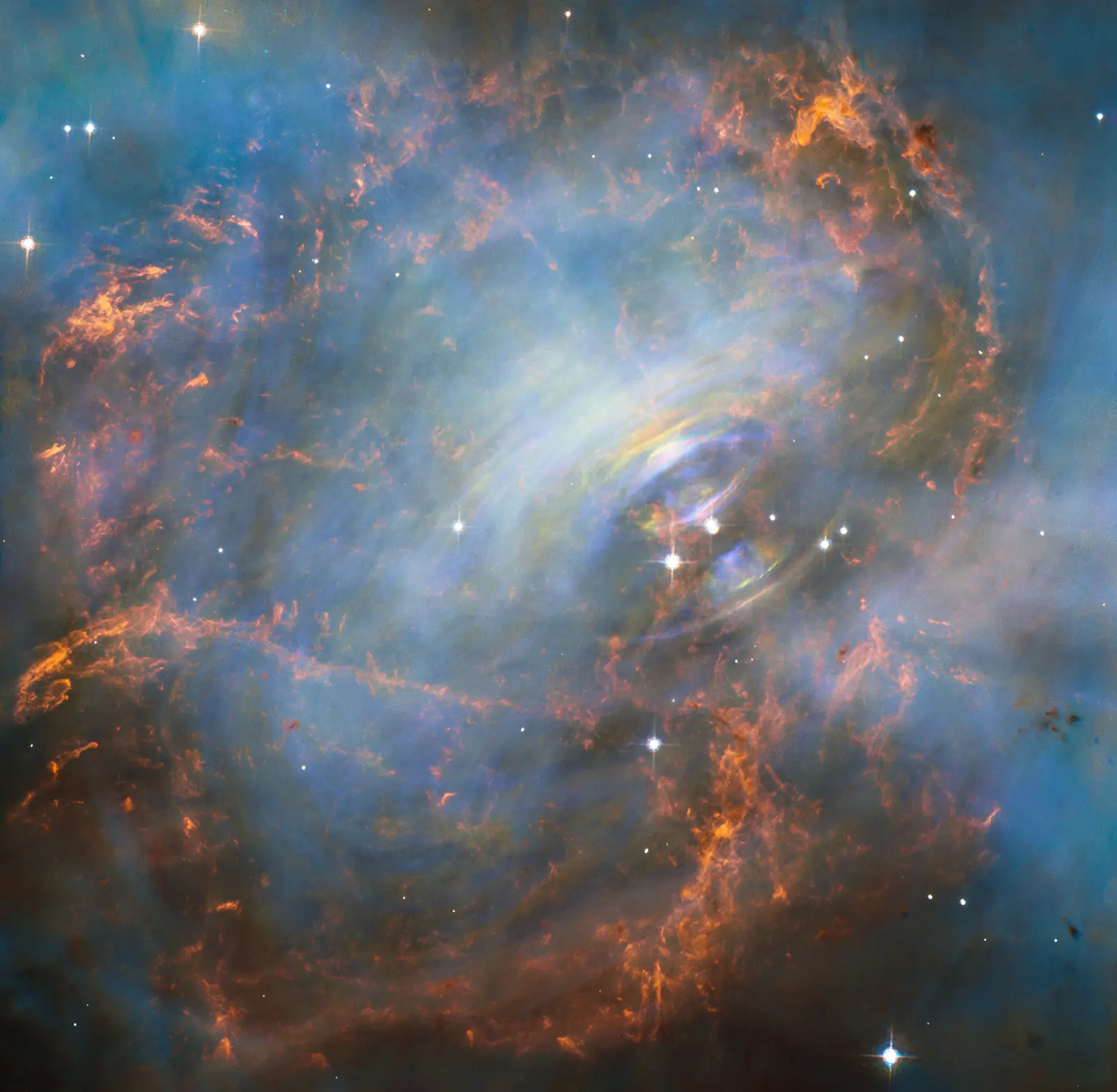
Collapsed star cores: more than a Sun’s mass in a city-sized sphere. The Crab spins 30×/second; the record holder, PSR J1748−2446ad, 716×/second. A teaspoon outweighs a mountain.
ESA/Hubble & NASA. Acknowledgement: Mahdi Zamani · Original image and terms · CC BY 4.0. Web-sized reproduction.
Find the wreckage.


How to see it tonight
A pulsar is fundamentally a radio and X-ray object, not something you look at with your eyes. It is a collapsed star core, heavier than the Sun and squeezed to about the size of a city. It spins fast enough to sweep a beam of radiation across space like a lighthouse.
The most famous one sits inside the Crab Nebula, in Taurus, spinning about 30 times a second. Taurus is a northern hemisphere winter evening constellation, also well placed for southern observers. The nebula around the pulsar, cataloged as Messier 1, shines at magnitude 8.4. That makes it a genuine binocular and small-telescope target from a dark site.
The pulsar itself, buried at the nebula’s center, is far fainter: around magnitude 16.5. That is reachable only with a large telescope of roughly 20 inches or more, under excellent dark skies. Even then, it appears as a faint, steady-looking star, not a flashing light. A pulsar’s pulse is a radio and X-ray phenomenon; an ordinary telescope cannot detect thirty flashes a second.
The fastest confirmed pulsar, PSR J1748-2446ad, spins 716 times a second. It sits inside a dense star cluster called Terzan 5, toward Sagittarius. Terzan 5 itself, around magnitude 13, is a genuine challenge for an 8-inch telescope. The individual pulsar inside it is entirely unresolvable by any optical instrument; radio telescopes found it, not eyes.
The first pulsar was found in 1967 by Jocelyn Bell Burnell, then a graduate student. She noticed a radio signal so regular that she and her supervisor briefly nicknamed it LGM-1, for Little Green Men. They later ruled out anything artificial. More than 3,000 pulsars are cataloged today, most with no visible counterpart at all.
Theorists calculate that a neutron star could spin at up to roughly 72,000 rotations a minute before flying apart. PSR J1748-2446ad, the current record holder, spins at about 43,000 rotations a minute. That is roughly 60 percent of the theoretical limit, already thought to be near the physical edge of survival.
What SkyLumi does
Search for the Crab Nebula, Messier 1, and SkyLumi points the map at the real object in Taurus. Aim your phone at that patch, or open AR to see it marked against the sky tonight.
Pinch in and the view moves into real observatory survey imagery of the nebula, from Pan-STARRS, SkyMapper and DSS2. It shows the actual supernova wreckage. The pulsar buried at its center stays unmarked, far too faint and small to resolve at that scale.
Night Vision keeps your eyes dark-adapted with a deep red display. No account, no ads. The core sky works offline; survey imagery needs a connection.
A few things to know.
Can I see a pulsar spinning through a telescope?
No. A pulsar’s rapid pulse is a radio and X-ray signal, invisible to the eye regardless of telescope size. Even the Crab pulsar itself, as a plain point of light, needs a very large amateur telescope, around magnitude 16.5.
What can I actually see?
The Crab Nebula is real wreckage from the supernova that made the pulsar. It is a genuine binocular and small-telescope target, at magnitude 8.4. The pulsar hidden inside it is a separate, fainter challenge, and its pulsing is never visible either way.
How fast is the fastest known pulsar?
716 times a second, held by PSR J1748-2446ad in the star cluster Terzan 5. Its equator moves at roughly a quarter of the speed of light.
Why are pulsars so dense?
A pulsar packs more mass than the Sun into a sphere about the width of a city. A single teaspoon of that material would weigh millions of tons.
More in the Sky Library
Sources and image credit
Image attribution and original terms are linked beneath the image. Use of imagery does not imply endorsement of SkyLumi.