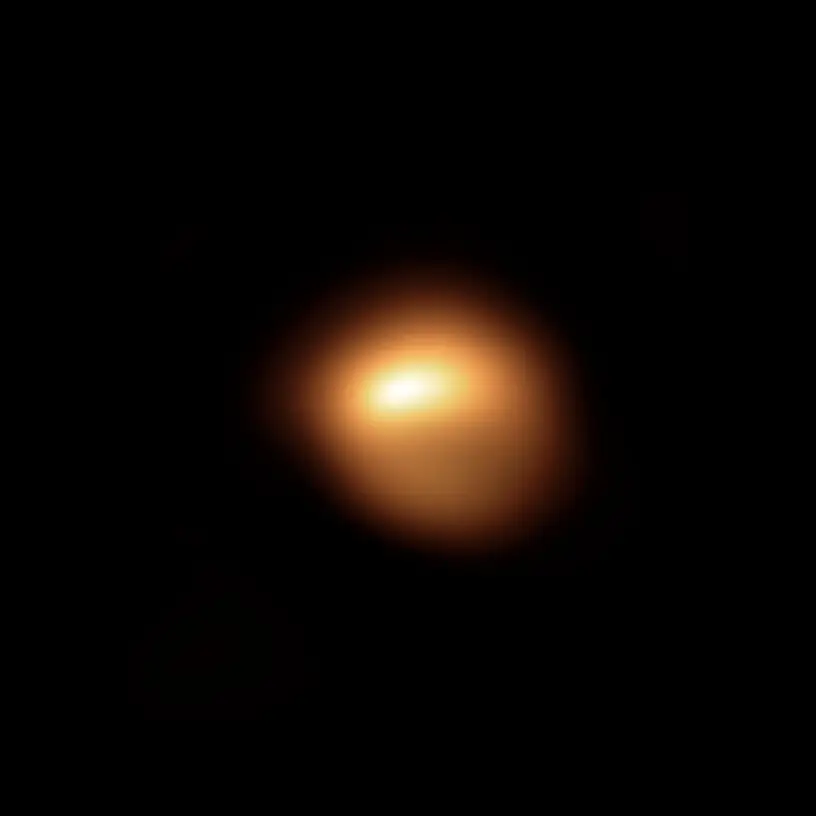
A red supergiant ~600 light-years away. At the Sun, it would engulf Mars. It will go supernova within ~100,000 years. Its light is 600 years old, so it may already have exploded.
ESO/M. Montargès et al. · Original image and terms · CC BY 4.0. Web-sized reproduction.
Find it tonight.


How to see it tonight
Betelgeuse marks Orion’s shoulder and is visible from almost everywhere on Earth, November through April evenings.
No equipment is needed to find it. Betelgeuse is one of the brightest stars in the sky, and its orange-red color is obvious even from a city.
Binoculars sharpen the color, but they show the same point of light. Even a large backyard telescope cannot resolve Betelgeuse into a disc.
Seeing its actual surface took a specialized instrument. In 2019 the SPHERE camera on the Very Large Telescope imaged Betelgeuse directly. It caught the star mid-dimming, lopsided and dark across one side.
Placed at the center of our solar system, Betelgeuse’s surface would reach past Mars and toward Jupiter’s orbit. It will eventually end in a supernova, but nobody knows exactly when. Estimates range from any day to roughly 100,000 years from now. Because its light takes centuries to reach Earth, the star could already be gone and we would not yet know.
What to expect: eyes, binoculars, telescope, photograph
What you actually see changes completely with equipment. Here is each view, sourced.
| View | What you can expect |
|---|---|
| Naked eye | Betelgeuse needs no equipment. It is a bright, clearly orange-red star on Orion’s shoulder. NASA’s Night Sky Network lists it among Orion’s most recognizable stars. |
| Binoculars | Binoculars make the color easier to judge against the sky. They show the same point of light as the naked eye. This is a cautious estimate. No source measures a specific binocular appearance for Betelgeuse, since it is simply a bright star, not a faint target. |
| Telescope | A backyard telescope, however large, still shows only a point of light. Resolving Betelgeuse’s actual disc needed the Very Large Telescope’s SPHERE instrument, with adaptive optics no home telescope has. ESO published the resulting image in 2020. |
| Photograph | This page’s photograph is that same observatory image, not an ordinary astrophotograph. It shows a lopsided, dimming disc, not the point of light the eye and most telescopes see. ESO confirms it was taken during Betelgeuse’s unusual 2019 dimming event. |
What SkyLumi does
Search jumps to Betelgeuse by name, or Aim the phone at Orion to find it directly. AR lines the sky over your camera so the star sits where it actually is.
SkyLumi’s own map shows Betelgeuse as a point of light, the way any telescope does. The observatory image above came from a specialized instrument, not from the app’s own survey imagery.
Night Vision is a deep red display that keeps your eyes dark-adapted. No account, no ads. The core sky works offline.
A few things to know.
Could Betelgeuse already be a supernova remnant?
Possibly. Its light takes centuries to reach Earth, so an explosion that already happened would not be visible yet. Nobody knows. Estimates for when it will explode range from any day to about 100,000 years from now.
Can I see Betelgeuse’s disc through my own telescope?
No backyard telescope can resolve it into a disc. You will see the same bright point as with the naked eye. The image on this page needed the Very Large Telescope’s adaptive optics.
How far away is Betelgeuse?
Roughly 500 to 650 light-years, depending on the method used to measure it. That range, not a single precise number, is the honest answer.
Will Betelgeuse’s supernova be dangerous to Earth?
No. It is far too distant to harm Earth. It would be dramatically bright, visible in daylight for weeks, but poses no physical danger.
More in the Sky Library
Sources and image credit
Image attribution and original terms are linked beneath the image. Use of imagery does not imply endorsement of SkyLumi.