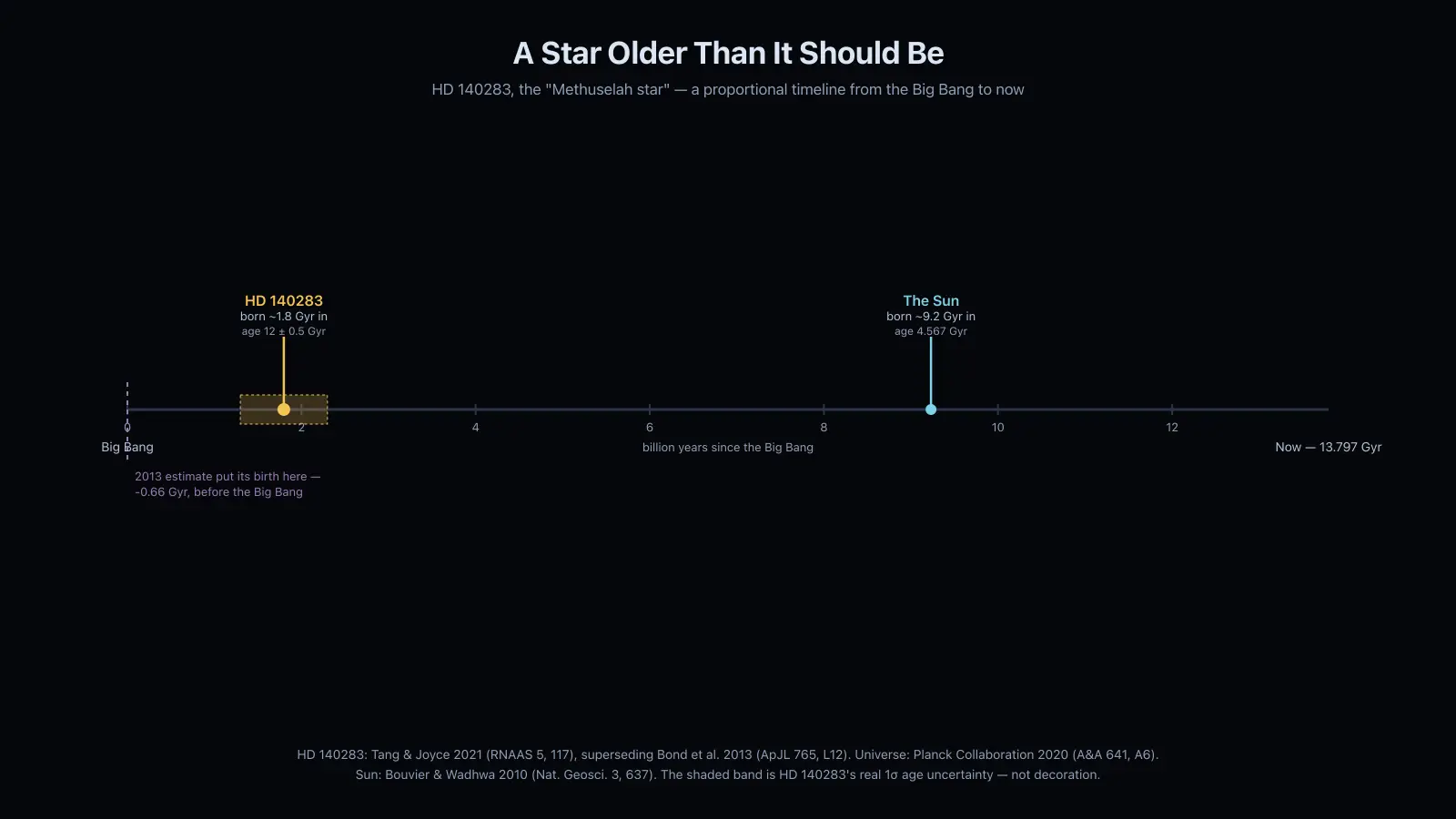
Its estimated age approaches the universe’s 13.8 billion years. It is nearly pure hydrogen and helium, formed before most heavier elements existed.
SkyLumi, ages from Tang & Joyce (2021), Bond et al. (2013) and Planck Collaboration (2020) · Original image and terms. Web-sized reproduction.
Find it in Libra.


How to see it tonight
The Methuselah Star, formally HD 140283, is real and findable. That sets it apart from most objects in this part of the Sky Library. It sits in Libra at magnitude 7.2, about 190 light-years away. Hubble measurements place its age close to the age of the universe itself.
Libra rises in evening skies through northern hemisphere spring and summer. It is well placed for southern hemisphere observers in the same months. At magnitude 7.2, HD 140283 is too faint for the naked eye under almost any conditions.
Binoculars reach it without much difficulty from a reasonably dark site. Through the eyepiece it looks entirely ordinary: a plain, whitish point of light. Nothing about its appearance hints at its age. A small telescope shows the same unremarkable star, just steadier.
Its age is not something any instrument shows directly. Astronomers derived it from the star’s distance, brightness, chemical makeup and structure. Hubble’s Fine Guidance Sensors pinned the distance down precisely. The 2013 result: 14.5 billion years, plus or minus 800 million years. That range overlaps the universe’s own age, about 13.8 billion years.
HD 140283 is a subgiant, a star that has used up the hydrogen fuel in its core. It is now evolving past the stage the Sun is in now. Its scarcity of heavy elements, only about one four-hundredth of the Sun’s share, is itself evidence of age. Those elements build up across a galaxy only after generations of stars have lived and died. Very few had when this one formed.
Astronomers think HD 140283 formed in a small dwarf galaxy. That galaxy later merged into the Milky Way, more than 12 billion years ago. It has been orbiting our galaxy’s halo ever since. Its path carries it far above and below the disk we live inside.
What SkyLumi does
Search for HD 140283 and SkyLumi points the map at the real star in Libra. Aim your phone at that patch, or open AR to see it marked against the sky tonight.
Pinch in and the view moves into real observatory survey imagery of that patch, from Pan-STARRS, SkyMapper and DSS2. It looks like an ordinary point among many others. Nothing in the photograph marks it as unusual either; the age comes from measurement, not appearance.
Night Vision keeps your eyes dark-adapted with a deep red display. No account, no ads. The core sky works offline; survey imagery needs a connection.
A few things to know.
Can I actually see the Methuselah Star?
Yes, with binoculars or a small telescope from a reasonably dark site. It is too faint for the naked eye, at magnitude 7.2. Modest equipment is enough to find it, unlike most other objects on this page.
How old is it exactly?
Hubble measurements put it at 14.5 billion years, plus or minus 800 million years. That range overlaps the universe’s own age of about 13.8 billion years. The star could be younger than the headline number, not genuinely older than the universe.
Why does it look so plain?
Nothing about a star’s appearance reveals its age directly. HD 140283 looks like any other faint white star. Its age comes from measuring distance, brightness and chemistry, not from how it looks.
What makes it so old in the first place?
It contains very little of the heavier elements, like carbon, oxygen and iron, that later stars are built from. That shortage marks it as having formed very early, before most of those elements existed.
More in the Sky Library
Sources and image credit
- NASA/Hubble: Hubble finds birth certificate of oldest known star
- NASA: stars, formation and life cycle
Image attribution and original terms are linked beneath the image. Use of imagery does not imply endorsement of SkyLumi.