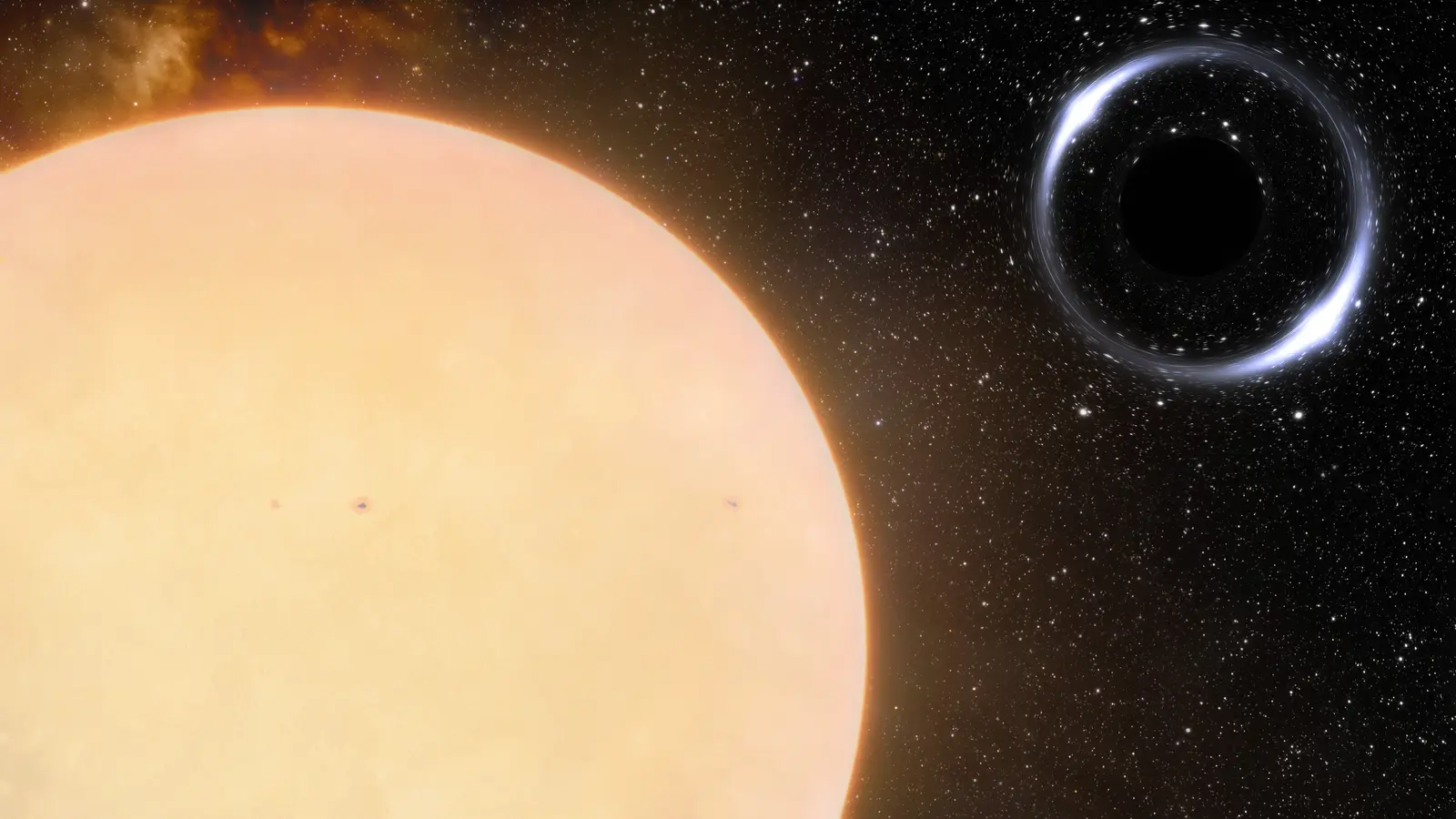
The nearest known black hole is ~1,560 light-years away. A Sun-like star wobbles around its invisible 10-solar-mass companion. Our galaxy may hold ~100 million more.
International Gemini Observatory/NOIRLab/NSF/AURA/J. da Silva/Spaceengine/M. Zamani · Original image and terms · CC BY 4.0. Web-sized reproduction.
Find the wobbling star.


How to see it tonight
A black hole that is not actively feeding gives off no light at all. Gaia BH1 is exactly that kind, completely dark in any telescope or photograph. What can be found is its companion, an ordinary Sun-like star orbiting the black hole once every 185.6 days.
That companion star sits in Ophiuchus, at magnitude 13.8, roughly 1,560 light-years away. Ophiuchus is best placed in northern hemisphere summer evenings, and reasonably well seen from southern latitudes in that season. Magnitude 13.8 is faint: it needs a mid-size or larger amateur telescope, well beyond binoculars.
Through the eyepiece the star looks completely unremarkable, a faint steady point like countless others nearby. Nothing visible marks it as orbiting anything unusual. The European Space Agency’s Gaia satellite measured its wobble instead. That tracked the star’s position to a precision no ground camera can match.
That wobble showed the star being tugged by something roughly ten times the Sun’s mass. It was too heavy and too dark to be another star. A black hole was the only explanation left. Astronomers estimate our galaxy holds around a hundred million black holes of similar mass. This is simply the closest confirmed.
Before Gaia BH1, almost every known stellar-mass black hole was found because it was actively pulling gas from a companion. That gas glows in X-rays. Gaia BH1 is dormant instead. It is not feeding on its companion at all, which is why this discovery matters.
Researchers combined years of the star’s radial velocity with Gaia’s own position measurements, to pin the companion’s mass down. The companion star’s orbit is roughly the size of Earth’s own path around the Sun. A black hole stands where a star would ordinarily be.
What SkyLumi does
Search for Gaia BH1 and SkyLumi points the map at the real coordinates of the companion star in Ophiuchus. Aim your phone at that patch, or open AR to see it marked against the sky tonight.
Pinch in and the view moves into real observatory survey imagery of that patch, from Pan-STARRS, SkyMapper and DSS2. It shows the star as an ordinary point among its neighbors. The black hole itself is not drawn, because it emits nothing to draw.
Night Vision keeps your eyes dark-adapted with a deep red display. No account, no ads. The core sky works offline; survey imagery needs a connection.
A few things to know.
Can I see the black hole itself?
No, never, by any instrument. It emits no light of its own. It is not pulling in and heating gas the way a feeding black hole does. What was measured is the motion of its companion star.
Can I see the companion star?
With a mid-size or larger amateur telescope, under dark skies, yes. At magnitude 13.8 it is too faint for binoculars or the naked eye. Through the eyepiece it looks like any other ordinary star.
How was it found if nothing can be seen?
The European Space Agency’s Gaia satellite measured a tiny, regular wobble in the companion star’s position. Something roughly ten times the Sun’s mass was pulling on it. Nothing that heavy and that dark could be anything but a black hole.
Are there really 100 million black holes in our galaxy?
That is the estimate astronomers work from, based on how many massive stars are thought to have collapsed. Only a small handful have actually been confirmed, Gaia BH1 among them.
More in the Sky Library
Sources and image credit
- ESA: Gaia discovers a new family of black holes
- El-Badry et al., "A Sun-like star orbiting a black hole," MNRAS (2023)
Image attribution and original terms are linked beneath the image. Use of imagery does not imply endorsement of SkyLumi.