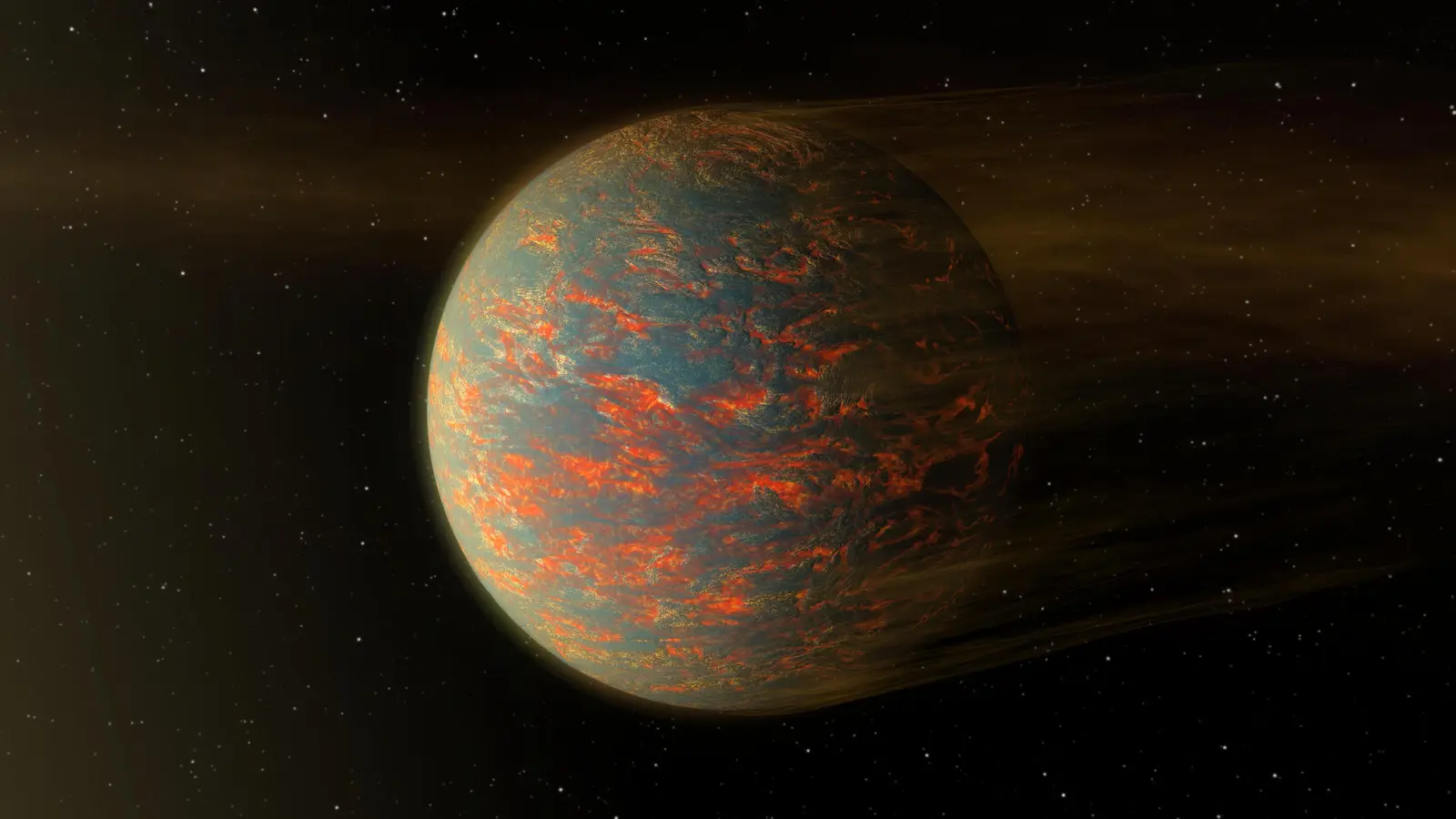
A planet twice Earth's size, covered in molten rock. Its year is 18 hours. Surface: 1,500°C+. Its star is visible to the naked eye from dark sites.
NASA/JPL-Caltech · Original image and terms. Web-sized reproduction.
Find the star you can see.


How to see it tonight
55 Cancri e itself is invisible, to the eye and to every telescope on Earth. What you can actually find is its star, 55 Cancri A, in Cancer. It is one of the few planet-hosting stars bright enough to spot without equipment, at magnitude 5.95.
Cancer is a faint constellation, best reached from a dark site. Look for it in northern hemisphere winter and spring evenings. It also clears the horizon for many southern observers in that season. Under a genuinely dark sky, 55 Cancri A shows as a dim, steady point. From a city, streetlight usually wins.
Binoculars make the star easy once you know where to look. A small telescope holds it steady enough to notice its faint orange-yellow color. None of that equipment reveals the planet. 55 Cancri e was found the same way most exoplanets are. Astronomers watched that star’s light dip, once every eighteen hours, each time the planet crossed in front of it.
The picture on this page is an artist’s impression of a molten surface, not a photograph. In 2024, NASA’s Webb telescope measured the planet’s heat signature and found hints of carbon dioxide or carbon monoxide gas. That would mean a real, if thin, atmosphere, rather than bare glowing rock. Researchers describe that reading as one plausible model among a few, not a settled picture.
55 Cancri e is about eight times Earth’s mass, and nearly twice Earth’s width. Astronomers call that size category a super-Earth. It orbits at roughly 0.015 astronomical units, about two percent of the Earth-Sun distance. That is why a full year there lasts under a day, rather than 365. It is one of five known planets circling 55 Cancri A, though the only one confirmed to transit.
What SkyLumi does
Search for 55 Cancri and SkyLumi points the map at the real star in Cancer. Aim your phone at that patch of sky, or open AR to see it marked. That is the same star an astronomer’s finder chart would show.
Pinch in and the view moves into real observatory survey imagery of that patch, from Pan-STARRS, SkyMapper and DSS2. It shows the star field the way a telescope photograph would. It does not, and cannot, show the planet.
Night Vision keeps your eyes dark-adapted with a deep red display. No account, no ads. The core sky works offline; survey imagery needs a connection.
A few things to know.
Can I see 55 Cancri e?
No, never, by any means available to anyone on Earth. Its star, 55 Cancri A, is faintly visible to the naked eye from a dark site. That is unusual for a planet-hosting star; most are far too faint.
Is 55 Cancri e really covered in lava?
That is the leading picture from its temperature and density, yes. The surface runs over 1,500 degrees Celsius on a planet twice Earth’s size. A 2024 Webb telescope reading also hints at a thin gas atmosphere. The full picture is still being worked out.
Why is its year only 18 hours?
55 Cancri e orbits extremely close to its star, far closer than Mercury orbits the Sun. A shorter orbit means a shorter year, and this is one of the shortest known.
Is it really made of diamond?
An early study raised that possibility from the planet’s density. Later measurements made it unlikely. It is treated as a rejected idea now, not a live one.
More in the Sky Library
Sources and image credit
Image attribution and original terms are linked beneath the image. Use of imagery does not imply endorsement of SkyLumi.