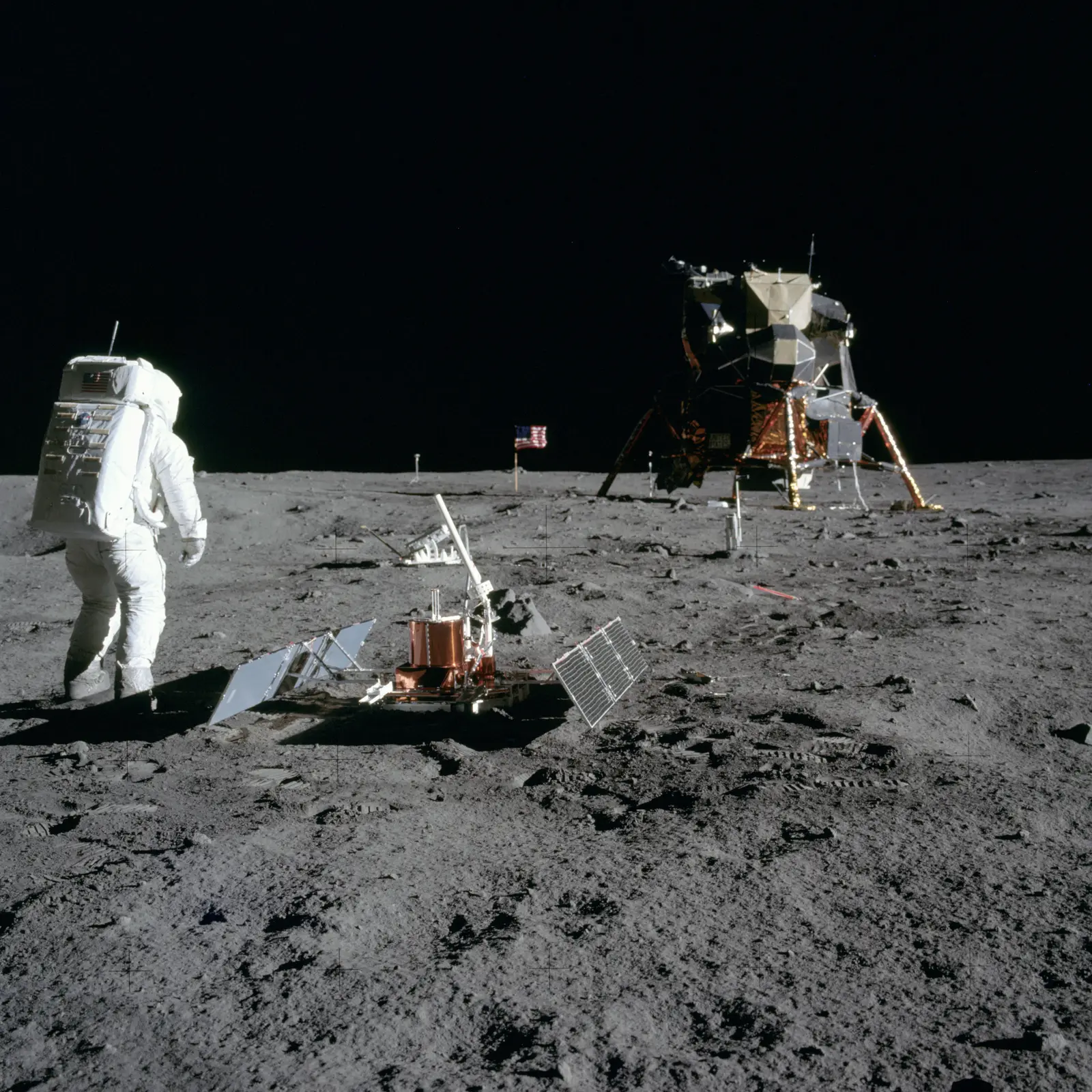
Apollo 11 landed here. Its footprints remain because the Moon has no weather. Laser reflectors still measure the Moon moving away at 3.8 cm each year.
NASA · Original image and terms. Web-sized reproduction.
Find the Sea of Tranquility.


How to see it tonight
No telescope on Earth can resolve Apollo 11’s footprints or the mirrored panel the astronauts left behind. Both are far smaller than any Earth-based telescope can distinguish. This page points you to the region, Mare Tranquillitatis, not to the hardware itself.
Mare Tranquillitatis, the Sea of Tranquility, is a dark, smooth patch. You can already see it on the Moon with your naked eye. It sits on the eastern half of the Moon’s face as seen from northern latitudes. Binoculars sharpen its edge against the brighter, rougher highlands around it.
A small telescope shows the neighborhood in detail: craters, ridges, and the line where the smooth mare meets rougher ground. None of that shows the landing site itself. That hardware measures only meters across, far below what any Earth telescope can resolve.
Only a spacecraft orbiting close to the Moon has photographed the site well. That is close enough to show the descent stage and the footprint trails. NASA’s Lunar Reconnaissance Orbiter did that from lunar orbit, not from Earth.
The Moon is easiest to study around first quarter and last quarter. Low sunlight then throws long shadows across Mare Tranquillitatis and its craters. A full Moon flattens that contrast and hides the detail.
What to expect: eyes, binoculars, telescope, photograph
The landing site itself is too small for any Earth telescope. Here is what the Moon actually shows, sourced.
| View | What you can expect |
|---|---|
| Naked eye | Mare Tranquillitatis is one of the Moon’s dark, smooth patches, visible without equipment as part of the Moon’s familiar face. NASA documents the landing site within this region. |
| Binoculars | The mare’s edge against the brighter highlands becomes easier to trace. This is a general skywatching estimate; sharpness depends on the Moon’s phase and your optics. |
| Telescope | Craters and ridges near the region resolve clearly. The landing hardware and footprints are far too small for any Earth-based telescope, amateur or professional, to show. |
| Photograph | Only spacecraft orbiting close to the Moon have photographed the site well. That is close enough to show the descent stage and footprint trails. NASA’s Lunar Reconnaissance Orbiter took those images from orbit, not from Earth. |
What SkyLumi does
SkyLumi tracks the real Moon in real time. Search for it, or tap it directly, and the app spotlights Mare Tranquillitatis on the live lunar disc.
Aim and AR line the map up with your phone’s camera. Hold your phone toward the Moon and the region is marked over the real view. Night Vision keeps a deep red display for dark adaptation.
The Moon and the rest of the core sky work offline. No account, no ads. Deep survey imagery of other objects needs a connection and streams in as you pinch to zoom. The Moon itself is drawn from its own position data, not from that imagery.
A few things to know.
Can I actually see the Apollo 11 landing site through a telescope?
No backyard or professional Earth-based telescope can resolve it. The hardware and footprints are meters across; only spacecraft orbiting the Moon, like NASA’s Lunar Reconnaissance Orbiter, have photographed them.
Where is Mare Tranquillitatis?
It’s one of the dark, smooth patches on the Moon’s face, visible with the naked eye. SkyLumi spotlights it on the live Moon.
Are the footprints really still there?
Yes. The Moon has no wind, rain or weather to erase them. NASA’s own orbital images still show the trails the astronauts left in 1969.
What are the mirrors the astronauts left behind?
Small reflector panels. Observatories on Earth still fire lasers at them and time the reflection. That is how scientists know the Moon drifts away from Earth by about 3.8 centimeters a year.
More in the Sky Library
Sources and image credit
Image attribution and original terms are linked beneath the image. Use of imagery does not imply endorsement of SkyLumi.