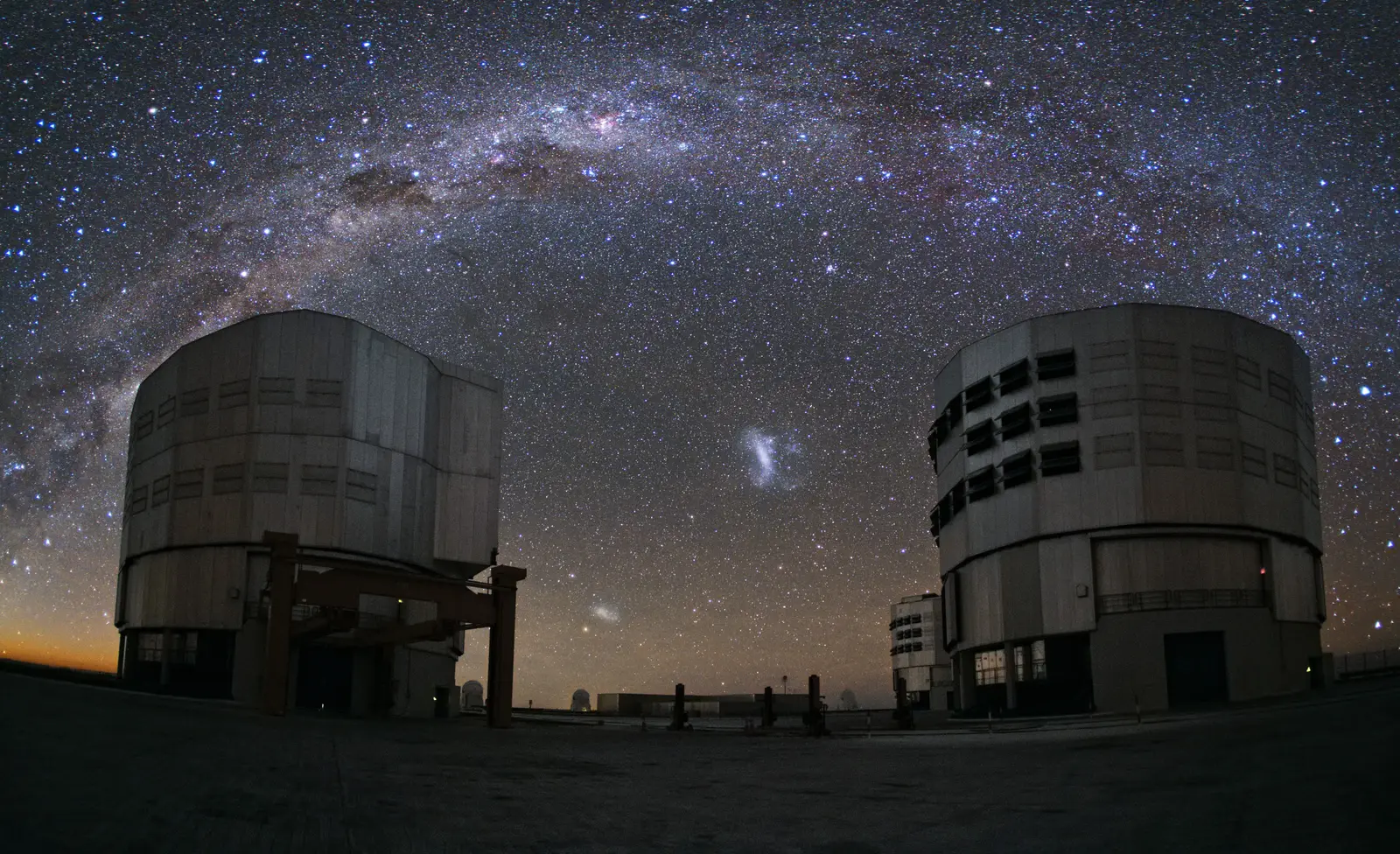
The dark rifts in the band are dense dust clouds: star nurseries, not gaps. Aboriginal Australians drew the Emu in the Sky from them; the Coalsack is its head.
ESO/Y. Beletsky · Original image and terms · CC BY 4.0. Web-sized reproduction.
Trace the dark river.


How to see it tonight
The dark rifts running through the Milky Way’s band are a genuine naked-eye feature, but only from a dark sky. From most cities, light pollution washes out the band itself, let alone the darker patches within it.
Look for the bright, cloudy band of the Milky Way arching across a dark sky. The dark rivers cutting through it, called the Great Rift or, in the south, the Coalsack, are not empty gaps. They are clouds of gas and dust so dense that no starlight gets through.
The band is best placed on summer evenings from mid-northern latitudes, when it arcs high overhead. It is well placed for much of the year from the southern hemisphere too. Some part of the Milky Way is above the horizon on most nights.
Getting away from city lights matters more than any equipment. NASA’s own stargazing guidance puts a genuinely dark sky at least 20 to 30 miles from a city’s edge. That distance is what reveals the contrast between the bright star clouds and the darker rifts within them.
Some cultures read constellations from these dark shapes rather than the bright stars around them. In the Andes, the Inca traced a llama, the Yacana, through the dark clouds. Its eyes are the bright stars Alpha and Beta Centauri.
What to expect: eyes, binoculars, telescope, photograph
What you actually see changes with darkness and equipment. Here is each view, sourced.
| View | What you can expect |
|---|---|
| Naked eye | From a genuinely dark site, the Milky Way’s bright band and its dark rifts are both visible without equipment. From a typical city sky, light pollution hides the band entirely. NASA puts a dark enough site at least 20 to 30 miles from a city’s edge. |
| Binoculars | The bright star clouds bordering the dark rifts resolve into denser fields of individual stars. That sharpens the contrast against the dust. This is a general skywatching estimate; results depend on sky darkness. |
| Telescope | A telescope can resolve star clusters and bright nebulae embedded near the rifts. The dust clouds themselves stay a dark silhouette; no amateur telescope reveals their interior structure. ESO confirms these clouds are active star-forming regions, not empty gaps. |
| Photograph | SkyLumi’s photographic view uses real observatory survey imagery, from Pan-STARRS, SkyMapper and DSS2. Long exposures reveal the clouds’ structure and the young stars forming inside them, detail no eye can gather. ESO explains how dark nebulae like the Coalsack hide active star birth. |
What SkyLumi does
SkyLumi outlines the Milky Way’s band and its dark rifts on the live sky map, wherever you’re standing.
Search, Aim and AR work the same way for any target. Point your phone toward the band and the map follows, lined up with the real sky. Night Vision keeps a deep red display for dark adaptation.
The core sky works offline, no account, no ads. Pinch into survey imagery from Pan-STARRS, SkyMapper and DSS2 for the star-forming detail inside; that layer needs a connection.
A few things to know.
Can I see the Great Rift from a city?
Usually not. City light pollution washes out the Milky Way’s band before its darker rifts become visible at all. A dark sky, well away from town, is what reveals them.
Are the dark patches actually empty?
No. They are dense clouds of gas and dust, thick enough to block starlight. New stars are forming inside them right now.
What is the Coalsack?
A prominent dark cloud near the Southern Cross. It is one of the clearest naked-eye dark nebulae, best seen from the southern hemisphere.
Why did some cultures draw constellations from the dark shapes?
The Inca traced a llama, the Yacana, through the Milky Way’s dark clouds rather than its bright stars. It’s a different, equally valid way of reading the same sky.
More in the Sky Library
Sources and image credit
Image attribution and original terms are linked beneath the image. Use of imagery does not imply endorsement of SkyLumi.