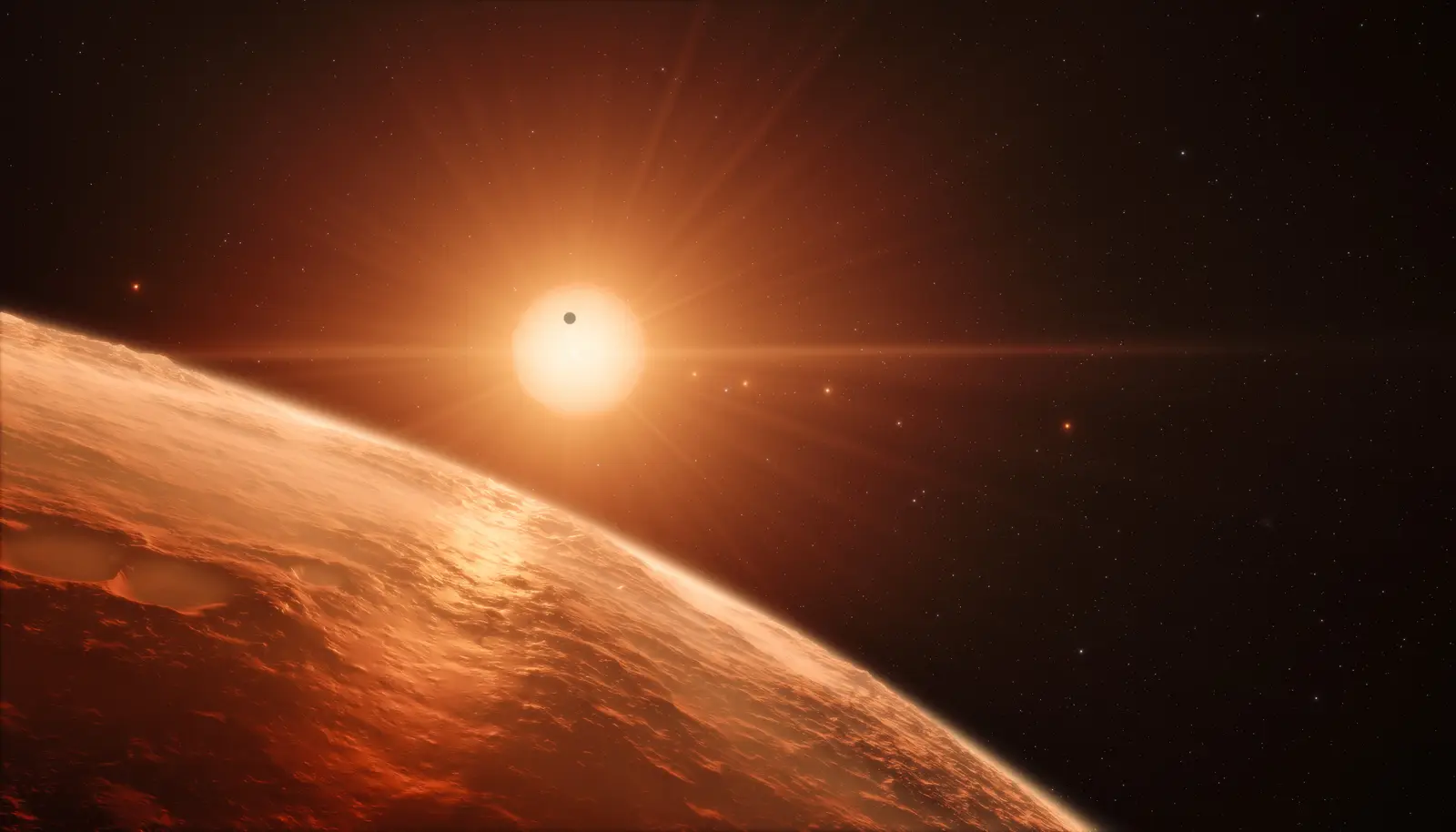
7 Earth-sized planets around one red dwarf. The whole system is smaller than Mercury’s orbit. 3 are in the habitable zone. All are tidally locked: permanent day on one face, night on the other.
ESO/N. Bartmann/spaceengine.org · Original image and terms · CC BY 4.0. Web-sized reproduction.
Point at where it is.


How to see it tonight
TRAPPIST-1 is a red dwarf so dim that no eye, no binoculars and no backyard telescope will ever show it. It sits far beyond what amateur equipment can reach. SkyLumi can still point you at the exact patch of sky where it lives.
The star is in Aquarius, close to the celestial equator. That means it is reachable from both hemispheres. Northern autumn and southern spring evenings are the easiest time to look, once Aquarius has climbed the sky.
What you get on the map is the star’s true position, not a view of it. No telescope is needed to find that spot. Seeing the star itself is not possible, whatever the equipment.
The seven planets have never been photographed directly. Every picture of the system, including the one above, is an artist’s rendering. It is not a captured image.
The system was found from Earth, not by photographing planets. Astronomers watched TRAPPIST-1’s light dim slightly each time a planet crossed it, the transit method behind thousands of discoveries.
What to expect: eyes, binoculars, telescope, photograph
What you actually see changes completely with equipment. Here is each view, honestly.
| View | What you can expect |
|---|---|
| Naked eye | Nothing. TRAPPIST-1 is catalogued near magnitude 19, far beyond what an unaided eye can detect. This compares against the naked-eye limit of about magnitude 6. NASA’s TRAPPIST-1 page does not itself state a magnitude. |
| Binoculars | Also nothing. Ordinary binoculars reach roughly magnitude 9 or 10 under a dark sky. TRAPPIST-1 stays out of reach by a wide margin. This is the same brightness comparison as above. |
| Telescope | Even a large amateur telescope falls short. Detecting a star this faint took research-grade instruments in the first place. A backyard scope in the 8 to 12 inch range is not enough. This is an equipment estimate, not a NASA-stated limit. |
| Photograph | The image above is an artist’s rendering of the system, not a captured photograph. No telescope has ever imaged the seven planets directly. ESO credits this specific illustration to N. Bartmann. |
What SkyLumi does
Search jumps straight to TRAPPIST-1’s marked position in Aquarius. Aim the phone at the sky and the app tracks that patch as you move.
The story panel explains what makes the system unusual. Seven Earth-sized worlds would all fit inside Mercury’s orbit, three of them where water could stay liquid.
Night Vision keeps your eyes dark-adapted for everything else in view nearby. No account, no ads. The core sky works offline; the story content needs a connection the first time.
A few things to know.
Can I actually see TRAPPIST-1?
No, not with any equipment a backyard observer owns. It is roughly magnitude 19, thousands of times fainter than the dimmest naked-eye star. SkyLumi shows you where it is, not what it looks like.
Have the seven planets been photographed?
No. Every image of the TRAPPIST-1 system, including illustrations used here, is an artist’s rendering. It is based on measured sizes and orbits, not a picture taken through a telescope.
Why is the system famous if nobody can see it?
Because of what it contains: seven roughly Earth-sized planets around one small star, three of them in the habitable zone. That was discovered through the star’s own dimming, not by photographing the planets.
Where is Aquarius, and when is it up?
Aquarius sits near the celestial equator, so both hemispheres get a turn. Northern autumn and southern spring evenings are the easiest window to find it above the horizon.
More in the Sky Library
Sources and image credit
Image attribution and original terms are linked beneath the image. Use of imagery does not imply endorsement of SkyLumi.