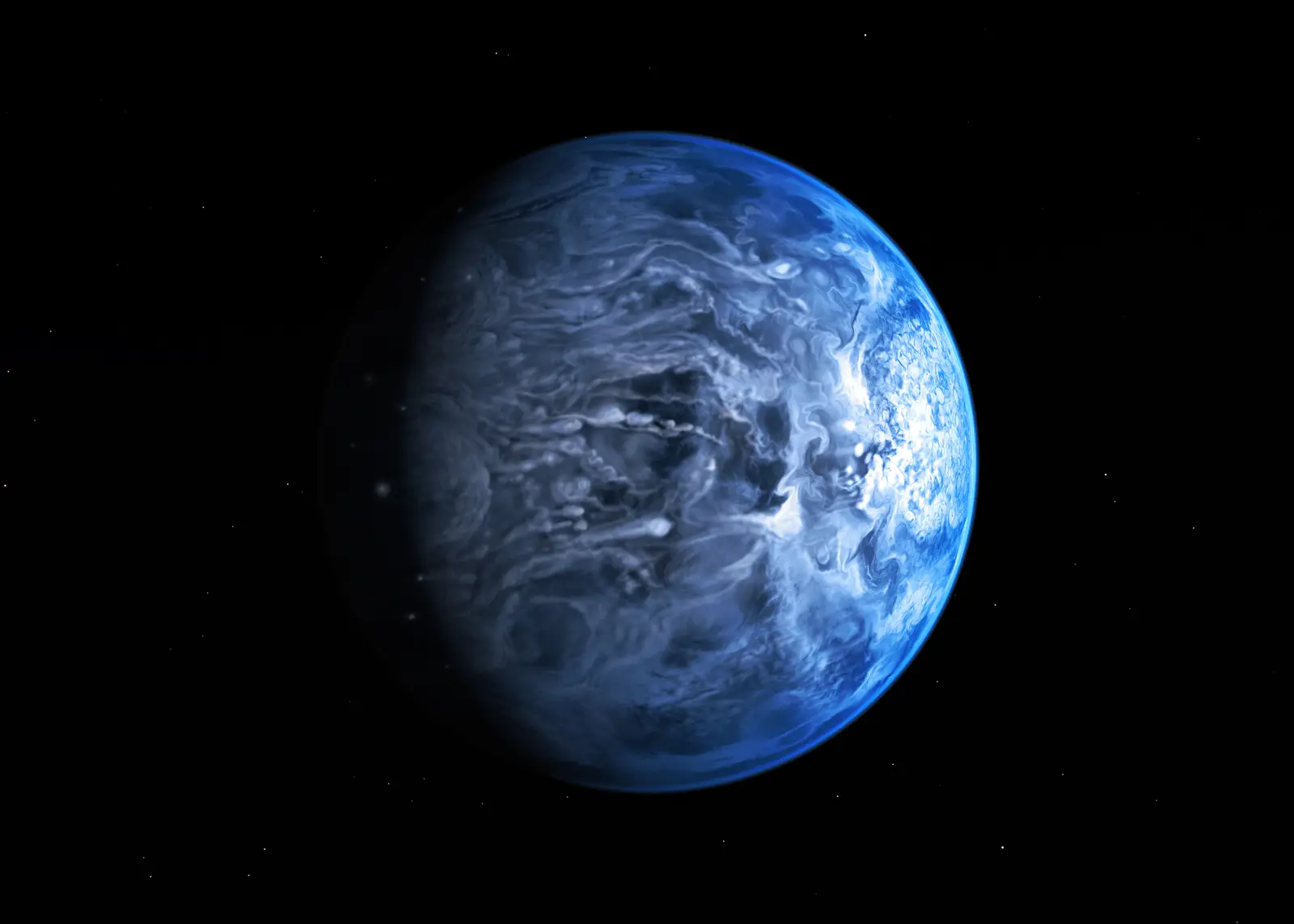
A deep-blue gas giant, colored by silicate (glass) clouds: ~930°C, winds ~8,700 km/h. Its color came from the light lost when it slipped behind its star.
NASA, ESA, M. Kornmesser · Original image and terms · CC BY 4.0. Web-sized reproduction.
Find the real star.


How to see it tonight
HD 189733b cannot be seen directly by anyone, on Earth or in orbit. It is a gas giant far too close to its star to separate from it in any image. What astronomers reached instead was its color, measured indirectly with the Hubble Space Telescope.
The host star, HD 189733, sits in Vulpecula, the small fox constellation inside the Summer Triangle. It shines at magnitude 7.7, too faint for the naked eye. Binoculars find it without much trouble on a clear evening. Look from northern hemisphere summer into autumn, or from southern latitudes in that same season.
A small telescope holds the star steady as an ordinary point of light. Nothing about it looks unusual through an eyepiece. The blue color belongs to the unseen planet, not to the star you are actually looking at.
Hubble found that color by watching the whole system’s brightness dip, as the planet slipped behind its star. That technique is called a secondary eclipse. Comparing the light lost at different wavelengths let astronomers work out how much blue light the planet was reflecting. The answer: a deep azure blue, caused by glass particles scattering blue light in a scorching, roughly 1,000-degree atmosphere.
HD 189733b is close to Jupiter’s own size and mass, but far hotter. It orbits at about three percent of the Earth-Sun distance, completing a full year in just over two days. It was found in 2005, by the radial velocity method. That technique detects the tiny gravitational tug a planet exerts on its star, years before this eclipse revealed its color.
It has since become one of the most studied hot Jupiters known. It sits close and transits its star cleanly, an easy repeat target for space telescopes. Sodium, water vapor and carbon dioxide have all turned up in its atmosphere. So has the glass haze that gives it its color.
What SkyLumi does
Search for HD 189733 and SkyLumi points the map at the real star in Vulpecula. Aim your phone at that patch of sky, or open AR to see it marked, inside the Summer Triangle.
Pinch in and the view moves into real observatory survey imagery of that patch, from Pan-STARRS, SkyMapper and DSS2. That is the honest photographic view. The blue planet is not in it, because no photograph of it exists at any resolution.
Night Vision keeps your eyes dark-adapted with a deep red display. No account, no ads. The core sky works offline; survey imagery needs a connection.
A few things to know.
Can I see HD 189733b?
No. Nobody has photographed it directly. Its color was measured from starlight lost during a secondary eclipse, not from a picture of the planet.
Does it really rain glass?
The atmosphere is thought to carry silicate particles, essentially glass, at winds clocked around 8,700 kilometers per hour. Whether that counts as rain in any familiar sense is unclear, though the phrase has stuck for a reason.
Can I see its star without a telescope?
Not with the naked eye. At magnitude 7.7, HD 189733 needs binoculars or a small telescope from a reasonably dark site.
Why is the planet blue?
Hubble measured that its atmosphere scatters blue light more than red, likely from tiny glass grains in the extreme heat. Researchers admit atmospheric color is hard to pin down exactly, even in our own solar system.
More in the Sky Library
Sources and image credit
Image attribution and original terms are linked beneath the image. Use of imagery does not imply endorsement of SkyLumi.