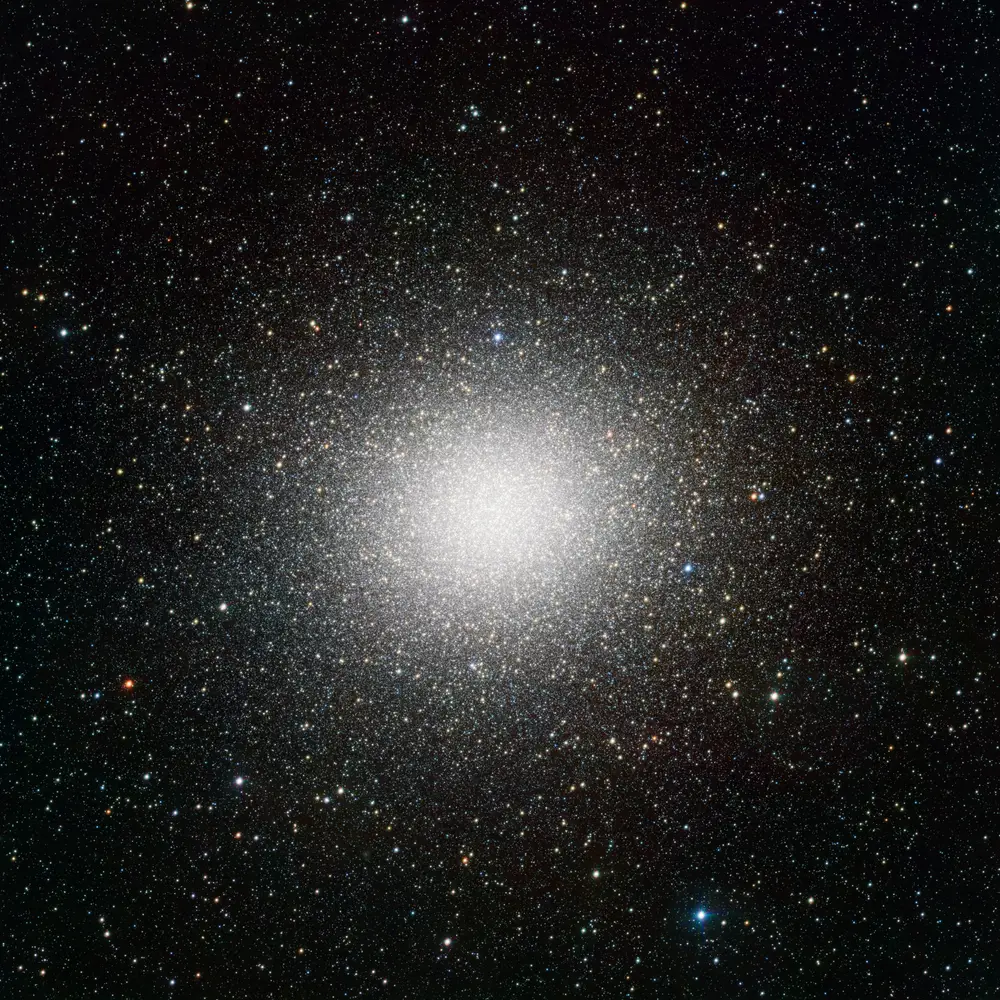
~10 million stars in one ball, seen as one fuzzy star. Near its core, stars are a fraction of a light-year apart. It may be the stripped core of a swallowed galaxy.
ESO/INAF-VST/OmegaCAM. Acknowledgement: A. Grado, L. Limatola/INAF-Capodimonte Observatory · Original image and terms · CC BY 4.0. Web-sized reproduction.
See it resolved.


How to see it tonight
Omega Centauri sits deep in the southern sky, in Centaurus. It is a southern object, low from mid-northern latitudes and much higher from the south.
At magnitude 3.7, it is bright enough for the naked eye. It is visible from a dark site at low northern latitudes and throughout the Southern Hemisphere.
To the unaided eye it looks like a single fuzzy star, easy to mistake for an ordinary one. Binoculars show it as a distinctly round, hazy ball rather than a point.
A telescope begins to resolve individual stars around its edges, more of them with a larger aperture. NASA counts roughly 10 million stars bound together in the cluster.
Pinch in on the map and the fuzzy ball becomes that swarm, photographed. Near the cluster’s core, stars sit a fraction of a light-year apart, closer than any of our own neighbors.
What to expect: eyes, binoculars, telescope, photograph
What you actually see changes completely with equipment. Here is each view, sourced.
| View | What you can expect |
|---|---|
| Naked eye | At magnitude 3.7, Omega Centauri is an easy naked-eye target from dark, low-latitude or southern skies. NASA confirms it is bright enough to see without any equipment. |
| Binoculars | Binoculars turn the naked-eye point into a distinctly round, hazy ball. ESO calls it the largest globular cluster visible from Earth. |
| Telescope | A telescope resolves individual stars around the cluster’s edges, more of them as aperture grows. Resolving all the way to the crowded core takes a large aperture and steady skies. Most backyard views stop well short of that. NASA puts roughly 10 million stars in the cluster. |
| Photograph | SkyLumi’s photographic view uses real observatory survey imagery, from Pan-STARRS, SkyMapper and DSS2, not a drawing. ESO’s deep image resolves the cluster down toward its crowded core, detail no eyepiece reaches. |
What SkyLumi does
Find it with search, or Aim the phone toward Centaurus, deep in the southern sky. Pinch into photographic survey imagery from Pan-STARRS, SkyMapper and DSS2.
Night Vision is a deep red display that keeps your eyes dark-adapted. No account, no ads.
The core sky works offline. High-resolution survey imagery streams as you zoom and needs a connection.
A few things to know.
Is Omega Centauri visible without a telescope?
Yes, from a dark site at low northern latitudes or in the Southern Hemisphere. It looks like a single fuzzy star to the naked eye.
How many stars does Omega Centauri actually contain?
Roughly 10 million, held together by gravity in one ball. Near the core, they sit a fraction of a light-year apart.
Is Omega Centauri really a star cluster?
Probably not an ordinary one. Its stars vary in age more than a normal cluster’s should. Many astronomers think it is the stripped core of a small galaxy the Milky Way absorbed long ago.
How far away is Omega Centauri?
About 17,000 light-years, in the direction of Centaurus. That makes it one of the closer globular clusters to Earth.
More in the Sky Library
Sources and image credit
Image attribution and original terms are linked beneath the image. Use of imagery does not imply endorsement of SkyLumi.