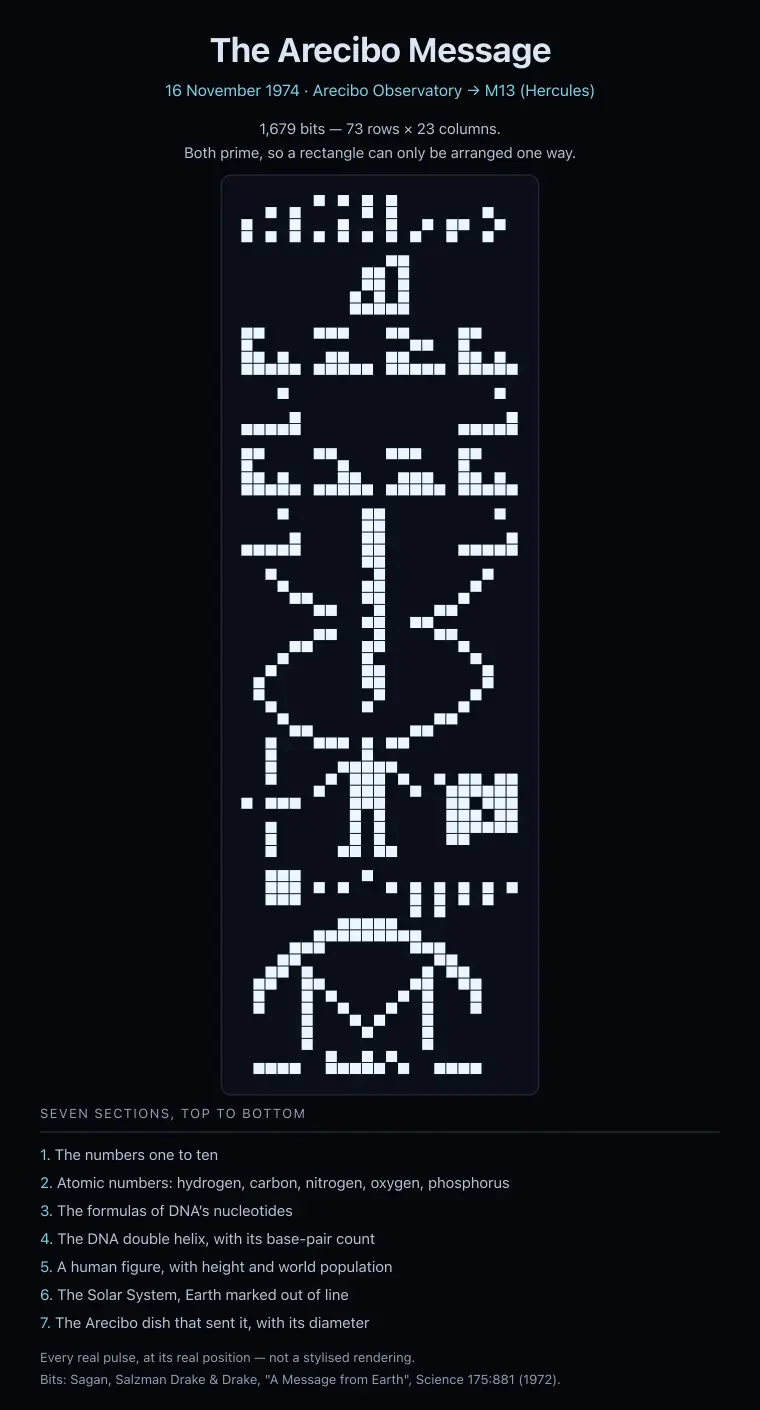
In 1974, Arecibo sent 1,679 bits to this cluster: numbers, DNA, a human figure, and our address. It arrives around the year 27,000.
SkyLumi, from the 1974 Arecibo message (Sagan, Salzman Drake & Drake 1972) · Original image and terms. Web-sized reproduction.
Find the cluster.


How to see it tonight
M13, the Great Hercules Cluster, is one of the brightest globular clusters visible from the Northern Hemisphere. It is up from northern spring through autumn evenings.
From a dark site, it can be seen as a faint, fuzzy point with the naked eye. From a typical city sky, streetlight usually wins. Binoculars make it noticeably easier to pick out.
What the eye or binoculars shows is a soft glow, not individual stars. The cluster actually holds over 100,000 stars, packed far too tightly for anything but a telescope to start resolving.
It is well placed for northern observers and low or hard to reach from far southern latitudes. Check its height above your horizon before planning a look.
Edmond Halley found the cluster in 1714. Charles Messier catalogued it in 1764, long before anyone knew what a globular cluster actually was.
What to expect: eyes, binoculars, telescope, photograph
What you actually see changes completely with equipment. Here is each view, sourced.
| View | What you can expect |
|---|---|
| Naked eye | From a dark site, a faint, fuzzy point in Hercules. NASA lists its apparent magnitude at 5.8 and calls it “one of the brightest star clusters visible from the Northern Hemisphere.” |
| Binoculars | The glow becomes easier to find and holds together as clearly nebulous rather than star-like. NASA notes it can be “spotted with a pair of binoculars most easily in July.” |
| Telescope | A telescope starts to resolve individual stars around the cluster’s edge, with the dense core staying a bright blur. Exactly how many stars resolve depends on aperture and sky darkness; this is a general estimate, not a NASA-stated figure. |
| Photograph | SkyLumi’s hero image here is not a photograph of the cluster. It is the actual 1974 Arecibo message, as its real 73-by-23 pixel grid. Credited to the message design published by Sagan, Salzman Drake and Drake. |
What SkyLumi does
Search jumps to M13 in Hercules, or Aim the phone at that patch of sky. The story panel shows the cluster’s real position and the Arecibo message aimed at it.
Pinch in and the map switches to observatory survey imagery of the same sky, from Pan-STARRS, SkyMapper and DSS2. Not a drawing.
Night Vision keeps your eyes dark-adapted while you search nearby. No account, no ads. The core sky works offline; high-resolution survey imagery needs a connection.
A few things to know.
Can I see M13 without a telescope?
From a dark site, yes, as a faint fuzzy point. From a typical city sky, usually not. Binoculars make it noticeably easier to find.
What was the Arecibo message?
A 1,679-bit radio message sent from the Arecibo telescope in 1974, aimed at M13. It encoded numbers, the chemistry of DNA, a human figure and our solar system.
When will the message arrive?
M13 is about 25,000 light-years away, so the message needs roughly that long to reach it. It arrives around the year 27,000.
Why M13 specifically?
It was a large, close cluster of stars, in the right part of the sky for the Arecibo telescope’s ceremony. There was no other reason.
More in the Sky Library
Sources and image credit
- NASA Hubble: Messier 13, the Hercules Cluster
- NASA: Fantastic Alien Civilizations and Where to Find Them
Image attribution and original terms are linked beneath the image. Use of imagery does not imply endorsement of SkyLumi.