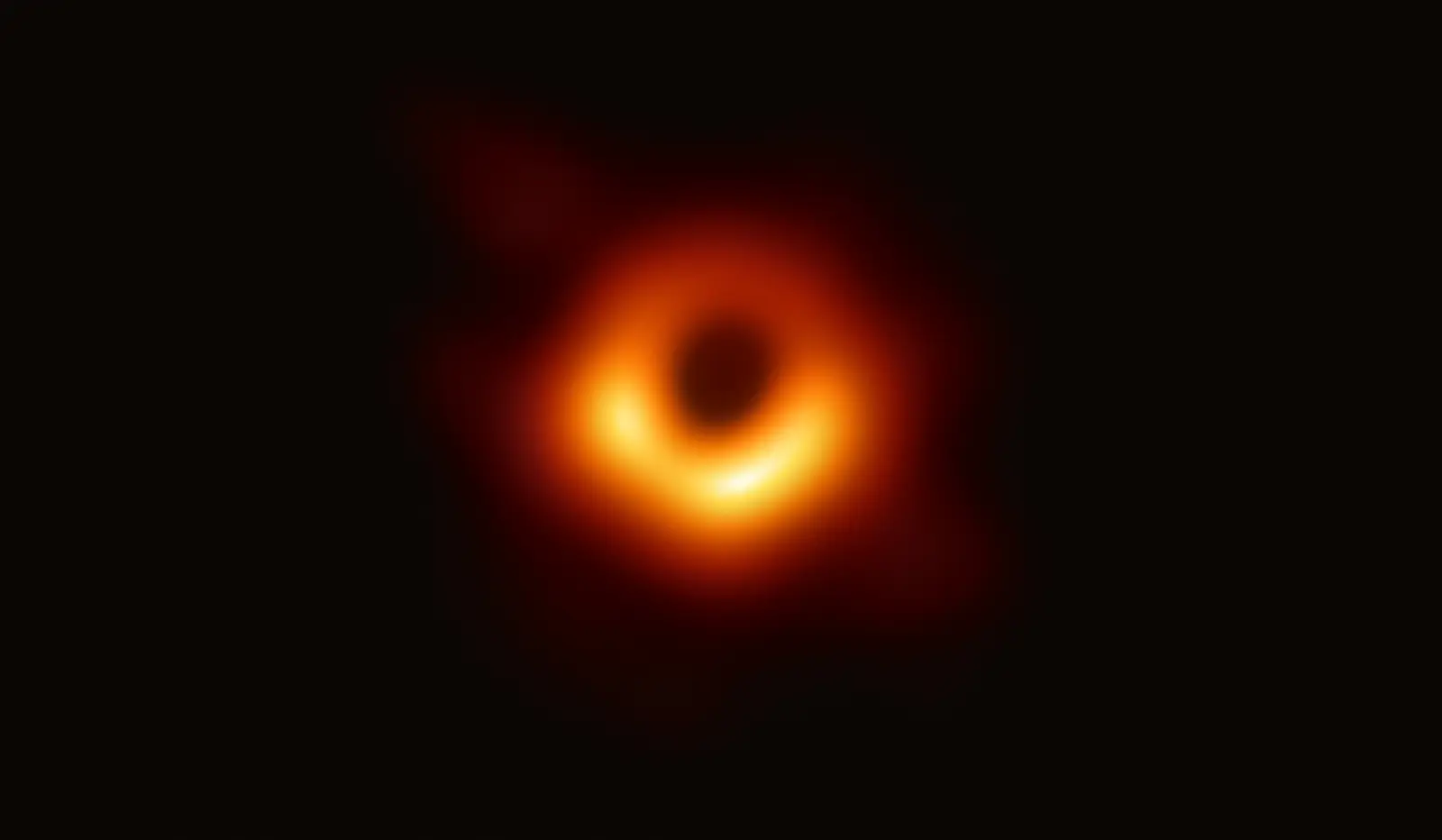
The first photographed black hole (2019). Mass: 6.5 billion Suns. Distance: 55 million light-years. The ring is light bent around it from behind.
EHT Collaboration · Original image and terms · CC BY 4.0. Web-sized reproduction.
See the first photograph.


How to see it tonight
M87* sits inside the galaxy M87, in Virgo. It is best placed on spring evenings in the Northern Hemisphere, and visible from much of the Southern Hemisphere too.
You cannot see the black hole itself, by eye or through any telescope. What you can see, under a dark sky and with a telescope, is its host galaxy.
M87 is a bright elliptical galaxy, and a modest telescope under dark skies shows it as a small, fuzzy oval. Binoculars and the naked eye cannot.
In 2019, radio telescopes around the world combined into one Earth-sized instrument photographed the black hole at its center. NASA/JPL called it the first image of a black hole ever taken.
Pinch in on the map and that image appears, an orange ring of light bent around the black hole’s shadow. No optical telescope, home or professional, could ever capture that ring directly.
What to expect: eyes, binoculars, telescope, photograph
What you actually see changes completely with equipment. Here is each view, sourced.
| View | What you can expect |
|---|---|
| Naked eye | M87 is far too faint for the naked eye, at magnitude 8.6. ESO confirms the black hole itself is invisible at any wavelength the eye detects. |
| Binoculars | Ordinary binoculars generally cannot show M87 as more than a faint smudge, if that. This is a cautious estimate. Results depend on sky darkness and binocular aperture, and many observers will see nothing. |
| Telescope | A telescope under a dark sky shows M87 as a small, fuzzy oval galaxy. It is one of many galaxies in the Virgo Cluster. NASA/JPL confirms its central black hole is never visible through any optical telescope. |
| Photograph | This page’s photograph is the 2019 Event Horizon Telescope image, made from radio data. It is not from ordinary observatory survey imagery. NASA/JPL confirms the black hole holds about 6.5 billion solar masses, roughly 53 to 55 million light-years away. |
What SkyLumi does
Search jumps to M87, or Aim the phone toward Virgo. Pinch into photographic survey imagery from Pan-STARRS, SkyMapper and DSS2 to see the galaxy itself, closer.
SkyLumi’s own survey imagery shows the galaxy as a small glow, the same thing a telescope shows. The 2019 radio image on this page came from a dedicated global project, not from that survey.
Night Vision is a deep red display that keeps your eyes dark-adapted. No account, no ads. The core sky works offline.
A few things to know.
Can I see the M87 black hole through a telescope?
No. No optical telescope, at any size, can show a black hole directly. A dark-sky telescope can show its host galaxy, M87, as a small fuzzy oval.
How big is the black hole in M87?
About 6.5 billion times the mass of the Sun. Our entire solar system would fit inside it.
Why does the image show a ring instead of a black circle?
The dark center is the black hole’s shadow. The bright ring is light that passed behind the black hole and bent around it on its way to us.
How was this photograph actually taken?
With radio telescopes, not a camera. The Event Horizon Telescope linked eight observatories worldwide into one virtual telescope nearly the size of Earth.
More in the Sky Library
Sources and image credit
- NASA/JPL: how scientists captured the first image of a black hole
- ESO: the first image of a black hole, M87*
Image attribution and original terms are linked beneath the image. Use of imagery does not imply endorsement of SkyLumi.