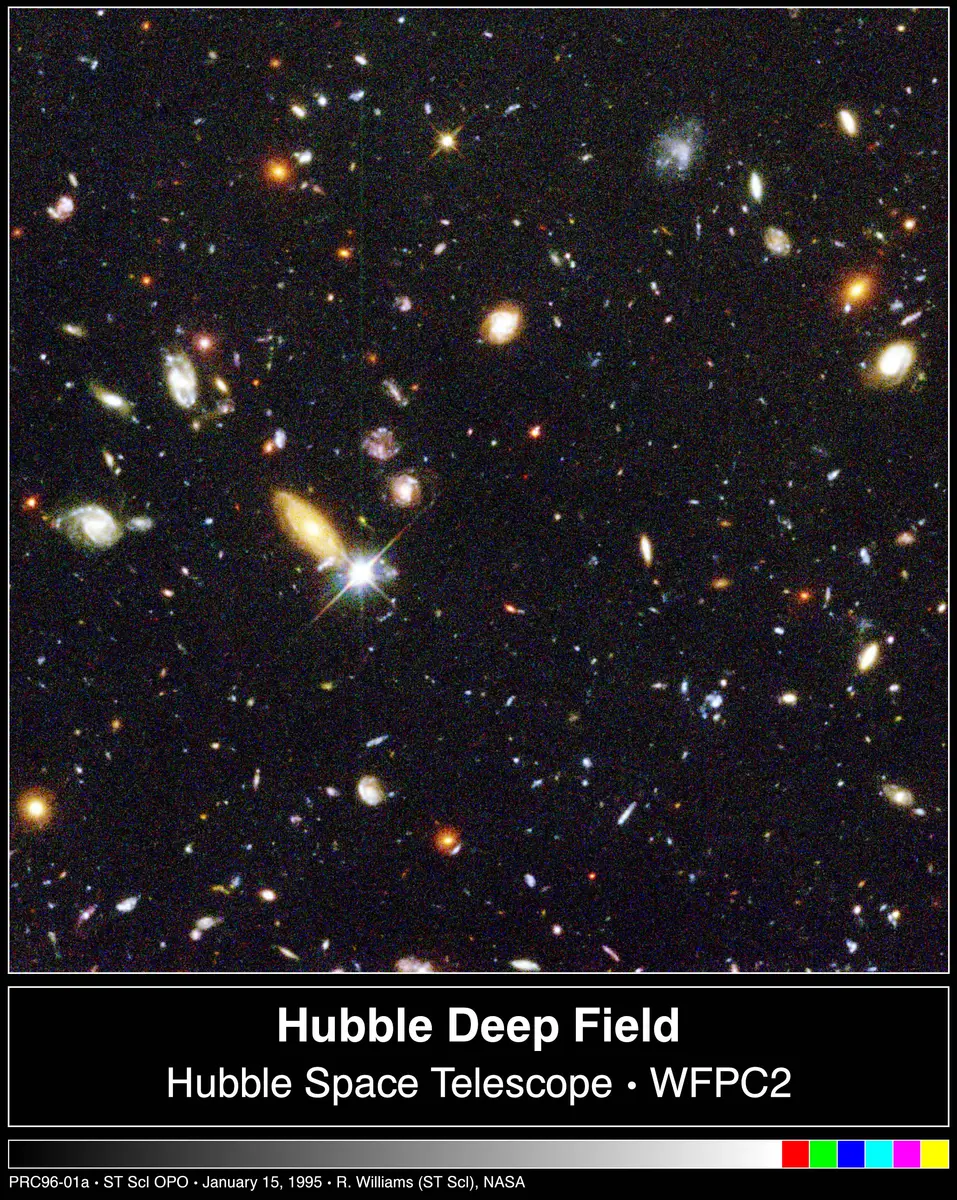
In 1995, Hubble stared for 10 days at an “empty” patch the size of a sand grain at arm’s length. It found ~3,000 galaxies. The patch is one thirty-millionth of the sky.
Robert Williams and the Hubble Deep Field Team (STScI) and NASA/ESA · Original image and terms · CC BY 4.0. Web-sized reproduction.
See what's really there.


How to see it tonight
The Hubble Deep Field is a small patch of sky near the handle of the Big Dipper, in Ursa Major. To the naked eye, binoculars, or any backyard telescope, it looks like nothing: no star, no visible object at all.
That emptiness was the point. In 1995, Hubble was pointed at this patch precisely because it appeared blank. It then stared for ten straight days to see what turned up.
Ursa Major is circumpolar for most of the Northern Hemisphere, up on any clear night. It sits low or out of reach for much of the far south.
There is nothing to look for here with your own eyes; the patch really is that dark. What the long exposure revealed only shows up in the photograph itself.
Astronomers later stared even longer at a smaller patch, in the southern constellation Fornax, and found roughly 5,500 galaxies there. No patch of sky is truly empty.
What to expect: eyes, binoculars, telescope, photograph
What you actually see changes completely with equipment. Here is each view, sourced.
| View | What you can expect |
|---|---|
| Naked eye | Nothing. This patch was chosen because it looked empty, near Ursa Major’s handle. ESA/Hubble describes it as selected “to be as empty as possible.” |
| Binoculars | Still nothing. The patch covers roughly a thirtieth the width of the full Moon, with no cataloged bright star inside it. ESA/Hubble puts the field at “1/30th the diameter of the full Moon.” |
| Telescope | A backyard telescope will not reveal what Hubble found here. ESA/Hubble notes the original field took “10 consecutive days” of exposure with a space telescope. |
| Photograph | The find was roughly 3,000 galaxies, packed into that one seemingly empty patch. ESA/Hubble reports “almost 3000 galaxies were seen in the image,” built from over 100 hours of exposure. |
What SkyLumi does
Search jumps to the Hubble Deep Field’s exact position near the Big Dipper’s handle. Aim the phone at that patch, and the app marks it even though nothing is visible there by eye.
The story panel explains the size comparison. This patch is about one thirty-millionth of the sky, yet it held thousands of galaxies once Hubble stared long enough.
Night Vision keeps your eyes dark-adapted while you explore the rest of Ursa Major nearby. No account, no ads. The core sky works offline.
A few things to know.
Can I see anything if I look at that spot?
No. The patch was chosen because it looks empty to any instrument short of a space telescope staring for days. There is no naked-eye or backyard-telescope target here.
How many galaxies did Hubble find there?
About 3,000, in a patch of sky roughly a thirtieth the width of the full Moon. Later, even deeper stares of other patches found more.
Where exactly is it?
Near the handle of the Big Dipper, in Ursa Major. That constellation is up most clear nights for the Northern Hemisphere. It sits low or absent for much of the far south.
Why point a major telescope at nothing?
“Nothing” was the hypothesis being tested. Astronomers wanted to know what a truly blank patch would reveal, given enough exposure time. The answer reshaped how the sky is read.
More in the Sky Library
Sources and image credit
Image attribution and original terms are linked beneath the image. Use of imagery does not imply endorsement of SkyLumi.