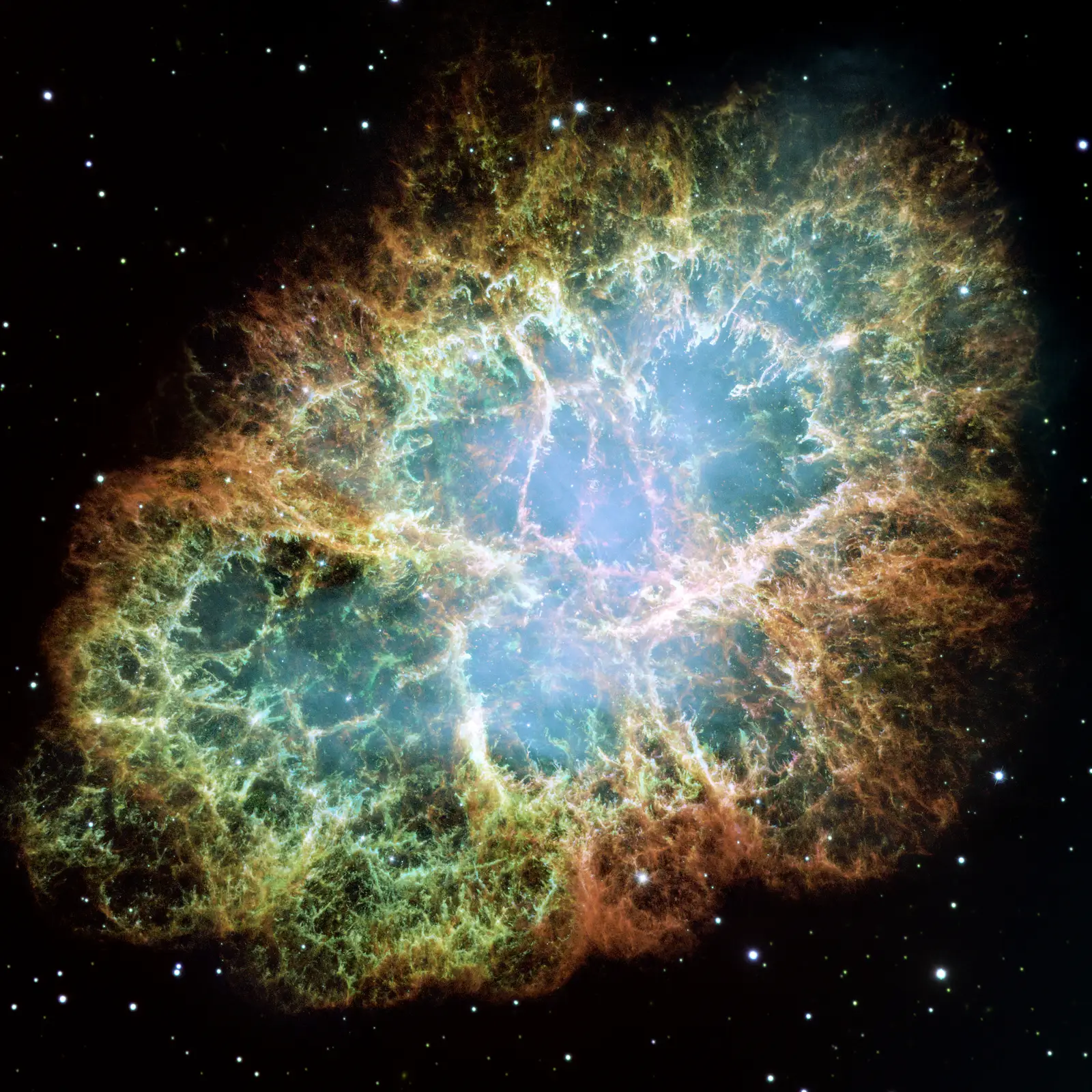
A supernova recorded in China on July 4, 1054, visible by day for 23 days. Its debris still expands at 1,500 km/s and visibly grows between photos taken decades apart.
NASA, ESA and Allison Loll/Jeff Hester (Arizona State University). Acknowledgement: Davide De Martin (ESA/Hubble) · Original image and terms · CC BY 4.0. Web-sized reproduction.
See the wreckage.


How to see it tonight
The Crab Nebula sits in Taurus, near Zeta Tauri, one of the bull’s horn-tip stars. It is up from November through April.
It is too faint for the naked eye. From a dark site, binoculars can show it as a small, dim smudge. It can be lost near city lights.
A telescope resolves it into an oval, misty patch. Backyard telescopes reveal that structure. The pulsar at its center needs a professional instrument, invisible to any home telescope.
This is the wreckage of a supernova Chinese astronomers recorded on July 4, 1054, visible in daylight for weeks. NASA confirms it stayed visible in the daytime sky for nearly a month.
The cloud is still flying apart, fast enough that photographs taken years apart show visible growth. Pinch in on the map and the photograph replaces the smudge.
What to expect: eyes, binoculars, telescope, photograph
What you actually see changes completely with equipment. Here is each view, sourced.
| View | What you can expect |
|---|---|
| Naked eye | At magnitude 8.4, the Crab Nebula is far below naked-eye brightness. It is invisible without optical aid, even from a dark site. NASA’s Hubble Messier catalog lists it at that magnitude. |
| Binoculars | Under dark skies, binoculars can show a faint, small smudge near Zeta Tauri. This is a cautious estimate. Results depend heavily on sky darkness, and many observers will see nothing at all. |
| Telescope | A telescope under a dark sky shows an oval, misty patch, the nebula’s overall shape. NASA confirms the wreckage still expands at roughly half the speed of light. A backyard telescope cannot show that motion directly. |
| Photograph | SkyLumi’s photographic view uses real observatory survey imagery, from Pan-STARRS, SkyMapper and DSS2, not a drawing. ESA/Webb’s comparison with Hubble shows the same nebula in visible light and infrared, each revealing different structure. |
What SkyLumi does
Find it with search, or Aim the phone at Taurus. Pinch into photographic survey imagery from Pan-STARRS, SkyMapper and DSS2, the same map, closer.
Night Vision is a deep red display that keeps your eyes dark-adapted. No account, no ads.
The core sky works offline. High-resolution survey imagery streams as you zoom and needs a connection.
A few things to know.
Can I see the Crab Nebula without a telescope?
No. At magnitude 8.4 it is far too faint for the naked eye, even from a dark site. A telescope or good binoculars are needed.
Does the nebula really grow between photographs?
Yes. Its debris still expands at roughly half the speed of light. Photographs taken decades apart show the cloud visibly larger.
What made the Crab Nebula?
A star exploded as a supernova. Astronomers in China recorded it on July 4, 1054, and it stayed visible in daylight for weeks.
Is there anything left of the star that exploded?
Yes, a neutron star at the center, spinning about 30 times a second. It is a pulsar, and it needs a professional telescope to detect.
More in the Sky Library
Sources and image credit
- NASA Hubble Messier Catalog: Messier 1, the Crab Nebula
- ESA/Webb: the Crab Nebula, Hubble and Webb compared
Image attribution and original terms are linked beneath the image. Use of imagery does not imply endorsement of SkyLumi.