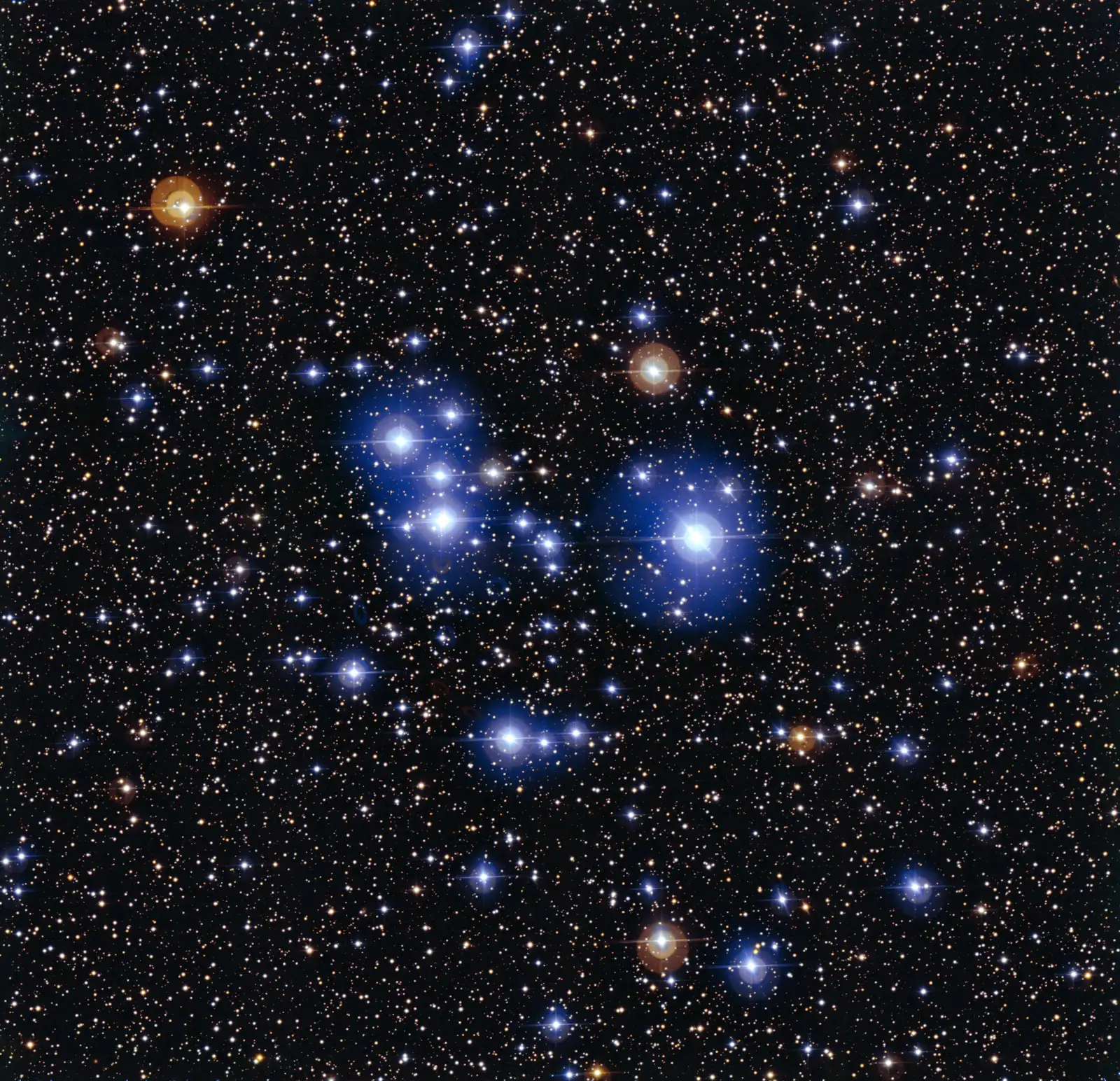
A leading solar-sibling candidate: it shares the Sun’s chemical fingerprint and likely formed in the same cluster 4.5 billion years ago. It is visible in binoculars.
ESO · Original image and terms · CC BY 4.0. Web-sized reproduction.
Point at the Sun’s sibling.


How to see it tonight
HD 162826 is a real star, faint but within reach of ordinary binoculars from a reasonably dark sky. This page points you to it directly, not just to an idea.
It sits in Hercules, near the bright star Vega. It’s well placed on northern summer evenings and visible for much of the year from mid-northern latitudes. It stays low or out of view from far southern locations.
At magnitude 6.7, it’s right at the edge of naked-eye visibility under the darkest skies, and easy in any pair of binoculars. Through binoculars or a telescope it looks like an ordinary point of light. No equipment reveals anything special about it visually; what makes it remarkable is chemical, not visual.
A 2014 study matched its chemical makeup and orbit to the Sun’s. The match was close enough to call it a leading solar sibling candidate. That means a star born in the Sun’s birth cluster, about 4.5 billion years ago, before the family scattered.
The astronomers behind the study reached HD 162826 by checking thirty candidate stars. Most had chemistry that didn’t quite line up with the Sun’s. This one did, on rare elements as well as common ones.
What to expect: eyes, binoculars, telescope, photograph
What you actually see changes little with equipment here. Here is each view, sourced.
| View | What you can expect |
|---|---|
| Naked eye | At magnitude 6.7, it sits right at the edge of what a dark, clear sky allows without equipment. Most observers will need binoculars; naked-eye visibility depends on genuinely dark, transparent skies. |
| Binoculars | An easy point of light in any ordinary pair of binoculars from a reasonably dark sky. The discovery paper notes it is bright enough for small and medium telescopes, well within binocular range. |
| Telescope | Still just a point of light; stars are too far away for any telescope to show a disc. A telescope adds brightness here, not detail. |
| Photograph | A photograph reveals nothing extra about this star; its significance is chemical, found in its spectrum, not its appearance. The 2014 study identified its matching composition through spectroscopy, not imaging. |
What SkyLumi does
Search for HD 162826, or let SkyLumi’s Aim mode point your phone toward it in Hercules, near Vega.
AR lines the sky map up with your camera. Hold your phone up and find it against the real sky. Night Vision keeps a deep red display for dark adaptation.
The core sky works offline, no account, no ads. Deep survey imagery from Pan-STARRS, SkyMapper and DSS2 needs a connection and streams in when you pinch to zoom.
A few things to know.
Can I really see the Sun’s sibling star?
Yes, with ordinary binoculars from a reasonably dark sky. It’s a real, findable star in Hercules, near Vega, not just a computed direction.
How do we know it’s related to the Sun?
A 2014 study matched its chemical fingerprint and orbit to the Sun’s. The match is close enough to call it a leading candidate. It’s a strong match, not a certainty.
Would it look different through a telescope?
No. Stars are so far away that even a large telescope shows only a point of light. A telescope makes it brighter, not more detailed.
How far away is it?
About 110 light-years, in the constellation Hercules.
More in the Sky Library
Sources and image credit
- Ramírez et al., “Elemental Abundances of Solar Sibling Candidates,” The Astrophysical Journal (2014)
- NASA: how stars form together in clusters
Image attribution and original terms are linked beneath the image. Use of imagery does not imply endorsement of SkyLumi.