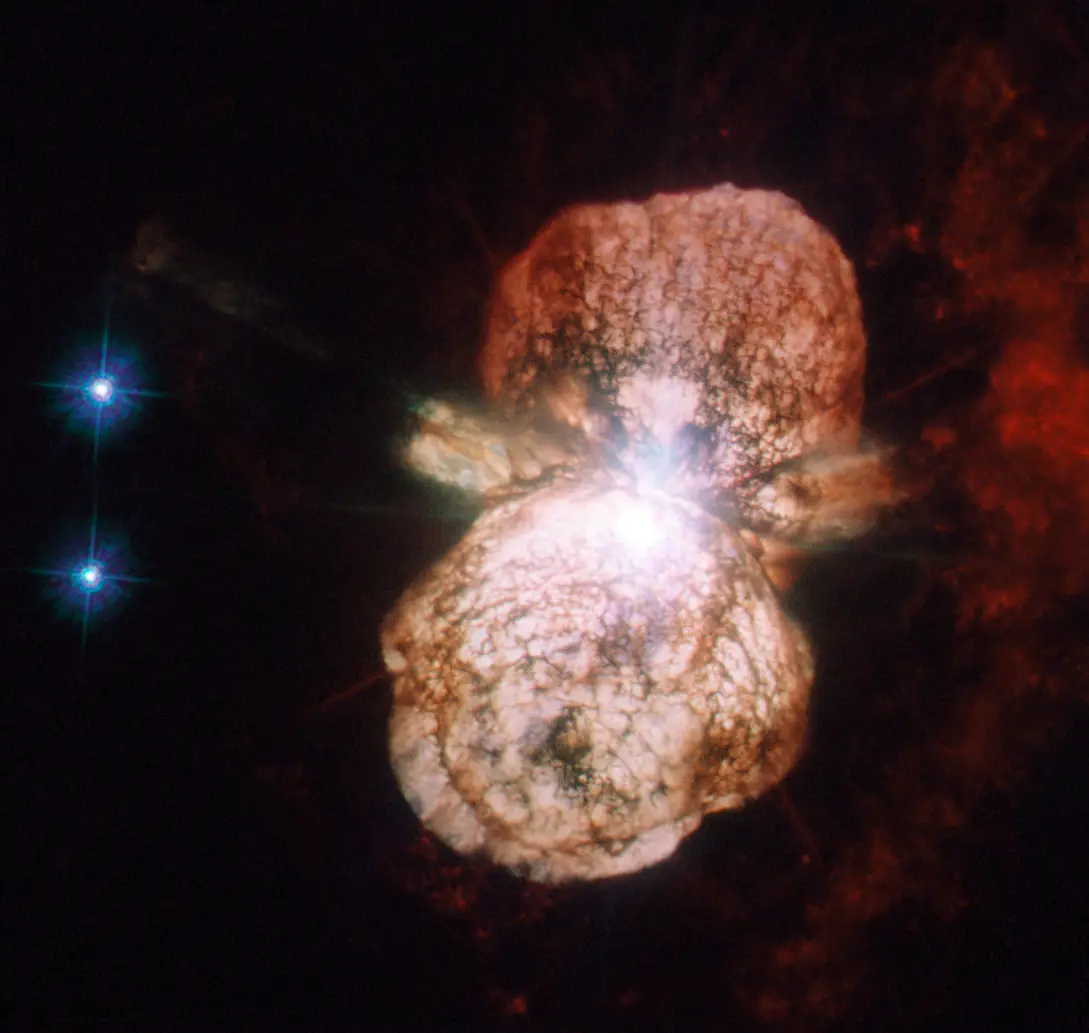
In the 1840s it flared to the second-brightest star in the sky, shed 10+ Suns of material, and survived. Mass: ~100 Suns. A future supernova is guaranteed.
ESA/Hubble & NASA · Original image and terms · CC BY 4.0. Web-sized reproduction.
See the survivor.


How to see it tonight
Eta Carinae sits deep in the southern sky, inside the Carina Nebula. It is a headline object for southern observers, high overhead from the south. Most of the Northern Hemisphere sees it low or not at all.
The wider Carina Nebula is bright enough to see with the naked eye from a dark southern site. It is a glowing patch in the Milky Way. The star itself, Eta Carinae, is fainter and variable.
Binoculars show the nebula’s glow more clearly. A telescope, under dark skies, can reveal the star’s ejected material as a small double-lobed shape. The fine bipolar structure is easiest to see in a photograph.
In the 1840s, Eta Carinae flared to the second-brightest star in the sky, then faded without exploding. ESA/Hubble confirms it threw off huge clouds of gas and dust that survived as the Homunculus Nebula.
Pinch in and the map becomes Hubble’s photograph of those two lobes. A future supernova is considered likely, though nobody can say when.
What to expect: eyes, binoculars, telescope, photograph
What you actually see changes completely with equipment. Here is each view, sourced.
| View | What you can expect |
|---|---|
| Naked eye | The wider Carina Nebula shines at roughly magnitude 1, bright enough for the naked eye from a dark southern site. Eta Carinae, the star, is fainter and variable. NASA confirms the nebula itself is an easy naked-eye target from the south. |
| Binoculars | Binoculars from a dark southern site show the nebula’s glow more clearly, and hint at brighter knots within it. This is a cautious estimate. The two-lobed Homunculus shape around the star itself is not something ordinary binoculars resolve. |
| Telescope | A telescope under dark skies can begin to show the Homunculus as a small, elongated glow around the star. Its full two-lobed shape, as distinct as a photograph, needs more aperture and steadier skies than most backyard setups offer. ESA/Hubble confirms the lobes formed during the star’s 1840s eruption. |
| Photograph | SkyLumi’s photographic view uses real observatory survey imagery, from Pan-STARRS, SkyMapper and DSS2, not a drawing. ESA/Hubble’s dedicated image of the Homunculus shows the two lobes in full, saturated detail no eyepiece reaches. |
What SkyLumi does
Find it with search, or Aim the phone toward Carina, deep in the southern sky. Pinch into photographic survey imagery from Pan-STARRS, SkyMapper and DSS2.
Night Vision is a deep red display that keeps your eyes dark-adapted. No account, no ads.
The core sky works offline. High-resolution survey imagery streams as you zoom and needs a connection.
A few things to know.
Can I see Eta Carinae from the Northern Hemisphere?
Only poorly, or not at all, from most northern latitudes. It is a southern-hemisphere object, high overhead for observers south of the equator.
What happened to Eta Carinae in the 1840s?
It erupted violently, briefly becoming the second-brightest star in the sky. It threw off huge amounts of gas and dust, then faded and survived.
Will Eta Carinae explode as a supernova?
Eventually, most likely, though nobody knows exactly when. Astronomers describe a future supernova as guaranteed but on an uncertain timescale.
How massive is Eta Carinae?
Around 100 times the mass of the Sun. Stars that large are rare, and they live fast and die violently.
More in the Sky Library
Sources and image credit
- NASA Hubble Caldwell Catalog: Caldwell 92, the Carina Nebula
- ESA/Hubble: the Homunculus Nebula around Eta Carinae
Image attribution and original terms are linked beneath the image. Use of imagery does not imply endorsement of SkyLumi.