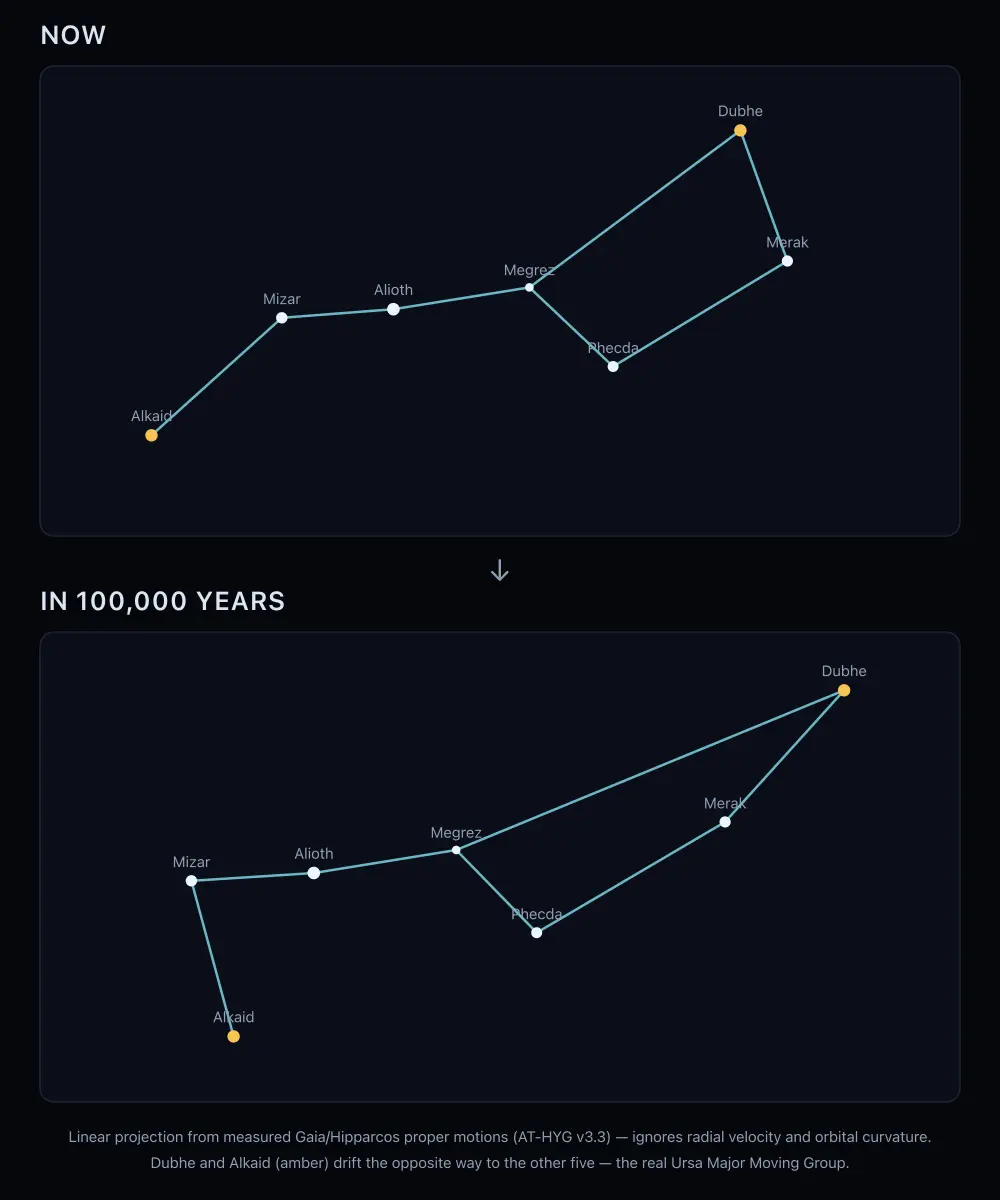
5 of the Dipper’s 7 stars formed together ~300 million years ago and still travel as a group. The Sun is just passing through. The pattern changes within ~100,000 years.
SkyLumi, from Gaia DR3 / Hipparcos proper motions (AT-HYG catalog v3.3) · Original image and terms. Web-sized reproduction.
Find the family.


How to see it tonight
The Big Dipper is a naked-eye pattern within Ursa Major, easy to find without any equipment. It is circumpolar for most of the Northern Hemisphere, up on any clear night year-round.
It sits low or does not rise at all from much of the far Southern Hemisphere. Check its height for your location before planning to find it.
What binoculars or a telescope add here is detail, not brightness. Each star resolves as a sharp point, and a small scope splits Mizar into its own close double.
The moving-group structure itself is invisible in any single night’s view. It only shows up by comparing each star’s measured motion across the sky, which is what SkyLumi’s own diagram plots.
The five siblings share more than direction. Similar chemical makeup and estimated age are what convinced astronomers they were once one cluster, not simply neighbours by coincidence.
What to expect: eyes, binoculars, telescope, photograph
What you actually see changes completely with equipment. Here is each view, sourced.
| View | What you can expect |
|---|---|
| Naked eye | All seven stars, clearly, forming the familiar bowl-and-handle shape. It is one of the most recognisable patterns in the northern sky and needs no equipment to find. |
| Binoculars | The stars sharpen to clean points. Mizar, at the bend of the handle, shows a fainter companion, Alcor, nearby. NASA’s Astronomy Picture of the Day puts the group at “only about 75 light-years away.” |
| Telescope | A small telescope splits Mizar into its own close double star. The wider moving-group motion cannot be seen in any single observation. It only emerges from measurements taken years or decades apart. |
| Photograph | SkyLumi’s diagram here is not a photograph. It is a computed plot, projecting each star’s real measured motion 100,000 years forward, from the Gaia mission’s DR3 catalog. |
What SkyLumi does
Search jumps to the Big Dipper, or Aim the phone straight at it. No equipment is needed to find the pattern itself.
The story panel shows which five stars are true siblings, and which two are not. A computed projection shows the shape drifting across 100,000 years, from each star’s real measured motion.
Night Vision keeps your eyes dark-adapted while you explore Ursa Major further. No account, no ads. The core sky, including this pattern, works fully offline.
A few things to know.
Are all seven stars really related?
No. Five, Merak, Phecda, Megrez, Alioth and Mizar, were born together and still move as a group. The two at the ends, Dubhe and Alkaid, are unrelated stars drifting the other way.
Will the Big Dipper always look this way?
No. Every star in it is moving, so the shape slowly changes. Run the motion forward 100,000 years and the bowl and handle deform into a different pattern.
Can I see the moving group with a telescope?
Not directly. The motion is far too slow to see in any single observation. It only shows up by comparing each star’s measured position across years or decades.
Can I see the Big Dipper from the Southern Hemisphere?
From most of it, no. It sits low or below the horizon across much of the far south. Low southern latitudes can catch parts of it at certain times of year.
More in the Sky Library
Sources and image credit
Image attribution and original terms are linked beneath the image. Use of imagery does not imply endorsement of SkyLumi.