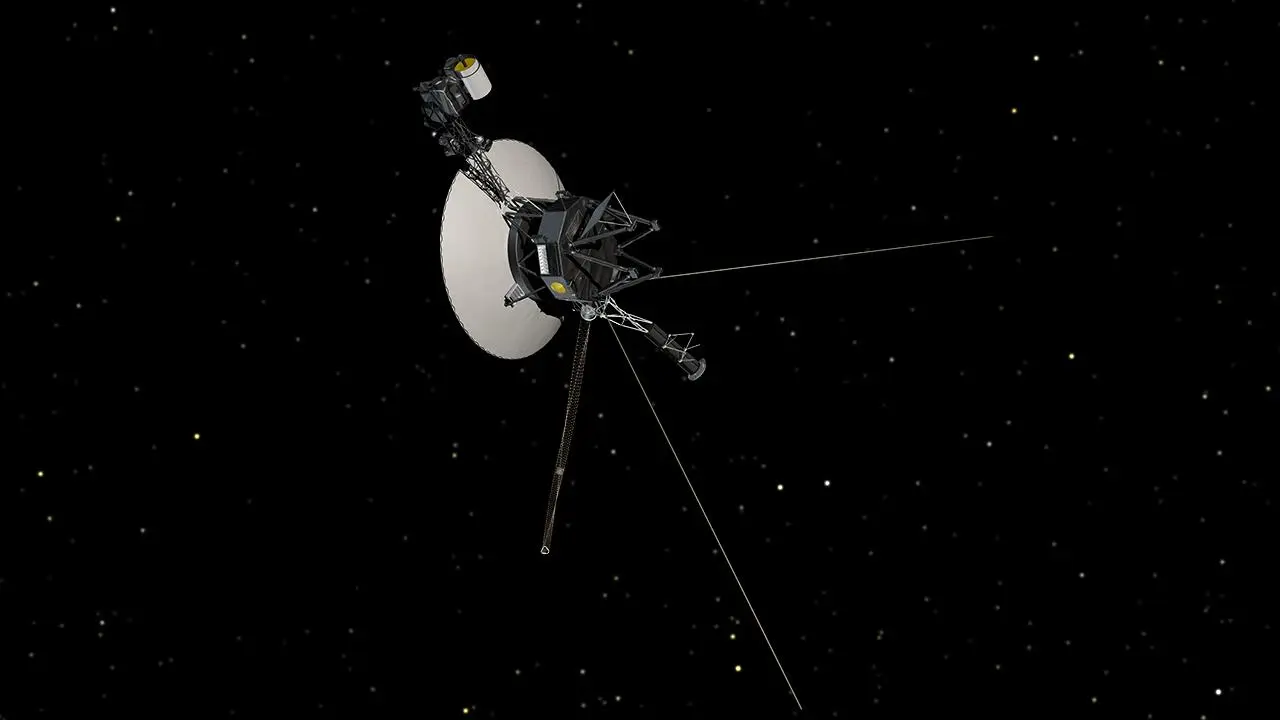
Launched in 1977. The farthest human-made object: a radio call takes nearly a day to reach it. Still transmitting at 17 km/s. Power runs out in the 2030s; it keeps coasting.
NASA/JPL-Caltech · Original image and terms. Web-sized reproduction.
Watch the distance climb.


How to see it tonight
Voyager 1 cannot be seen with any telescope. It carries no light of its own. At its distance, a craft the size of a small car is far too dim to detect optically.
What SkyLumi shows instead is the true live direction, toward the constellation Ophiuchus, computed from the spacecraft’s real tracked position. There is no season for this. The direction is fixed, and the app can point there any night.
Ophiuchus itself is visible from most of the world during local summer evenings, sitting between Scorpius and Hercules. Voyager 1 is not a point of light within it, only a direction to aim at.
The one thing that does change is the distance. It grows by about 17 kilometres every second. SkyLumi’s counter reflects that live, rather than freezing on a fixed number.
Voyager 1 also carries a golden record, playable by anyone who finds it. It holds greetings in 55 languages, music and a recorded human heartbeat. Nobody has found it yet.
What to expect: eyes, binoculars, telescope, photograph
What you actually see changes completely with equipment. Here is each view, sourced.
| View | What you can expect |
|---|---|
| Naked eye | Nothing. There is no visible point of light to find, at any distance a telescope could reach. Voyager 1 is more than 15 billion miles from Earth, per NASA’s Voyager blog. |
| Binoculars | Also nothing to find. The spacecraft has no meaningful light detectable from Earth at this range. NASA confirms the distance keeps growing. |
| Telescope | Not visible in any consumer telescope. Even radio contact is difficult. NASA’s Voyager FAQ notes the Deep Space Network can likely stay in range only “through about 2036,” power permitting. |
| Photograph | The image above is an artist’s rendering of the spacecraft, not a photograph. Nobody has ever imaged Voyager 1 itself from outside. NASA/JPL-Caltech credits this specific illustration. |
What SkyLumi does
Aim the phone at the sky, and SkyLumi marks Voyager 1’s live computed direction toward Ophiuchus. It tracks as you move, even though nothing is visible there.
The story panel runs a live counter of the spacecraft’s distance, climbing roughly 17 kilometres every second. It explains why the radio signal now takes almost a full day to arrive.
Night Vision keeps your eyes dark-adapted for the rest of Ophiuchus nearby. No account, no ads. The core sky works offline; the live counter needs a connection.
A few things to know.
Can I actually see Voyager 1?
No, at any distance and with any equipment. The spacecraft is too small and dark to reflect enough light to detect. SkyLumi shows the direction, not a visible dot.
How far away is it right now?
More than 15 billion miles, and growing by about 17 kilometres every second. That is why SkyLumi’s counter runs live rather than showing a fixed number.
Is it still working?
Yes, as of NASA’s most recent public updates. Engineers have been shutting down individual instruments to conserve its dwindling power. It could go silent sometime in the 2030s.
Why does its signal take so long to arrive?
It is so far away now that light itself takes nearly a full day to cross the gap one way.
More in the Sky Library
Sources and image credit
- NASA: NASA Shuts Off Instrument on Voyager 1 to Keep Spacecraft Operating
- NASA: Voyager Frequently Asked Questions
Image attribution and original terms are linked beneath the image. Use of imagery does not imply endorsement of SkyLumi.